


There are some conversations in this business that happen out loud… and then there are the ones that happen in hushed tones, in hallways, in text messages that start with, “Did you hear…?”
This is one of those conversations.
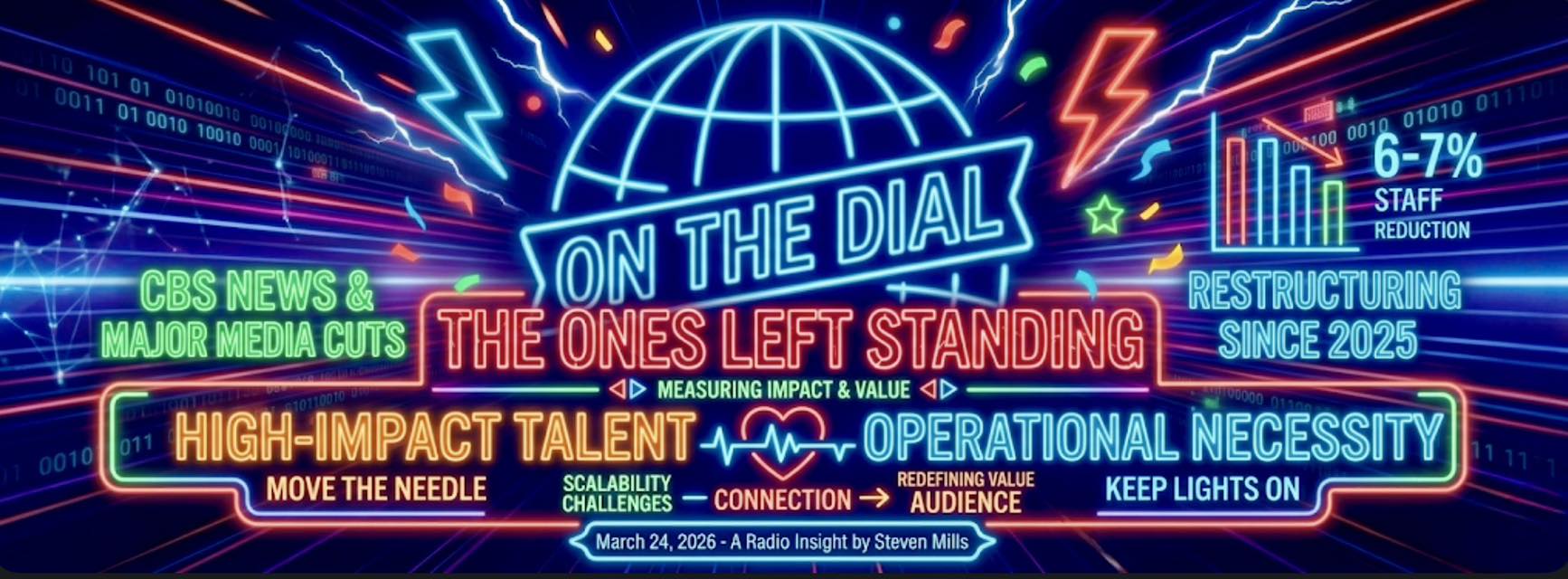
Because by now, you’ve heard about what happened with CBS News—cuts, restructuring, and the quiet but heavy reality that radio, as they knew it in that space, is gone. Staff reduced by around six to seven percent, entire operations shifted, and a legacy that once defined excellence… now being reimagined, or maybe even erased, depending on how you look at it.
And if you’re paying attention, you know that’s not an isolated situation.
That’s the part we have to sit with.
Because it would be easy—too easy—to point at one company and say, “Well, that’s their issue.” It would be comforting to believe this is just a one-off, a bad decision, a unique circumstance.
But it’s not.
Layoffs have been rolling through media since 2025 like a slow-moving storm. Not always loud. Not always front-page. But steady. Consistent. Unrelenting.
And here in 2026, that storm hasn’t passed.
It’s settled in.
This isn’t random.
This is intentional.
Companies are making calculated decisions about what stays… and what goes.
They’re cutting legacy costs—the things that made sense in a different era but feel heavy now. Buildings that used to be full. Layers of management that once helped guide the product. Roles that were built for a version of radio that doesn’t quite exist the same way anymore.
They’re reallocating to digital—because whether we like it or not, that’s where the growth is being measured now. That’s where the advertisers are looking. That’s where the pressure is pointing.
And above all else, they’re prioritizing scalability.
That word sounds clean. Efficient. Smart, even.
But what it really means is this:
“How do we reach more people… with fewer people?”
And when that question becomes the driving force behind decisions, something has to give.
And more often than not… it’s people.
Now here’s the part that doesn’t get said out loud enough.
The middle layer is disappearing.
Not fading.
Not shrinking.
Disappearing.
The program directors who used to shape the sound of a station day in and day out… fewer of them.
The local leadership that understood the market, the people, the nuance… leaner than ever.
The staff that filled the building with energy, collaboration, creativity… reduced to a fraction.
In their place?
Syndication.
Voice tracking.
Centralized content that can stretch across multiple markets without ever setting foot in any of them.
And listen—I’m not here to pretend those things don’t have value. They do. They keep stations on the air. They make the math work. They allow companies to survive in an environment that is getting tighter by the day.
But let’s not confuse survival with strength.
Because when you remove layers… you also remove support.
You remove mentorship.
You remove the spaces where ideas are sharpened, challenged, refined.
You remove the people who used to stand in the gap between vision and execution.
And what you’re left with is a different kind of structure.
Leaner.
Faster.
But also… more fragile than we want to admit.
So now we find ourselves in a new reality.
The people left standing in this business fall into two categories.
High-impact talent.
Or operational necessity.
That’s it.
If you are high-impact—if you move the needle, bring in revenue, create content that cuts through the noise—you are valuable in a way that is very clear.
And if you are operational—if you keep the machine running, if your role is essential to keeping the lights on—you are necessary.
But if you’re somewhere in the middle?
If you’re solid… consistent… dependable… but not seen as essential or exceptional?
That’s where the pressure lives.
That’s where the uncertainty creeps in.
That’s where people start asking themselves questions they never had to ask before:
“Am I doing enough?”
“Am I visible enough?”
“Am I valuable… or just available?”
And those are heavy questions.
Because this business used to have more room.
Room to grow.
Room to learn.
Room to develop into something greater over time.
Now?
Time feels compressed.
Expectations feel immediate.
And patience feels… rare.
I’ve seen people who gave years—decades—to this industry suddenly find themselves on the outside looking in.
Not because they didn’t care.
Not because they didn’t work hard.
But because the structure around them changed.
And when the structure changes, loyalty doesn’t always carry the weight it used to.
That’s hard to say.
But it’s true.
And if we’re going to talk about this honestly, we have to acknowledge what that does to the people still inside.
Because when you watch others leave—when you see names disappear from email chains, offices emptied, voices gone from the air—it changes you.
It makes you sharper.
But it can also make you anxious.
It can make you question your place, your future, your stability.
And yet… in the middle of all of that… the show still has to go on.
The mic still opens.
The music still plays.
The commercials still run.
And the listener?
They have no idea what just happened behind the scenes.
They just know whether what they’re hearing connects… or it doesn’t.
That’s the weight of it.
Because no matter how much the structure changes, the expectation from the audience hasn’t.
They still want something real.
Something local.
Something that feels like it was made for them—not just delivered to them.
And that’s where the tension reaches its peak.
Because the industry is moving toward scalability…
But the audience still craves connection.
And connection doesn’t scale easily.
It takes time.
It takes presence.
It takes people.
So now the question becomes:
Can we maintain that connection… with fewer people in the room?
Can we keep the heart of radio beating… when the body has been trimmed down?
That’s not a question with an easy answer.
But it’s the question we’re living in right now.
And maybe—just maybe—this moment is forcing something important.
Maybe it’s forcing us to redefine what value really looks like.
Maybe it’s pushing talent to become sharper, more intentional, more impactful with every break, every post, every moment on air.
Maybe it’s reminding us that average doesn’t survive in seasons like this.
You have to know who you are.
You have to know what you bring.
And you have to be able to show it—clearly, consistently, undeniably.
Because in a landscape like this, being good isn’t always enough.
You have to be necessary.
Or you have to be undeniable.
And that’s not meant to discourage you.
It’s meant to wake you up.
Because even in the middle of layoffs… even in the middle of restructuring… even in the middle of an industry trying to figure itself out…
There is still opportunity.
There is still space for voices that connect, that resonate, that matter.
But that space?
It’s tighter now.
More competitive.
Less forgiving.
So the ones left standing… they have a choice.
You can operate in fear—looking over your shoulder, wondering when the next change is coming.
Or you can operate with purpose—understanding exactly what you bring to the table and leaning into it with everything you’ve got.
Because this business may be changing…
But it’s not done.
Not by a long shot.
The tools are different.
The structure is different.
The expectations are higher.
But the core?
The core is still the same.
A voice.
A message.
A connection.
And as long as that still matters to someone on the other end of the speaker…
There will always be something worth fighting for.
Even now.
Especially now.
Because in a time when so many are being let go…
The ones who remain?
They’re not just surviving.
They’re being called to rise.
-Just Plain Steve