

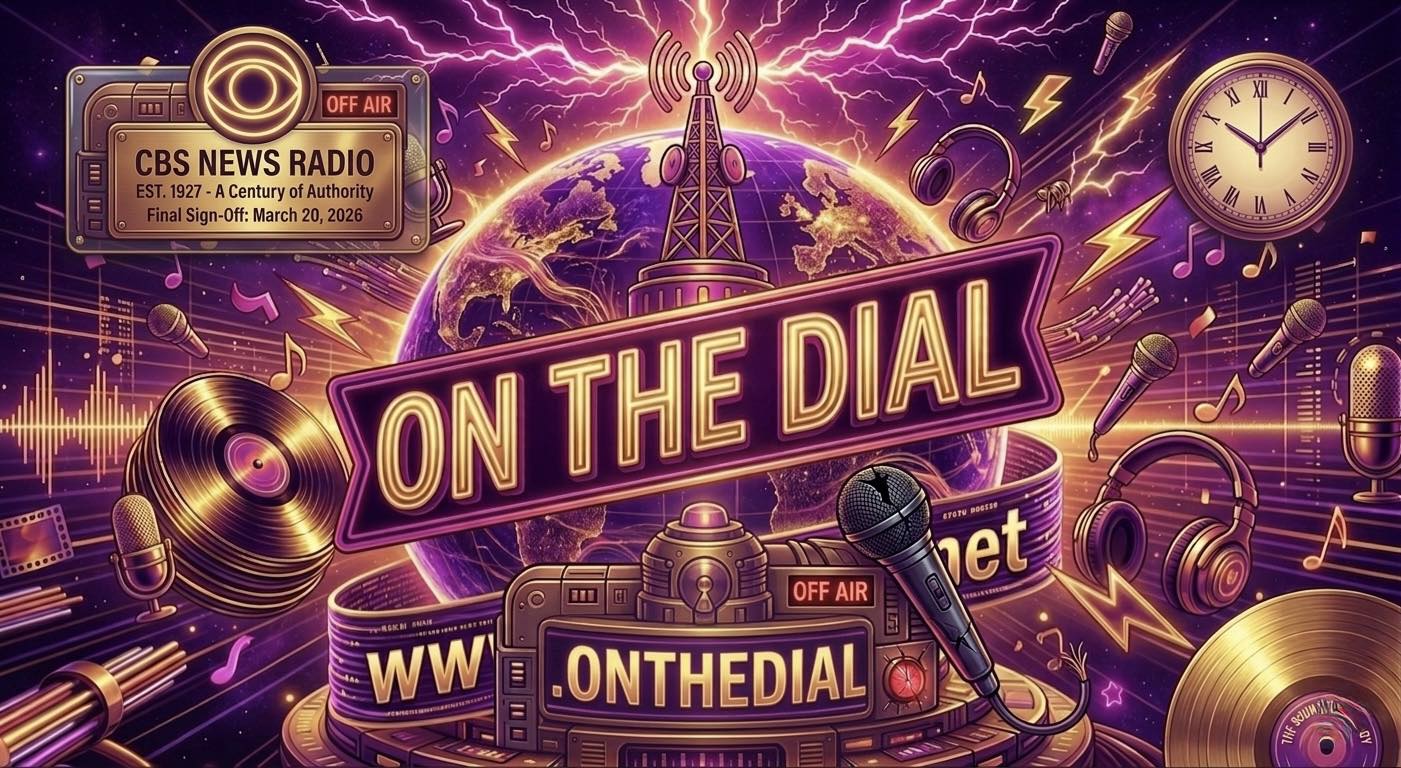
I’ve heard a lot of silence in radio over the years. Dead air will make your heart stop. A dropped network feed will make a grown program director start praying real fast. And that moment when somebody thinks they’re on the air but they’re not? That’s the kind of quiet that’ll make you laugh later and sweat right now. But this kind of silence… this one is different. This one isn’t a mistake. This one is permanent. Because CBS News Radio is going away, and just like that, one of the most trusted sounds in American broadcasting is about to fade into history.
And if you’ve ever sat in a control room, watching that clock hit :00 and waiting for the tone, you already understand what that means. This isn’t just another company making cuts. This is a cornerstone being pulled out from under something that’s been standing for nearly a century.
Now let’s be clear—this didn’t happen overnight. Nothing in radio ever really does. It’s more like watching a slow leak in a tire. You keep driving on it because you can. You tell yourself it’ll hold. And then one day, you’re riding on the rim wondering when things got so rough. That’s where we are right now, not just with CBS, but with a whole lot of broadcast radio.
CBS News has been a giant since 1927. That’s not just history—that’s foundation. This is the network that spoke to America when there was no other way to reach millions of people at once. Families gathered around radios to hear what was happening in the world. Wars, elections, tragedies, triumphs—if it mattered, it came through that speaker. And it came with a level of credibility that today’s world is still trying to get back.
And here’s the part that hurts a little more than it should. A lot of the folks being laid off? These aren’t just employees. These are lifers. These are the men and women who still believe in clean copy, accurate reporting, and hitting the post on a live newscast with no safety net. These are the people who knew how to make you feel something with nothing but their voice and a stack of scripts. You don’t just replace that with an app or an algorithm.
So why is this happening? It comes down to a few things, and none of them are shocking if you’ve been paying attention. First, money. Always money. Traditional radio advertising isn’t what it used to be, and network radio has been feeling that pressure for years. Second, consolidation and corporate strategy. Parent companies are trimming what they see as non-essential, and unfortunately, legacy doesn’t always show up on a balance sheet the way quarterly earnings do. And third, the shift in how people consume news. Folks aren’t waiting for the top of the hour anymore. They’re getting alerts on their phones, scrolling social media, or pulling up podcasts when it’s convenient for them.
And that right there is the word that changed everything—convenience.
Radio used to own immediacy. Now it’s competing with everything.
But don’t get it twisted—radio is not dead. Not even close. In fact, broadcast radio still reaches over 90 percent of Americans every single week. Think about that. In a world where everything is fragmented, radio is still one of the last true mass mediums left. It’s in your car, on job sites, in small towns, big cities, and places where internet signals come and go but that FM dial still holds strong. That’s power. Quiet power, but power nonetheless.
The problem is, reach doesn’t always equal revenue the way it used to. And when corporations start making decisions, they’re not always thinking about the emotional connection people have with a medium. They’re thinking about sustainability, scalability, and where the audience is going—not where it’s been.
Still, there’s something about this one that feels heavier.
Because CBS News Radio wasn’t just content. It was consistency. It was the sound of authority in the middle of chaos. When that voice came on, you believed it. And in today’s world, belief is a rare commodity.
I keep thinking about all the young broadcasters who will never experience that feeling of cracking the mic and knowing you’re connected to something bigger than yourself. Something national. Something trusted. There was a pride that came with that, whether you were in New York City or a small market like the ones I’ve spent my life in. You felt like you were part of the conversation that mattered.
And now? That conversation is changing.
It’s moving to digital platforms, streaming services, and on-demand audio. It’s faster, more personalized, and in some ways, more disconnected. Because while technology has made it easier to get information, it hasn’t necessarily made it easier to trust it.
That’s where radio still has a shot—if it leans into what made it great in the first place. Local connection. Authentic voices. Real storytelling. The kind you can’t fake and you can’t automate.
Because here’s the truth, plain and simple. You can replace distribution. You can replace delivery systems. But replacing trust? That’s a whole different ballgame.
As for the folks affected by these layoffs, this industry still needs them—even if it doesn’t always act like it. Talent like that doesn’t just disappear. It adapts. It finds new lanes. Radio people are some of the most resilient folks you’ll ever meet. We’ve been reinventing ourselves since the first time somebody said, “Hey, what if we put pictures with this?”
So yeah, this one hurts.
It’s the end of something real.
But it’s also a reminder.
Radio isn’t dying—it’s being forced to grow up again.
And if history has taught us anything, it’s this: every time somebody counts radio out, it finds a way to turn the mic back on.
Even if it sounds a little different than it used to.
-Just Plain Steve