


This isn’t really about buying a music company.
Let’s get that out of the way early.
This is about control. It’s about perception. It’s about what happens when the suits from Wall Street decide the music business isn’t just entertainment anymore—it’s infrastructure. And now, one of the biggest financial players in the game is trying to plant a flag right in the middle of it.
Bill Ackman just made a move that has the entire industry side-eyeing their group chats. His firm, Pershing Square Capital Management, has stepped up with a $64 billion offer to acquire Universal Music Group. Not partner with. Not invest in quietly. Buy.
Flat out.
And if you think this is just another corporate shuffle, you’re missing the real story.
Because when money like that shows up, it doesn’t just change ownership—it changes behavior.
Ackman’s pitch is built on a pretty simple argument: UMG is worth more than the market is giving it credit for. He’s pointing at confusion around its ownership structure, hesitation around its U.S. listing, and the lingering question mark tied to its relationship with Spotify. In his view, none of that reflects how strong the actual music business is underneath it all.
Translation? He thinks the house is undervalued, and he wants the keys before everyone else figures it out.
The plan itself reads like a corporate remix. Merge UMG with Pershing Square SPARC Holdings, relocate the base to Nevada, and slide the stock listing over to the New York Stock Exchange. Clean it up, reposition it, and present it to the market like a newly mastered track.
But here’s where things get interesting—and a little uncomfortable if you’re in the artist community.
This isn’t just any label.
This is the label.
This is home to some of the biggest names walking the planet, including Taylor Swift.
And boy oh boy… let this deal go through, and watch how fast the conversation shifts.
Because if there’s one thing the modern artist—especially at that level—has made crystal clear, it’s this: ownership matters. Control matters. And the second the balance tips too far toward corporate engineering, artists start looking for the nearest exit like it’s a fire drill.
Swift, in particular, has already rewritten the playbook on what it means to control your work. She’s not just an artist; she’s a case study in leverage. So when you start talking about her label potentially being folded into a hedge fund-driven structure, you’re not just talking about a business move—you’re poking at the very philosophy she’s built her empire on.
And if that philosophy feels threatened?
Yeah… don’t be shocked if she moves like someone who’s already packed her bags.
Fast.
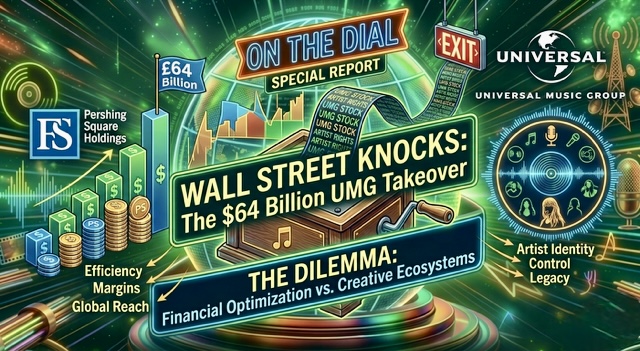
But this isn’t just about one artist potentially making a headline-grabbing exit. This is about what happens when financial optimization meets creative ecosystems.
Wall Street loves predictability. Music thrives on chaos.
Wall Street wants efficiency. Music runs on emotion.
Wall Street sees catalogs, margins, and growth curves. Artists see identity, expression, and legacy.
Those two worlds can coexist—but not without tension. And when that tension shows up, it doesn’t stay behind closed doors. It leaks into contracts, release schedules, creative decisions, and ultimately, the music itself.
Ackman’s bet is that those worlds can be aligned. That you can tighten the financial screws without suffocating the creative side. That you can unlock value without breaking the machine that generates it.
It’s a bold bet.
Because history has shown us that when finance gets too aggressive in entertainment, things start to feel… manufactured. And the audience? They can smell that from a mile away.
Still, there’s no denying the appeal here. UMG is a powerhouse. Its roster is deep, its catalog is unmatched, and its global reach is the kind of thing most companies can only dream about. If you’re looking for a long-term asset in a world where content is king, this is about as premium as it gets.
Ackman isn’t chasing a trend—he’s trying to own the pipeline.
And that’s the real headline.
Not just that a billionaire wants to buy a record label, but that the financial world is doubling down on the idea that music isn’t just culture—it’s currency.
So now the ball sits with UMG’s board. And while they weigh the numbers, you can bet the artists are watching just as closely.
Because depending on how this plays out, the next big release out of that building might not be an album.
It might be an exit.
-JPS