

There’s a conversation happening in radio right now that doesn’t always make the noise it deserves. It’s not flashy. It’s not always breaking news. But it’s steady, it’s real, and it’s changing the foundation of what AM radio has been for more than a century.
AM radio is still here. That part hasn’t changed. But what it is—and how it functions inside the larger media landscape—looks very different than it did even a decade ago. And depending on where things go next, the gap between “still operating” and “still relevant” may continue to widen.
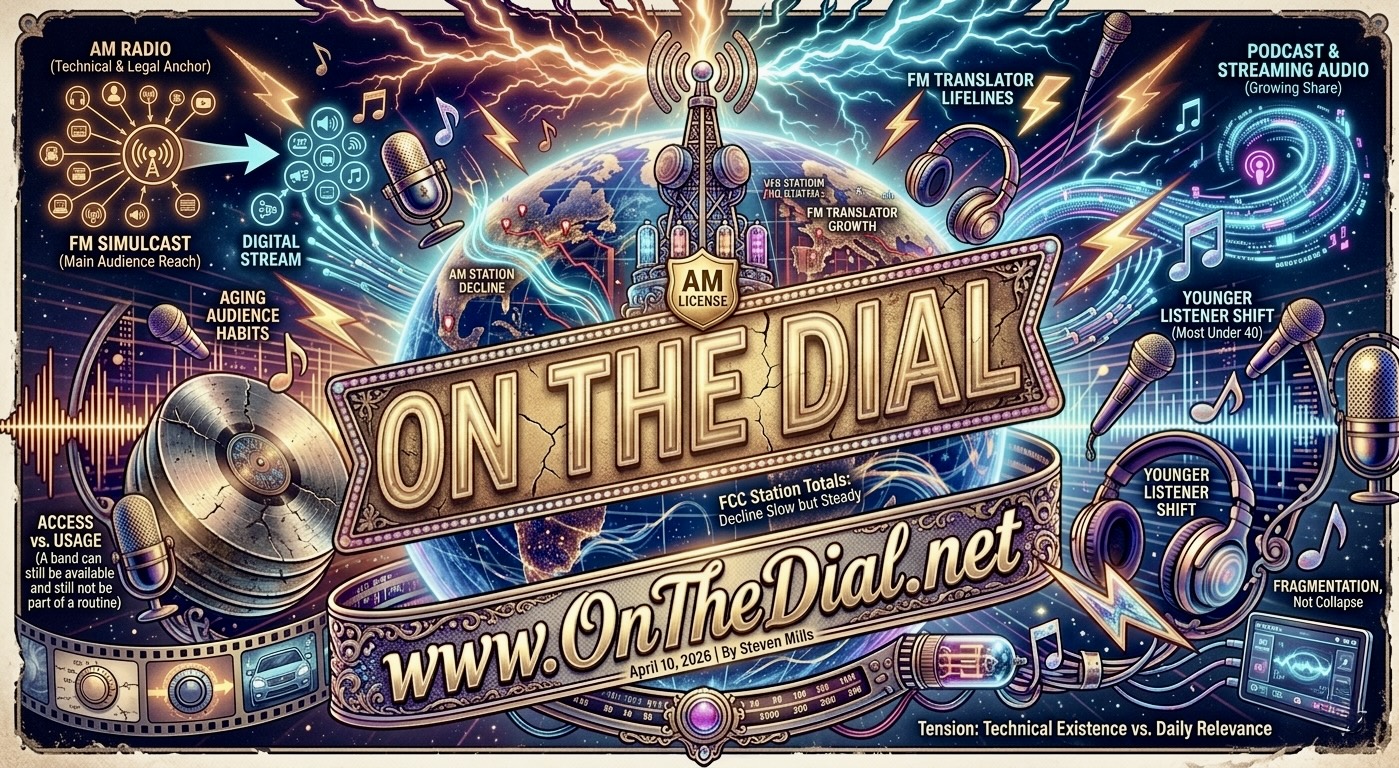
The numbers tell part of the story. According to FCC station totals, the AM band has been steadily shrinking over the last ten years, with fewer licensed stations overall and continued erosion in smaller markets as operators consolidate, sell, or shut down under financial pressure. At the same time, FM translators have grown significantly, filling coverage gaps and often becoming the primary way listeners actually hear programming that still originates from AM stations.
That shift matters more than it might look on paper. Because it means something simple but important—AM is still technically alive, but in many cases it’s no longer the main way people access the content attached to it.
Across the country, stations that once stood alone on the dial are increasingly dependent on FM simulcasts just to maintain audience reach. In many markets, the AM signal exists more as a legal and technical anchor than as the actual listening platform. The content survives, but the delivery method has already moved on.
And then there’s the audience reality.
Younger listeners are not growing up with AM as a default habit. For them, it’s not something they “tune into.” It’s something they might stumble across, if they ever use it at all. Most listening under 40 has already shifted to FM, streaming, podcasts, or phone-connected audio systems, leaving AM with an aging core audience and shrinking routine usage.
That gap is one of the quietest but most important trends in all of radio.
Because even when AM stations remain on the air, the question isn’t just whether they exist—it’s whether people are still actually listening in meaningful numbers.
This is where FM translators changed the game. What started as a technical solution to help AM stations extend coverage has, in many cases, become the primary listening path. Instead of driving audience back to AM, translators often bypass it entirely. The branding may still carry the AM identity, but the listening experience has shifted to FM or digital streams.
Industry observers have pointed out for years that in many cases, translators are no longer just a supplement—they’re the lifeline. And in some situations, they’ve quietly become the main product while AM carries the license in the background.
At the same time, the cost of keeping AM facilities running hasn’t gotten easier. Towers, land, maintenance, power requirements, and interference issues continue to weigh heavily on smaller operators. In some cases, the value of the real estate tied to transmitter sites has become more attractive than the broadcast operation itself, leading to more sales and shutdowns over time.
That’s part of why the overall AM count has continued to decline slowly but steadily rather than collapsing all at once. It’s not a dramatic exit. It’s a gradual thinning.
And while there’s been ongoing political and industry discussion around protecting AM in vehicles, especially with legislation aimed at ensuring receivers remain standard in new cars, that debate doesn’t fully address the deeper issue. Even if AM is preserved in dashboards, that doesn’t automatically restore listening habits that have already moved elsewhere.
That’s the part that doesn’t get said enough.
Access and usage are not the same thing.
A signal can exist and still not matter in the way it once did. A button can still be in the car and still never be pressed. A band can still be available and still not be part of someone’s daily routine.
That’s the tension AM is sitting in right now.
On one side, there is still institutional and regulatory support trying to preserve its place in the ecosystem. On the other side, the actual behavior of listeners has already shifted toward platforms that are faster, more personalized, and more integrated into digital life.
And somewhere in the middle, stations are trying to figure out how to operate in both worlds at the same time.
What makes this moment different from past cycles of “radio is dying” conversation is that AM is not disappearing—it’s fragmenting. Pieces of it are still strong. Certain talk formats, sports networks, and legacy signals continue to perform in specific markets. Some stations still maintain loyal, deeply engaged audiences. In certain regions, AM remains essential for news, emergencies, and local identity.
But the overall system around it is no longer stable in the way it once was.
Even the broader industry data reflects that shift. While traditional radio as a whole has shown resilience compared to some predictions, the long-term trajectory still shows slow decline in legacy platforms while streaming audio continues to grow its share of listening time year over year. That doesn’t mean radio is going away—it means the center of gravity is moving.
And AM is closest to the edge of that shift.
The hardest part of all of this is that there is no single moment where you can point and say “this is when it changed.” It’s been gradual. A station here. A signal there. A format shift. A translator sign-on. A younger audience that never builds the habit in the first place.
Over time, those small changes add up to something bigger than any one decision.
So where does that leave AM today?
Still on the air. Still operational. Still present in vehicles, in rural areas, in certain formats, and in emergency contexts. But increasingly dependent on extensions, workarounds, and alternative delivery methods just to stay in the conversation with listeners who are already somewhere else.
That’s the reality.
Not collapse. Not disappearance. But something quieter—and in some ways more permanent.
A platform that still exists… but is no longer the center of gravity it once was.
And unless something changes in how listening habits are formed in the next generation, that gap is likely to keep growing.
AM radio isn’t gone.
But it is no longer guaranteed a central place in how people choose to listen.
-JPS