


Every once in a while, a move gets made that isn’t just about filling a position — it’s about setting a tone.
That’s exactly what this is.
iHeartMedia didn’t just promote from within. They made a statement about where they’re going, how they plan to get there, and who they trust to carry the weight of the largest piece of their entire operation.
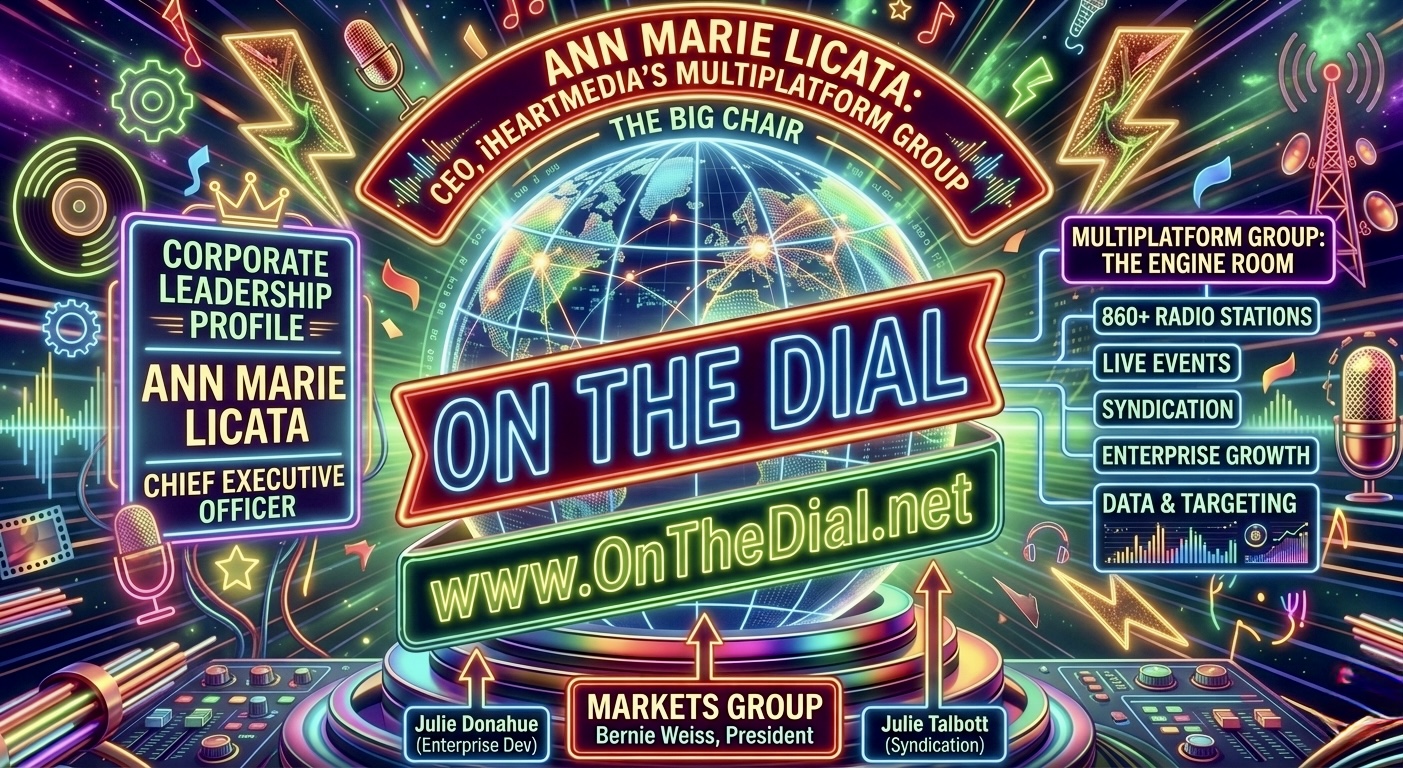
Ann Marie Licata is now CEO of the Multiplatform Group.
And if you understand how iHeart is built, you know that’s not just another title. That’s the engine room.
This is the division that touches just about everything that still defines the company at scale. We’re talking about the Markets Group — more than 860 radio stations spread across the country. We’re talking about live events that still cut through culture. We’re talking about network syndication, national reach, enterprise growth, and the evolving science of data and targeting in broadcast.
This is where legacy meets reinvention.
And now it has a new leader.
Licata didn’t just arrive here overnight. Her path has been deliberate, layered, and rooted in understanding both sides of the business — the creative and the commercial. She came into iHeart back in 2014 after time at Madison Square Garden, where activation and experience weren’t just buzzwords, they were the job.
That background matters more than ever right now.
Because radio — especially at this level — isn’t just about what comes out of the speakers anymore. It’s about how brands connect, how audiences engage, and how platforms extend beyond the dial into something bigger.
Over the past several years, Licata has been right in the middle of that evolution. As President of the Markets Group and Sales Operations, she’s had her hands on the levers that keep local radio moving while also helping shape how it competes in a world that’s increasingly digital-first.
That balancing act isn’t easy.
You’ve got heritage stations with decades of identity, talent, and community ties. At the same time, you’ve got pressure from streaming, podcasts, social platforms, and a generation of listeners who don’t consume audio the way they used to.
So the question becomes — how do you protect what works while building what’s next?
That’s the assignment now sitting squarely on Licata’s desk.
And she’s not walking into a quiet moment.
This is a critical stretch for iHeartMedia. The company has spent years expanding beyond traditional radio, building out its digital footprint, leaning into podcasting, and creating new revenue streams that weren’t even part of the conversation a decade ago.
At the center of all of that sits the Multiplatform Group.
It’s the connective tissue.
It’s where local meets national. Where broadcast meets digital. Where relationships with advertisers turn into long-term partnerships built on data, scale, and measurable results.
And that last part — data — is where things get especially interesting.
Because one of the biggest shifts happening right now is the push to bring broadcast radio fully into the modern buying ecosystem. Programmatic, attribution, targeting — the same language that’s been driving digital ad spend is now being applied to radio in a much more aggressive way.
That’s not just a technical upgrade.
That’s a repositioning of the medium itself.
Instead of being seen as broad and hard to measure, radio is being reframed as precise, accountable, and performance-driven. And if that shift sticks, it changes how agencies think, how dollars flow, and how radio competes against every other platform in the mix.
Licata is now in charge of pushing that forward.
Not alone, of course.
There’s a team around her, and the structure underneath this move says a lot about how iHeart is organizing for what’s next. Julie Donahue, who leads the Enterprise Development side, and Julie Talbott, who oversees one of the most powerful syndication arms in the business, will both report into Licata.
That alignment matters.
Because it brings together growth strategy, national programming, and revenue development under one umbrella. It creates a more unified approach to how the company scales its biggest assets.
And then there’s the Markets Group — the foundation.
With Licata moving up, that role now shifts to Bernie Weiss, who steps in as President after serving as COO of the group and previously running the New York market.
That’s another important piece of the puzzle.
Weiss knows the operational side. He understands the complexity of managing large market stations while still keeping an eye on local performance. He’s been in the trenches, and now he’s being asked to lead the day-to-day engine while Licata focuses on the broader horizon.
It’s a division of labor that suggests clarity.
One eye on execution.
One eye on expansion.
And hovering above it all is leadership that has been consistent in its messaging about where the company is headed. Bob Pittman has long talked about growth coming from both innovation and scale — using the company’s reach as a springboard for new business lines while continuing to evolve the core.
Alongside him, Rich Bressler has emphasized the importance of diversification — not relying on a single revenue stream, but building a portfolio that can adapt as the market shifts.
This move fits squarely into that philosophy.
It reinforces the idea that the Multiplatform Group isn’t just one part of the company — it’s the centerpiece. The place where different pieces come together to create something that’s bigger than any one format, platform, or revenue line.
But let’s bring this back to what it really means on the ground.
Because titles and org charts are one thing.
Impact is another.
For the folks inside those 860+ stations, this is about direction. About how much autonomy they’ll have, how much support they’ll get, and how their role fits into a much larger system that’s trying to move faster than ever before.
For advertisers, it’s about capability. About whether radio can deliver the kind of results they’ve come to expect from digital channels — and whether iHeart can package its assets in a way that makes sense in today’s buying environment.
For talent, it’s about opportunity. About whether personality still has a place in a data-driven world, and how content evolves without losing its connection to real listeners.
And for the industry as a whole, it’s about signals.
Because when the largest player in the space makes a move like this, people pay attention. Not just to the announcement, but to what happens next.
Does the strategy accelerate?
Do the numbers follow?
Does the company find new ways to make radio feel essential again — not just as a medium, but as a business?
Those answers won’t come overnight.
But the direction is clear.
This isn’t about maintaining the status quo.
It’s about building something that can compete in a landscape where attention is fragmented, expectations are higher, and the definition of “audio” keeps expanding.
Ann Marie Licata now sits at the center of that effort.
She’s stepping into a role that demands both respect for what radio has been and a willingness to push it into places it hasn’t fully gone yet. It’s not a small ask. But it’s also not unfamiliar territory for someone who has spent years navigating the intersection of content, commerce, and audience.
So here we are.
A leadership shift that carries more weight than it might seem at first glance.
A company doubling down on integration, scale, and innovation.
And an industry watching closely to see how it all plays out.
Because if this works — if the Multiplatform Group continues to evolve and deliver — it won’t just be a win for iHeartMedia.
It’ll be a blueprint.
And in a business that’s still figuring out its next chapter, that kind of clarity is worth a whole lot.
-Just Plain Steve