


There are moments in this business where the numbers don’t just inform—they confront.
And the latest financial report from Beasley Media Group is one of those moments. Not because it signals the end—but because it forces a clear-eyed look at what radio is dealing with right now.
Start with the surface.
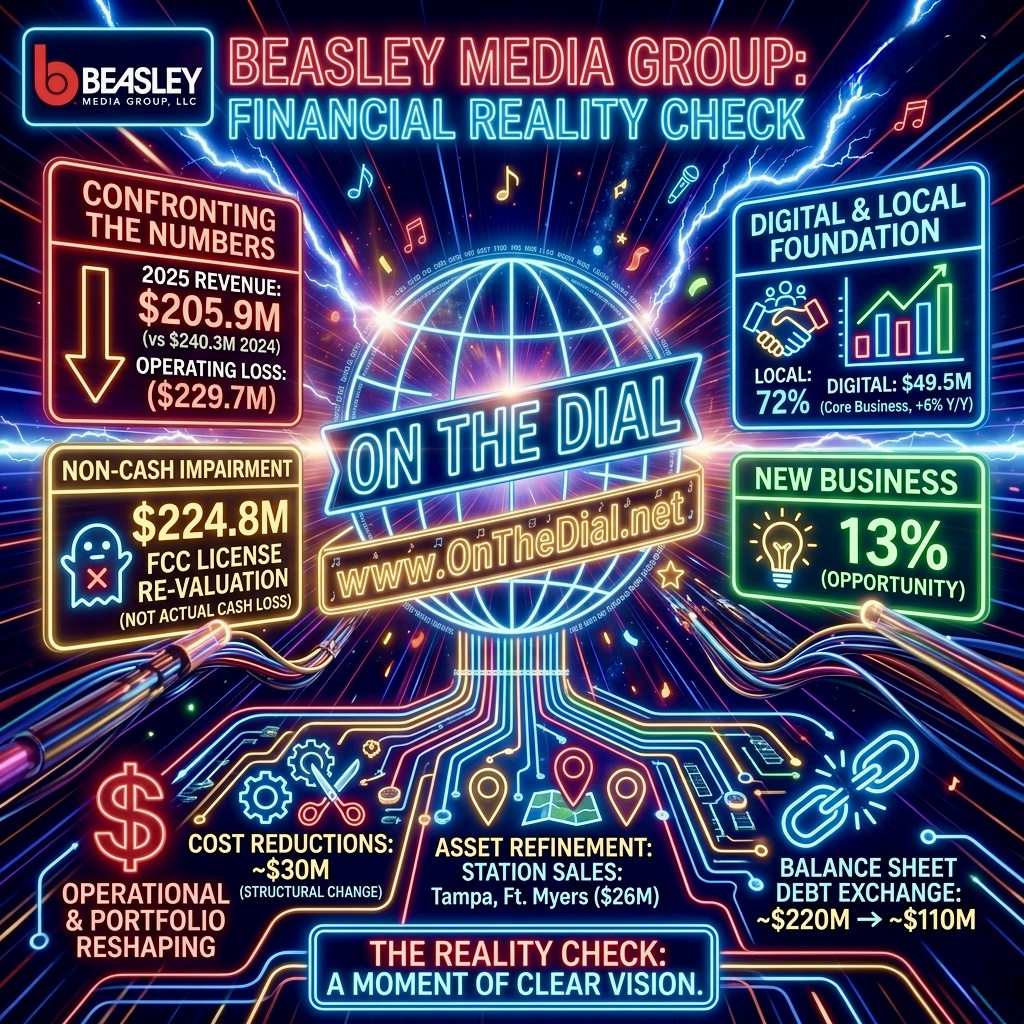
Revenue for 2025 landed at $205.9 million, down from $240.3 million the year before. That’s not subtle. That’s a noticeable tightening in a business already navigating pressure from multiple directions. Then comes the operating loss—$229.7 million—after posting a profit just a year earlier. That kind of swing gets your attention.
But context matters here.
A significant piece of that loss—$224.8 million—came from a non-cash FCC license impairment. In other words, Beasley adjusted the perceived value of its broadcast licenses based on today’s market realities. No actual cash walked out the door on that line item, but the meaning behind it carries weight.
It’s a recognition that the old math doesn’t work the same way anymore.
And that’s where this becomes less about one company and more about the industry as a whole.
Because while traditional radio continues to feel long-term pressure, the business itself isn’t standing still. It’s shifting—sometimes quietly, sometimes aggressively—toward what works now.
Look at the revenue mix.
Local revenue made up 72% of the total. That’s a strong reminder that radio’s foundation is still built on local relationships. The connection between stations and their communities hasn’t gone away. If anything, it’s become more important as national dollars tighten.
New business accounted for 13% of revenue. That’s another signal worth noting. It says there are still opportunities to grow—still advertisers willing to engage—if stations are willing to evolve how they sell and what they offer.
And then there’s digital.
Digital revenue reached $49.5 million, up nearly 6% year-over-year and even stronger when you isolate same-station performance. It now represents about 24% of total revenue. That’s not a side conversation anymore—that’s a core part of the business.
This is where the transition becomes real.
Not theoretical. Not “we’re working on it.” Real dollars, real growth, real importance.
Behind the scenes, the company has also been reshaping itself operationally. Over the past year and a half, Beasley has executed about $30 million in annualized cost reductions. These aren’t temporary cuts—they’re structural changes designed to align the company with today’s revenue environment.
That’s the kind of adjustment that doesn’t always make headlines, but it changes everything about how a company functions.
At the same time, there’s been a clear effort to refine the portfolio.
The sale of a Tampa station and the Fort Myers cluster brought in roughly $26 million. That move wasn’t just about generating cash—it was about focus. Putting resources behind the markets and assets that have the best chance to perform in this environment.
And then there’s the balance sheet.
A debt exchange currently in motion is expected to reduce total outstanding debt from around $220 million to approximately $110 million. That’s a meaningful shift that could give the company more flexibility moving forward—something every broadcaster could use right now.
Put it all together, and the picture becomes clearer.
Yes, there are challenges. Real ones. Revenue pressure. Industry-wide shifts. A rethinking of asset values.
But there’s also strategy.
A stronger emphasis on digital. A renewed focus on local. Cost structures being brought in line. Debt being addressed. Assets being refined.
That’s not a company standing still—that’s a company adjusting in real time.
And maybe that’s the biggest takeaway here.
This isn’t just about Beasley.
It’s about what happens when an entire industry hits a moment where it can’t rely on what used to work. Where it has to look at itself honestly—numbers and all—and decide what comes next.
Because the reality check isn’t the bad news.
The reality check is the moment you finally see clearly enough to move differently.
And right now, radio is in that moment.
-JPS