

Across the country, medium-sized radio markets are changing course—quietly but decisively. As the spring ratings period approaches, stations owned by Midwest Communications, Hubbard Radio, and Audacy are shaking up morning and afternoon schedules in an unmistakable shift toward personality-driven, live and local programming.
It’s not the industry’s usual pre-ratings shuffle. This year, the changes point to a deeper correction—radio returning to what made it matter in the first place: connection.
The Local Turn
For years, mid-tier markets often relied on syndication to keep budgets lean and schedules predictable. Voices piped in from other cities filled airwaves that once belonged to local personalities who knew the streets, sports, and slang of their own towns.
But that old math has stopped working. More than ever, stations have realized that connection—authentic, local connection—translates into retention.
The move toward local voices picked up steam in 2025, when several influential groups began trimming syndication in favor of homegrown content. Early returns showed something both simple and powerful: local voices drive engagement across every metric, from call-ins and texts to social reach and advertiser trust.
This spring, that slow turn has become a sprint.
Midwest Communications: Reclaiming Familiar Ground
Midwest Communications, a company known for strong regional clusters across Wisconsin, Michigan, Tennessee, and the Dakotas, has been at the front of this movement. Over the past six months, management has been repositioning local teams and reintroducing longtime hosts who embody their markets’ character.
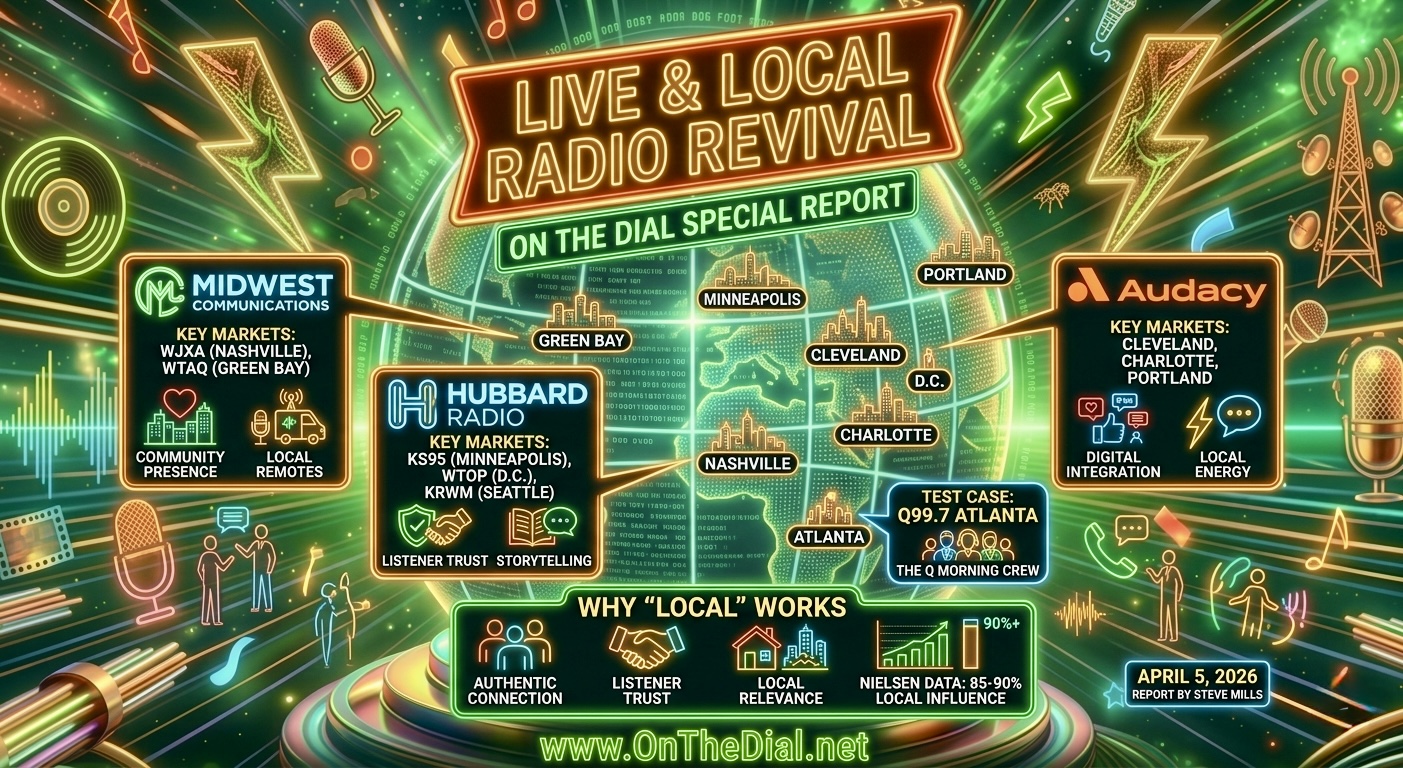
Stations like WJXA-FM in Nashville and WTAQ in Green Bay have each leaned more on community presence—on-air charity tie-ins, live local remotes, and storytelling segments that reach beyond the headlines. Insiders at Midwest describe it as “making radio feel like a conversation again.”
These changes come at a time when listener habits are more scattered than ever. By amplifying voices who actually live in the towns they serve, Midwest appears to be betting on something data analysts have been whispering for months: audiences still crave local relevance, even in a digital-first era.
Hubbard Radio: Trust and Familiarity as Strategy
Hubbard Radio—operator of heritage brands like KS95 Minneapolis, WTOP Washington, D.C., and KRWM Seattle—has sharpened its focus on the human side of radio. Long known for cultivating loyal talent, Hubbard’s recent lineup changes in its medium-sized markets have placed familiar hosts into more visible slots.
For Hubbard, it’s not about reinvention so much as recommitment. The company has doubled down on listener trust, ensuring each shift delivers not just music or talk, but voices people know. One standout example is KS95 in Minneapolis, which has sustained double-digit ratings by leaning into personality over playlist.
Hubbard’s playbook emphasizes storytelling, meet-and-greet events, and digital partnerships that keep hosts intertwined with local life well beyond airtime. It’s a formula reminiscent of the pre-syndication heyday—yet adapted with modern polish.
Audacy: Finding Local Energy in a National Footprint
As one of the largest networks in the U.S., Audacy has spent years riding the fine line between scale and intimacy. But the latest round of changes shows a clear lean toward local connection.
In markets such as Cleveland, Charlotte, and Portland, the company has reassigned syndicated hours to give morning and afternoon time blocks back to homegrown talent. The move coincides with an internal strategy shift Audacy leaders previewed in late 2025—focusing on “community-first, personality-based” content across all tiers.
Audacy’s executive team has also encouraged talent to build brand depth across digital platforms. Local hosts now generate short-form clips and interactive social segments designed to remind listeners they’re talking with someone down the road, not across the country. It’s an effort to bring local immediacy back into daily media routines, even as audiences toggle between FM receivers and streaming apps.
The Broader Pattern: Presence Over Perfection
The timing of these changes isn’t random. The spring 2026 Nielsen Audio ratings period, one of the year’s most watched windows, begins in mid-April, putting extra pressure on stations to present a fresh, listener-centered sound.
Across company lines, the message is consistent: presence beats polish. Programmers are inviting more spontaneous, in-the-moment content—hosts sharing local restaurant reviews, discussing high school sports, reporting on small-town events, even reacting live to regional weather or traffic.
This marks a philosophical turn from the pre-pandemic tendency toward automation and syndication. Industry observers at Barrett Media recently noted that listeners perceive real-time broadcasting as “the human texture missing from other platforms.” The shift suggests radio doesn’t have to out-tech streaming—it just has to out-human it.
Why “Local” Still Works
Research backs up the trend. Nielsen’s 2025 “Audio Today” report showed that 85% of radio listeners consider local relevance an influence on their listening decisions. For adults 25–54, the core commercial radio demographic, that figure jumps above 90%.
Advertisers are taking note. Local businesses increasingly see value in stations whose hosts are also recognizable personalities in the community—MC’ing charity runs, judging festivals, or plugging small shops with sincerity, not scripts. For mid-sized markets, that hometown loyalty often carries more weight than national endorsement deals.
Lessons from Atlanta’s Shift
The ripple effects of this industry-wide pivot can be seen in markets like Atlanta, where Cumulus-owned Q99.7 recently launched The Q Morning Crew with hosts Joe Breezy, Daena “DK” Kramer, and Cort Freeman. After only a week on air, early reactions hint that the show’s relatable, conversational tone is resonating quickly with listeners
Q99.7’s Program Director Patrick Davis, who also guided the transition after The Bert Show’s 25-year run, crafted the new lineup with a similar “local focus” mindset—distinct personalities, grounded humor, community relevance. The move underscores how both large and mid-tier stations are chasing the same energy: authenticity.
It’s a relevant test case for what Midwest, Hubbard, and Audacy are banking on—that audiences reward stations that sound like they actually live where they broadcast.
A Reset with Staying Power
If this “live and local” strategy sounds nostalgic, it’s not. It’s pragmatic. In a media landscape defined by personalization algorithms and endless choice, human connection becomes the rarest—and most reliable—resource.
Radio, once considered the victim of streaming’s rise, appears to be rediscovering its competitive edge as the platform that can still talk back. Callers get answered, texts get read, names get mentioned. It feels immediate because it is.
As April’s ratings book opens, the industry’s eyes are on how these lineup gambles perform. But no matter the numbers, one truth holds: the smartest medium-market programmers aren’t chasing trends; they’re reclaiming local voice.
And if the early signs are right, this year’s big winner may not be the flashiest playlist or the most syndicated feed—it’ll be the station that sounds most like home.
-Just Plain Steve