


Let me be very clear from the start—this isn’t just another industry conversation. This is a line being drawn. And depending on how this plays out, it could fundamentally reshape the relationship between radio and the listener in a way we’ve never seen before.
Because what surfaced at the New York International Auto Show wasn’t just a casual idea. It was a signal.
And signals matter.
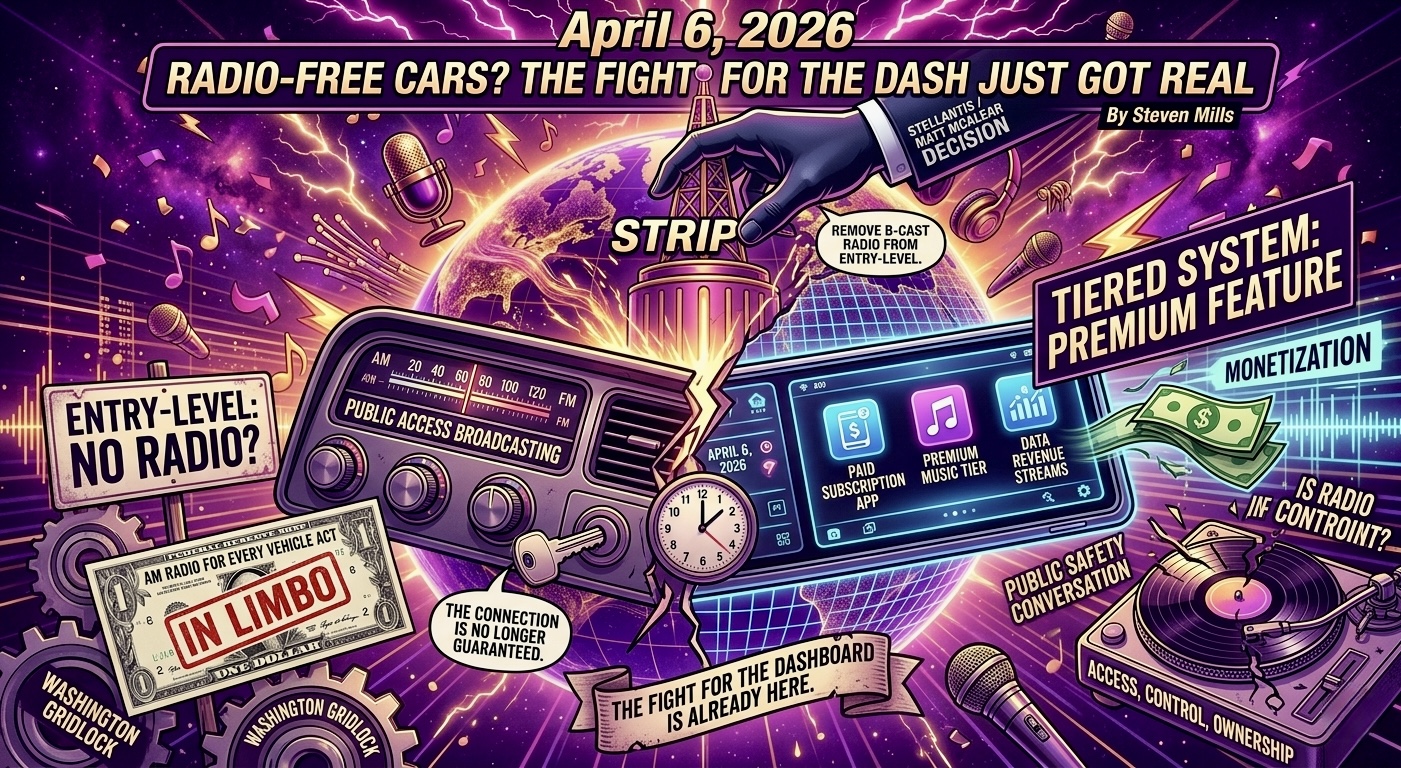
At the center of this growing conversation is Matt McAlear, who now sits in a powerful position under the Stellantis umbrella, overseeing both Dodge and Chrysler. His suggestion? Strip broadcast radio out of entry-level vehicles. Not phase it down. Not reimagine it. Remove it.
Let that settle in for a moment.
For decades, radio has been a standard—an expectation, not an option. You turn the key (or push the button), and radio is there. It has been the companion for commuters, the breaking news source during emergencies, the soundtrack to everyday life. And now, for the first time in a serious and public way, we’re talking about a future where that connection is no longer guaranteed.
This isn’t theoretical anymore. This is real.
And it’s happening while the AM Radio for Every Vehicle Act is still sitting in limbo—caught in the slow churn of Washington, uncertain, unresolved, and now under even more pressure as automakers begin to test the boundaries of what they can remove.
Make no mistake—this is about more than AM.
This is about access.
This is about control.
This is about who gets to occupy the dashboard.
Because once you open the door to removing radio from “entry-level” vehicles, you’ve created a tiered system. A system where access to free, over-the-air broadcasting becomes a premium feature instead of a public standard. And that should concern everyone in this space—from major market operators to small-town stations that rely on in-car listening as a primary touchpoint.
Let’s not ignore the strategy here.
Automakers are evolving. Dashboards are becoming digital ecosystems. Screens are getting bigger. Interfaces are getting smarter. And with that evolution comes opportunity—opportunity to prioritize apps, subscriptions, and platforms that generate recurring revenue.
Radio? It doesn’t operate in that model.
It’s free.
It’s immediate.
It’s local.
And in a world increasingly driven by monetization, those qualities—ironically—make it vulnerable.
But here’s where the intensity of this conversation really begins to rise.
Because radio is not just another content option. It is infrastructure.
When everything else fails—when networks go down, when data becomes unreliable, when emergencies hit—radio remains. It cuts through. It delivers. It connects. Removing it isn’t just a design decision. It’s a public safety conversation. It’s a cultural conversation. It’s a trust conversation.
And the timing of all this? It couldn’t be more critical.
With the legislative side still unresolved, moves like this don’t just test consumer reaction—they test resistance. They test how loud the industry is willing to be. They test whether broadcasters, lawmakers, and listeners are aligned or divided.
Because if this idea gains traction at the entry level, it won’t stay there. It never does.
It scales.
And suddenly, what starts as a cost-saving or modernization measure becomes a standard shift. One that could redefine how future generations discover—and connect with—radio.
Let’s talk about the listener for a moment.
The average person isn’t thinking about “broadcast infrastructure” or “dashboard ecosystems.” They’re thinking about getting in their car and turning something on. They’re thinking about familiarity. Ease. Habit.
Take that away, and you don’t just remove a feature—you disrupt a behavior.
And once that behavior changes, getting it back becomes exponentially harder.
That’s the part that should keep this industry locked in.
Because radio has always thrived on presence. On being there. On being the first option, not the forgotten one buried behind layers of menus and apps.
So now the question becomes—what happens next?
Does the industry push back harder?
Do lawmakers accelerate action?
Do automakers reconsider the broader implications?
Or do we quietly watch as one of radio’s most consistent platforms begins to slip away?
This moment demands attention. Not passive conversation—but active engagement.
Because what was introduced on that stage in New York wasn’t just an idea. It was a challenge.
A challenge to the industry.
A challenge to policymakers.
A challenge to the very identity of radio in a rapidly changing world.
And here’s the truth—radio has never been passive. It has adapted, evolved, and fought for relevance time and time again.
But this?
This is different.
This is about presence in the one place radio has always been guaranteed—the car.
And if that guarantee disappears, everything changes.
The fight for the dashboard is no longer coming.
It’s already here.