


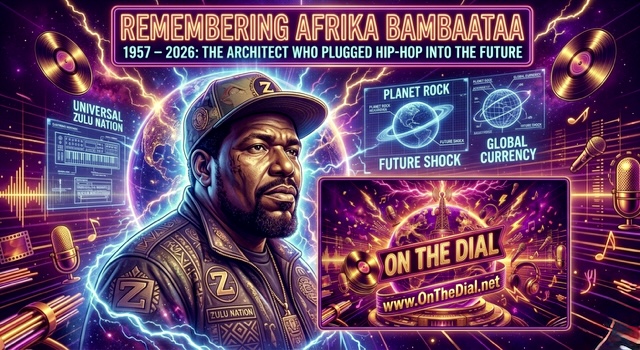
I can still hear it—the pulse that felt like a broadcast from another planet. The first time Planet Rock hit my ears during a Friday night mix show, it didn’t sound like hip-hop. It didn’t sound like anything from this world. The beat shimmered, the synths looped like neon circuitry, and suddenly hip-hop—the raw, street-born baby of block parties and borrowed turntables—had discovered space travel. That was the genius of Afrika Bambaataa, and we just lost him.
He died Wednesday at the age of 68. Universal Zulu Nation, the community organization he founded and guided for more than forty years, confirmed his passing. TMZ reported it was due to complications from cancer. For those of us who grew up chasing frequencies, hunting mixtapes, and waiting for our favorite DJs to blend the impossible, this loss hits like the power cutting out in the middle of the set.
Say the name Afrika Bambaataa and you’re calling out one of hip-hop’s original engineers—a man who didn’t just lay tracks but built bridges between sounds that weren’t supposed to touch. Before sampling was an industry, before “producer” became a household word, Bambaataa took the funk of James Brown, the electronic pulse of Kraftwerk, the rebellious joy of the Bronx, and welded them together into something that could only be described as future shock.
When Planet Rock dropped in 1982, hip-hop was still fighting for definition. DJs were kings, emcees were emcees, but nobody knew how far the form could stretch. Bambaataa did. He was already looking beyond the boroughs, scanning Europe’s avant-garde for signals, spinning records that didn’t seem to belong anywhere until he made them belong. The track wasn’t just a song—it was a reprogramming. Beats became blueprints. The Bronx had built a bridge to Berlin, and everybody was invited to dance across it.
I remember tuning in to late-night mixes in the ‘80s, back when DJs were experimenting with the edges of everything. If a show had Planet Rock in rotation, you knew it was the good kind of chaos—one built on innovation and respect for the craft. That robotic break could come on after Run-D.M.C. or before a funk cut; it didn’t matter. The crowd got louder, the air got tighter, and that unmistakable groove made a crowded club feel infinite.
He wasn’t just a musician; he was an ambassador. Through the Universal Zulu Nation, Bambaataa preached unity, self-expression, and empowerment at a time when hip-hop was dismissed by the mainstream as a fad or a threat. His mission was to prove it was neither—that the culture could be both revolutionary and uplifting. Zulu Nation became a blueprint for community-driven creativity, decades before “arts outreach” was a line item in any budget.
And while Bambaataa’s later years were complicated by personal and public controversies—things that cannot be ignored and must be part of his history—the shadow doesn’t erase the light. His influence on music, and on entire generations of producers and DJs, remains seismic. You can hear him in the DNA of electro-funk, in the architecture of house and techno, in the boldness of anything that dares to blend street energy with synthetic sound. Without Planet Rock, you don’t get Miami bass. You don’t get early rave culture. You don’t even get half the production techniques that define modern pop. He built the motherboard.
The thing about Bambaataa was how uncontainable his vision felt. He treated sound like a global currency—freely traded, constantly exchanged, and only worth something when everyone could access it. He didn’t hoard grooves; he unleashed them. If hip-hop was language, he was Esperanto’s DJ—making peace possible through rhythm.
When Zulu Nation announced his passing, those of us who came up through mix culture didn’t just mourn a figurehead. We mourned the energy he embodied—the curiosity, the daring, the refusal to stay in one genre, one neighborhood, one channel. For all his flaws, he gave DJs permission to be explorers. And once you’ve learned that kind of freedom behind the turntables, you never forget who gave you your passport.
According to TMZ, the cause of death was complications from cancer—a cruel ending for a man whose life was spent energizing the world. But maybe there’s symmetry in it: Bambaataa was always chasing the invisible wave, sending signals through wires and wind. Even now, somewhere, his influence keeps looping—passed down through samples, remixes, and memories of sweaty clubs where we didn’t know we were listening to history being made.
For those of us at On The Dial, this one’s personal. We grew up timing our Friday nights to the radio, waiting for that unmistakable vocoder line, futuristic yet ancient. We broadcast because of artists like him—because they proved the airwaves were a playground, not a boundary.
Our condolences go out to Afrika Bambaataa’s family, friends, and everyone in the Universal Zulu Nation who carried his torch of creativity, unity, and rhythm through decades of change. His sound was a time machine, and every beat since has been echoing inside it.
Somewhere a speaker hums, a synth wakes up, and an old record starts to turn. Planet Rock still plays. And the dance, thank God, still goes on.
-JPS