


Saturday night in Nashville was not built around spectacle.
It was built around gratitude.
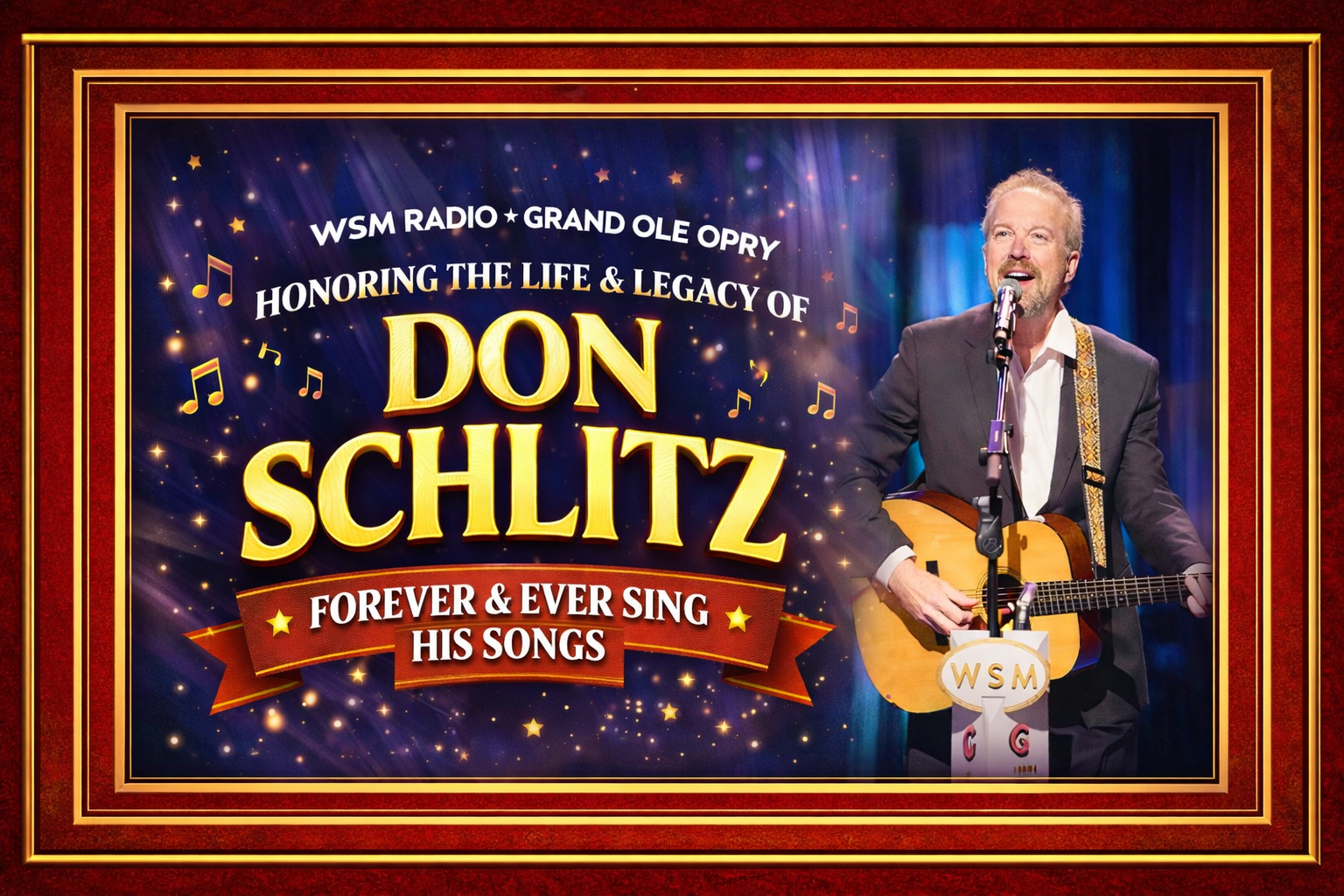
WSM Radio and the Grand Ole Opry used one of country music’s most sacred weekly stages to honor Don Schlitz, the Hall of Fame songwriter whose words helped shape generations of hits and whose passing just days earlier left a deep ache across the format. WSM had announced ahead of the broadcast that the second hour of the Opry Warm-Up Show would focus on songs written by Schlitz, and that the 5,233rd Saturday night Grand Ole Opry would be dedicated to his life, legacy and body of work. The planned lineup included Vince Gill, Charles Esten, John Conlee, Gary Mule Deer, Monte Warden & The Wagoneers, Riders In The Sky and Benny G in his Opry debut.
And that was exactly the right move.
You do not rush past a name like Don Schlitz. You do not treat a songwriter of that magnitude like a footnote between segments. You stop. You listen. You remember what the songs did, what they still do and how many artists built pieces of their careers on lines he wrote with uncommon precision and heart.
Schlitz died April 16 at age 73 after a sudden illness, according to the Songwriters Hall of Fame. The loss reverberated immediately because this was not just a successful writer with a few major credits. This was one of country music’s central architects, a songwriter whose catalog helped define the emotional language of the genre across decades.
That is why Saturday night felt bigger than a tribute show.
It felt like country music looking in the mirror.
The Grand Ole Opry and WSM both made clear just how much Schlitz meant to their world. In announcing his passing, the Opry and WSM said they were heartbroken and described him as “a gift to country music” and “a most beloved part of our Opry family,” adding that he was “a hero and a friend” who would not be forgotten. That kind of language does not get used casually, and in this case it fit the moment.
Schlitz’s place in country music was already towering long before he became an official Opry member. The Opry’s artist page credits him with 50 Top 10 singles and 24 No. 1 country hits, an outrageous body of work by any standard. The songs tied to his name include “The Gambler,” “Forever and Ever, Amen,” “On the Other Hand,” “When You Say Nothing at All,” “He Thinks He’ll Keep Her” and “The Greatest,” along with major recordings by artists including Kenny Rogers, Randy Travis, The Judds, Keith Whitley, Alison Krauss and Mary Chapin Carpenter.
That is not just a run of hits.
That is infrastructure.
Those are songs that did more than chart well. They helped shape how country music told stories, how it balanced melody with message and how it reached everyday people without sounding manufactured. Schlitz had a way of writing songs that felt lived in. Even when they were clever, they were never cheap. Even when they were big, they still felt human.
The Country Music Hall of Fame’s assessment of his career says a lot without needing to oversell it. The Hall notes that his greatness would have been secure even if he had written only “The Gambler,” but he kept going, and going at an elite level. Its summary points to his empathy, curiosity about people and work ethic as key ingredients in a catalog that stretched far beyond a single signature hit.
That matters because country music has never survived on stars alone.
It survives on songs.
And the people who write those songs, the real ones, the ones who know how to capture pain, humor, memory, regret, longing, hope and hard-earned perspective in three or four minutes, those people do not come around every day. Schlitz was one of them. More than that, he was one of the very best of them.
His rise also carries the kind of Nashville story that still means something in a town built on belief, hustle and timing. The Songwriters Hall of Fame says Schlitz moved to Nashville from North Carolina at 20, with little money and a big dream, and found his way into the songwriting community at a formative moment. He became one of the first performers at the Bluebird Cafe and helped pioneer the songwriter-in-the-round format with Thom Schuyler, J. Fred Knobloch and Paul Overstreet. That is not just biography. That is part of modern Nashville’s creative DNA.
By the time the Opry formally embraced him, it was really acknowledging what the rest of the business had known for years. Schlitz was inducted into the Grand Ole Opry in August 2022 after making his Opry debut in 2017. By then, he had already been inducted into the Country Music Hall of Fame, the Songwriters Hall of Fame and the Nashville Songwriters Hall of Fame.
So Saturday night was not about introducing anyone to Don Schlitz.
It was about honoring the depth of what he left behind.
That is why the WSM setup was so effective. Giving over the Warm-Up Show’s second hour to songs he wrote was a smart programming decision because it let the material lead the story. Before the applause, before the emotion on stage, before the Opry dedication reached its full weight, listeners had a chance to sit with the songs themselves. Not the mythology. Not the industry language. The songs. The part that mattered most in the first place.
And once the Opry broadcast took over, the symbolism became even stronger.
There are plenty of places to hold a tribute. There are fewer places where a tribute feels woven into the very identity of the medium. WSM is still the radio home of the Grand Ole Opry, and a night like this was a reminder of what radio can still do when it fully understands its purpose. It can gather people in real time. It can preserve ritual. It can turn mourning into fellowship. It can make listeners feel like they are sitting inside the same room, even when they are miles away.
And people had no shortage of ways to be there for it. WSM promoted the tribute across its app, iHeartRadio, TuneIn, 650 AM, online streaming and smart-speaker access. In other words, the old institution met the modern audience wherever it was. That felt fitting too. Schlitz’s songs crossed generations. So did the tribute built in his name.
What makes this story hit especially hard is that Schlitz’s songs were never cold exercises in craftsmanship. They had skill, obviously, but they also had soul. “The Gambler” became an American standard. “Forever and Ever, Amen” became one of the defining love songs in country music. “When You Say Nothing at All” proved how much can be said in restraint. Again and again, Schlitz found ways to write songs that ordinary people recognized immediately because they sounded like life, only sharper, cleaner and more lasting.
That is why Saturday night landed.
Because it was not just about loss.
It was about recognition.
Recognition that Don Schlitz did not simply contribute to country music. He helped build part of its emotional foundation. Recognition that the Opry was right to slow down and frame the night around him. Recognition that some songwriters are so important you do not honor them with a quick mention and a sad graphic. You honor them with air time, stage time, songs and silence in the right places.
That is what WSM and the Opry did.
And in doing so, they turned Saturday night into something more than a memorial. They turned it into a public thank you to a writer whose words are going to keep traveling long after the heartbreak of this weekend fades. Because Don Schlitz may be gone, but country music is still going to be singing him for a very long time.
-JPS