

March 13, 2026
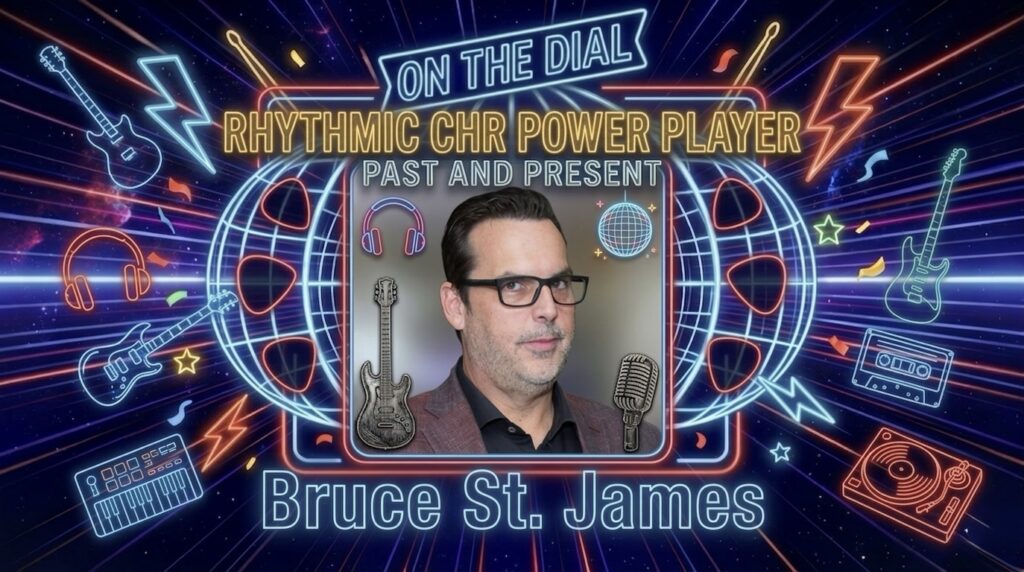
Rhythmic CHR Power Players — Past and Present:
Bruce St. James
Just Plain Steve
Every format has its architects.
Not the people who simply followed the trends, but the ones who recognized where the audience was headed before the rest of the industry caught up. The programmers who were willing to lean forward while everyone else was leaning back.
Rhythmic CHR has always been one of those formats that requires nerve. It lives right on the edge of culture. Too safe and you sound dated. Too aggressive and you lose the mass audience that makes the ratings work.
Walking that line takes instinct.
And one of the people who helped do it in the Southwest — particularly in Arizona — was Bruce St. James.
Today a lot of listeners know Bruce as a talk host on KTAR-FM, where he spent years talking politics, local issues, and life in Arizona. If you tune in there now, you’re hearing the seasoned broadcaster version of Bruce St. James.
But before the talk shows and political conversations, Bruce was deeply involved in the evolution of rhythmic radio — and the path there tells you a lot about how this business really works.
Because it didn’t start in a major market tower.
It started in Tucson.
Long before Phoenix became the battlefield where Bruce made his biggest programming mark, there was a small but influential station in southern Arizona called Power 1490.
To the casual listener, it was just another AM signal.
But inside the industry, Power 1490 had something that many stations would envy — a pipeline of talent and energy. Stations like that become training grounds. They’re the places where young broadcasters learn how to perform, produce, and create the sound of contemporary radio.
Power 1490 was one of those stations.
The format leaned rhythmic and urban, and it tapped into a musical movement that was just beginning to explode across the country. Hip-hop was gaining momentum. Dance records were pouring out of clubs. R&B was evolving into crossover pop.
The sound was raw, exciting, and unpredictable.
And stations like Power 1490 were learning how to put it on the air.
More importantly, the station had people.
People who understood how to move the culture through the speakers. Air personalities who sounded connected to the music rather than simply introducing it. Production that had attitude. Promotions that actually reached the community.
If you talk to broadcasters who passed through that station during its energetic years, you’ll hear stories about long nights, creative experiments, and a sense that something important was happening on the dial.
Those kinds of environments shape careers.
They also shape programmers.
Bruce St. James absorbed lessons from that era — about rhythm, about energy, about how a station connects with younger audiences — and those lessons would show up later when he moved into bigger markets.
Eventually Bruce landed at one of the most important rhythmic stations in the country: KPWR-FM.
Power 106 in Los Angeles was the epicenter of rhythmic CHR programming. Hip-hop was crossing over nationally, and KPWR was writing the playbook for how commercial radio could embrace that sound without losing the broader Top 40 audience.
Bruce served as Music Director there, which is one of those jobs that teaches you the difference between a good record and a hit record.
A Music Director lives inside the music.
They hear the records early. They watch the clubs. They talk with label reps, DJs, and street teams. They analyze what audiences are reacting to before the research even shows up.
And when you do that job in Los Angeles, you learn quickly that rhythmic radio is about timing.
The right record too early can miss.
The right record at the right moment can change everything.
Bruce carried that instinct with him when he moved to Phoenix.
That’s where he stepped into one of the most influential programming roles of his career at KKFR-FM — known to listeners simply as Power 92.
If you were in Arizona during the Power 92 era, you remember the sound.
It jumped out of the radio.
The imaging was aggressive. The music felt current. The personalities had swagger. It was rhythmic radio with confidence.
Bruce St. James spent thirteen years as Program Director there, and in the radio world that kind of run doesn’t happen unless the station is performing.
Power 92 wasn’t just performing.
It was defining the format in the market.
During the 1990s, rhythmic CHR was still evolving. Hip-hop was expanding beyond urban radio. Pop artists were incorporating R&B production. Dance music was crossing into mainstream playlists.
Programmers had to figure out how to balance all of it.
Too much street credibility and the station narrows its audience.
Too much pop and the station loses its edge.
Bruce St. James had the instinct for that balance. Under his watch, Power 92 maintained credibility with younger listeners while still sounding big enough for a major market Top 40 audience.
The results showed up in the ratings.
At times during the decade, Power 92 was pulling numbers around a seven share in the market — an impressive performance for a rhythmic station.
But the real impact of Bruce St. James wasn’t just the ratings.
It was the people.
Stations like Power 92 become career launch pads. Young producers learn how to create powerful imaging. Air personalities sharpen their skills. Promotions teams learn how to turn ideas into real community engagement.
Many of those people go on to other stations and markets, carrying the lessons they learned with them.
That’s how radio influence spreads.
Eventually the Phoenix market saw new competition when KZON-FM launched as Jamz, creating a rhythmic battle in the Valley.
And in one of those classic radio twists, Bruce eventually crossed the street and became Program Director there, while also overseeing programming duties at KMLE-FM, the market’s major country station.
That move alone tells you something about his reputation.
It takes a confident company to hire the former architect of a rival station — and it takes a confident programmer to walk into that situation and do the job.
Later Bruce stepped into the talk arena, becoming a host at KTAR and eventually even landing in mornings at the legendary WLS-AM before returning to Arizona.
But if you look at the bigger picture, the rhythmic CHR era of Bruce St. James’ career remains one of the most interesting chapters.
Because it happened during a time when the format itself was being invented.
Stations were figuring out how hip-hop, R&B, and pop could coexist on the same dial. Audiences were discovering a new sound that reflected what was happening in clubs, neighborhoods, and youth culture across the country.
Programmers who understood that moment helped define the format.
Bruce St. James was one of them.
From the energetic talent pipeline at Power 1490 in Tucson to the rhythmic laboratory of Power 106 in Los Angeles… to the long and influential run at Power 92 in Phoenix, his career tracks the growth of rhythmic radio itself.
Listeners may never know the names of the programmers behind the scenes.
But they remember the stations.
They remember the sound.
And for a lot of listeners in Arizona, that sound had rhythm, attitude, and a little bit of swagger.
That’s the mark of a Rhythmic CHR power player.