

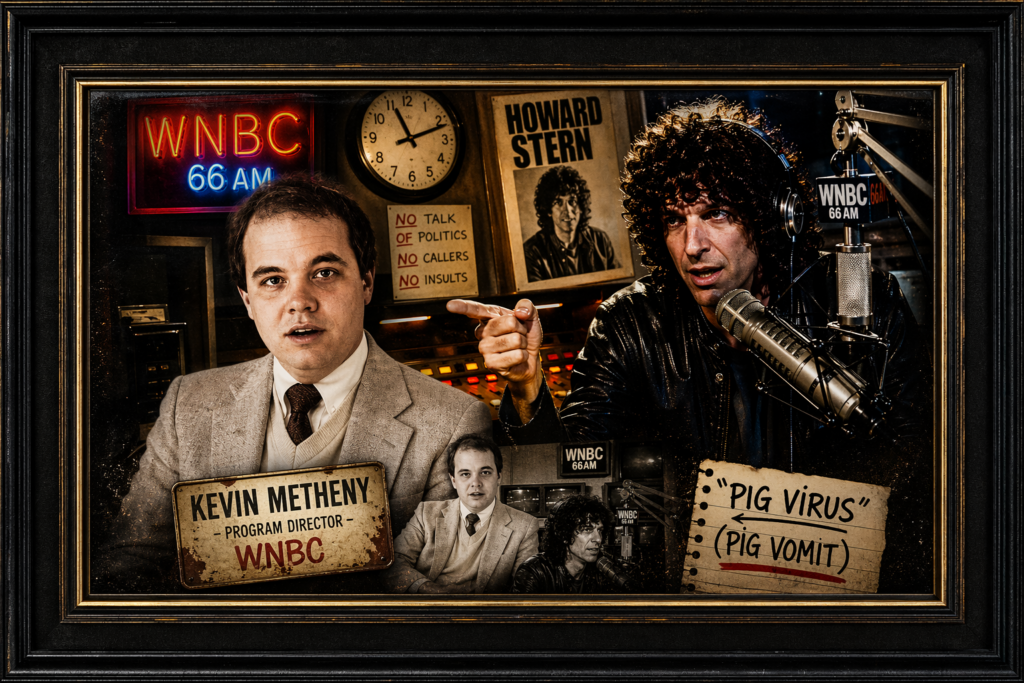
Power Players – Past & Present: Kevin Metheny
Steven Mills
Some names stay in the building long after the person has left it.
Not because of legend alone—but because of impact that refuses to fade.
Kevin Metheny was one of those names.
To the public, to pop culture, and to millions of listeners, he became something else entirely—forever tied to the orbit of Howard Stern as the man Stern branded “Pig Vomit.” That nickname didn’t just stick—it exploded, becoming part of radio folklore and one of the most recognizable jabs ever delivered over the air.
But like most things in radio… what the audience hears is only part of the story.
Because behind the mic, behind the noise, inside the station walls—Kevin Metheny was one of the most driven, aggressive, and results-oriented programmers the industry has ever seen.
The clash between Metheny and Stern during their time at WNBC-FM in New York became the stuff of legend. Metheny, brought in as a program director, was tasked with tightening, structuring, and ultimately controlling a show that thrived on chaos, unpredictability, and pushing boundaries.
Stern didn’t just resist it—he weaponized it.
On-air, Stern turned Metheny into a character, giving him the name “Pig Vomit,” a nickname rooted in both rebellion and ridicule, reflecting the tension between talent and management. What listeners heard as comedy was, in reality, a real-time collision between two powerful forces in radio: raw, unfiltered talent and disciplined, high-expectation programming leadership.
It made for great radio.
It also made for real friction.
But here’s what often gets lost in that story…
Metheny wasn’t wrong for demanding structure.
And Stern wasn’t wrong for protecting the edge that made his show different.
That tension? That push and pull?
That’s radio at its highest level.
Because great programming has never come from comfort.
Metheny understood that better than most.
Long before and long after that chapter, his career was defined by an unwavering commitment to performance. He didn’t approach radio casually. He didn’t program by feel alone. He attacked it with intent—formatics, flow, execution, accountability.
He expected results.
And he pushed people—hard—to get them.
That approach didn’t make him universally liked.
But it made him effective.
In markets across the country, Metheny carried a reputation as a leader who demanded more than what was easy. More than what was expected. More than what was comfortable. And in an industry where personalities are big and egos are bigger, that kind of leadership can create tension.
But it also creates growth.
Because at the end of the day, radio doesn’t reward comfort—it rewards performance.
Twelve years after his passing, Kevin Metheny’s imprint is still felt in the DNA of the medium. Not in the caricature. Not in the nickname. But in the standard.
A standard that says radio should sound urgent.
A standard that says talent should be pushed.
A standard that says winning is not optional.
The nickname made him famous.
The work made him matter.
And if you strip everything else away—the noise, the stories, the mythology—you’re left with something simple and undeniable:
Kevin Metheny didn’t just manage radio.
He challenged it.
He shaped it.
And in many ways, he forced it to be better than it was willing to be on its own.
That’s why his name still resonates today.
Not because of what was said about him on the air…
…but because of what he built when the microphones were off.
On The Dial covers breaking radio industry news, including layoffs, programming changes, talent moves, and broadcast trends across the United States.