

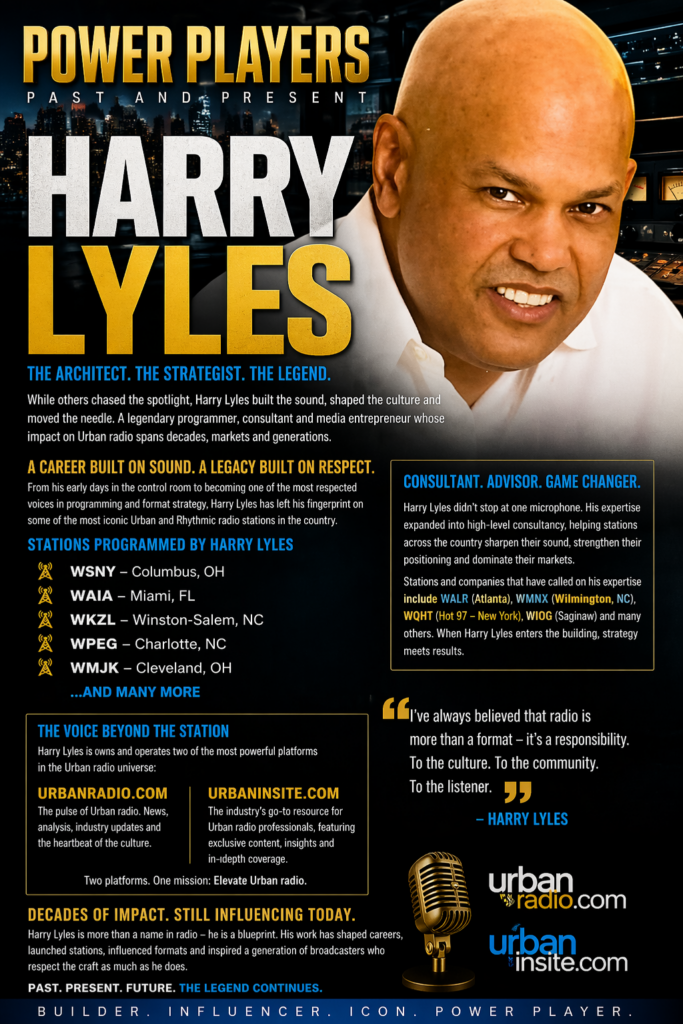
Some people work in radio, and some people bend it.
Harry Lyles belongs in that second category.
There are programmers who hold jobs, move chairs, survive ratings books and leave behind a paper trail of titles. Then there are the rare ones who help define how a format sounds, how it competes and how it survives the endless reinvention that this business demands. Harry Lyles is one of those names. In Urban radio, Rhythmic radio and even broader format strategy, he has never been just another executive in the hallway. He has been an operator, a builder, a teacher, a strategist and, more than anything else, a format man who understood that radio is never just about music. It is about culture, timing, instinct, discipline and knowing how to make a station feel like it belongs to the people listening.
That kind of work does not happen by accident, and it does not happen for a year or two. It happens over time, across markets, across ownership groups and across format eras that would have buried a lesser programmer. The trade-paper trail around Lyles shows exactly that kind of climb. In 1984, Radio & Records identified him as program director of WSNY in Columbus. By 1986, the same trade reported he had most recently been PD at WAIA in Miami before being selected to program WKZL in Winston-Salem/Greensboro. By 1987, another Radio & Records item noted that WPEG in Charlotte was filling a position “left open by Harry Lyles.” In 1989, Radio & Records reported he had been hired as PD of WMJK in Cleveland. That is not a résumé of somebody drifting through the business. That is a programmer moving through serious chairs and serious calls.
And here is why that matters.
Those are not interchangeable stations in interchangeable moments. They represent different markets, different competitive conditions and different demands. The person who can move from Columbus to Miami, from the Carolinas to Charlotte, from there to Cleveland, is not just doing one trick over and over again. He is reading rooms. He is reading markets. He is understanding listeners in a way that lets him adapt without losing the center of what makes a format work. That is what separates a playlist operator from a real programmer. Harry Lyles was clearly being trusted with real programming responsibility in multiple cities long before the modern industry started shrinking the number of people who even get that chance.
Urban radio has always demanded more from its programmers than many outsiders understand. You are not just rotating records. You are balancing current music against library, street energy against broad appeal, cultural credibility against the pressure to perform in ratings and revenue. If you lean too safe, you sound stale. If you lean too hard without discipline, you narrow the station unnecessarily. If you miss the audience even slightly, they know it before the first bad book lands. Harry Lyles built a reputation in precisely that tension zone, which is why his name continued to surface as both a programmer and a consultant as the industry changed around him.
And this is where his story moves from respected to legendary.
By 1992, industry reporting showed Lyles had moved beyond single-station command into wider consulting influence, adding clients including WALR in Atlanta and the then-new Urban outlet WMNX in Wilmington, North Carolina. A few years later, BRE reported that New York’s WQHT/Hot 97 brought in Harry Lyles as a consultant during one of the most consequential eras in hip-hop radio. Another industry profile from 1995 identified him as consultant to WIOG in Saginaw, proof that his reach was not boxed into a single format lane or one narrow definition of what he could help fix. That is what power looks like in radio when it is real. It stops being about one market and starts becoming about influence wherever the phone rings.
That consulting layer matters because it tells you what the business thought of him.
Stations do not bring in consultants because they want a pep talk. They bring them in because something important is on the line. Ratings. Image. Positioning. Morning drive. Music philosophy. Competitive survival. Harry Lyles built enough trust in enough rooms that stations were willing to put him inside the most sensitive part of the building: the sound itself. And for a programmer, that is one of the highest forms of respect there is. It means your judgment carries weight. It means your instincts have been proven. It means your experience is bankable.
Then came the part of his career that makes the legacy even bigger, because Harry Lyles did not stop at being a station guy or even a consultant. He built platforms.
Today, his Lyles Media site describes him as an Urban/Rhythmic radio adviser and uses hlyles@urbanradio.com as its core contact, while emphasizing that Lyles Media exists to help stations improve performance and win in Nielsen. A 2004 industry directory also listed UrbanRadio.com with “Harry Lyles, President.” And outside coverage has identified him as the founder of UrbanInsite, describing it as a long-running online trade focused on the Urban radio and music world. Urban Insite itself says it was established in 1997 as the first online source and community committed to providing information to the urban radio and music world. That is not just consultancy. That is institution-building.
Let that sink in for a second.
A lot of people spend their careers serving the format. Harry Lyles also helped create digital infrastructure around it. UrbanRadio.com and UrbanInsite.com are not side projects in that context. They are extensions of a lifetime spent understanding the ecosystem of Black radio, Urban radio and Rhythmic strategy. They give his thinking a home. They let him move the conversation, not just the clocks. They make it possible for him to speak not only to one GM, one PD or one market manager, but to the whole culture of the format. That is a very different level of power.
And maybe that is the part that defines him best.
Because radio has never simply been about who is on the air. Some of the most important people in the business are the ones shaping the sound before the microphone opens, the ones coaching talent, the ones telling ownership what the station really is, the ones with enough scar tissue and enough wins to say, “No, that won’t work,” or, “Yes, this is the move.” Harry Lyles became one of those figures. He programmed stations. He advised stations. He built media properties around the format. He kept showing up where real decisions were being made.
That is what makes this a “Power Players — Past and Present” story and not just a history lesson.
Past, because the station trail is real: WSNY, WAIA, WKZL, WPEG, WMJK. Present, because the advisory work, the Lyles Media mission, UrbanRadio.com and UrbanInsite.com all tell the same story: Harry Lyles never stopped being relevant. He simply changed the size of the room he was influencing.
And in a business that forgets people too fast, that part deserves to be said plainly.
Harry Lyles is not just a veteran. He is not just an old-school programmer with stories. He is one of those names that helped shape how Urban radio competed, how it sounded and how it thought about itself. He is a legend because the work lasted. He is a power player because the influence spread. He is still part of the conversation because people who know this business know exactly what his name means.
Some voices dominate the speakers.
Some names dominate the strategy.
Harry Lyles did something harder.
He helped shape both.