


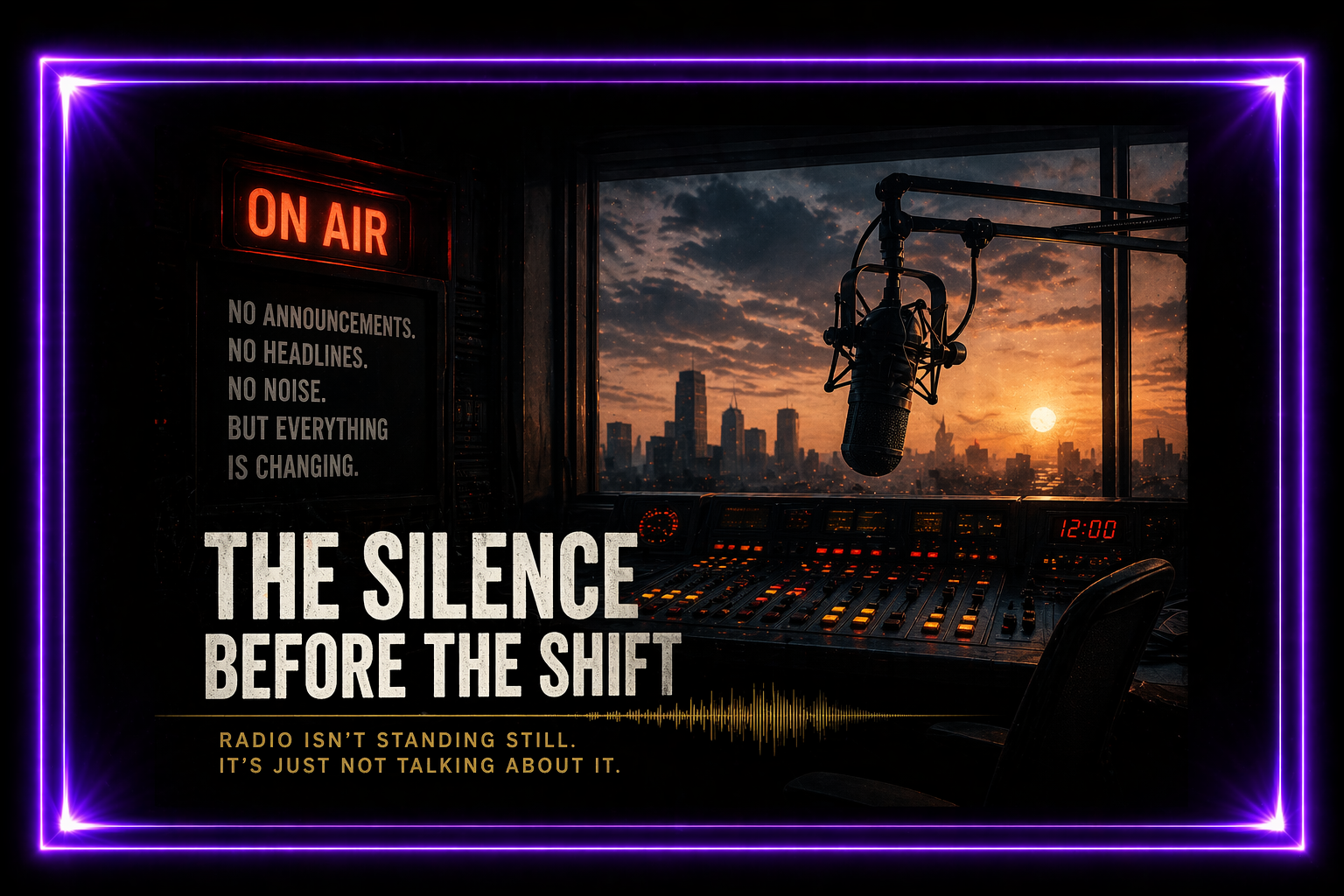
The quiet is not accidental, and it’s not comforting if you know what you’re listening for. Across the radio industry, the noise that once defined the business—press releases, talent moves, format flips, big personality hires—has thinned out to a near whisper, replaced by something far more telling: absence. The absence of daily headlines. The absence of bold announcements. The absence of the kind of movement that used to signal growth, competition and confidence. What remains is a steady, almost eerie calm, and in a business built on sound, that kind of silence carries meaning.
For years, radio thrived on visibility. Stations competed not just on the dial but in the trade headlines, each move designed to signal strength. A new morning show meant momentum. A major hire meant investment. A format flip meant urgency. Those moments created a rhythm the industry could follow, a pulse that reassured everyone—inside and outside the business—that radio was still moving forward. That rhythm has slowed, and now it’s barely audible.
The shift did not happen overnight. It came in layers. First, consolidation tightened control. Then digital competition fractured attention. Streaming platforms introduced infinite choice, and social media reshaped discovery. As those forces grew stronger, radio adapted, but adaptation did not always mean expansion. More often, it meant efficiency. More often, it meant reduction. The industry learned how to do more with less, and eventually, it learned how to say less while doing it.
That is where the silence began to take shape.
Decisions that once would have been celebrated publicly are now handled internally. Leadership changes happen without ceremony. Talent exits occur without explanation. Programming adjustments roll out quietly, sometimes without the audience even realizing a change has been made until it’s already in place. The absence of communication is not a failure of messaging—it is a strategy. In a business under pressure, control becomes currency, and information becomes something to manage carefully rather than distribute freely.
At the center of this quiet is a recalibration of priorities. Revenue models are shifting. Advertising dollars are being pulled in multiple directions. Corporate structures are being evaluated with a level of scrutiny that leaves little room for risk. In that environment, the loudest move a company can make is often the one it chooses not to announce. Silence becomes a shield. Silence becomes a signal to investors, to employees, to competitors that the real work is happening behind closed doors.
And yet, the silence is not empty.
Underneath it, the industry is moving.
Stations are rethinking what live programming means. Syndication is being reevaluated not just as a cost-saving tool but as a strategic asset. Digital integration is no longer optional—it is foundational. Audience measurement continues to evolve, forcing programmers to balance traditional metrics with emerging data points that do not always align. These are not small adjustments. They are structural shifts that redefine how radio operates at its core.
The challenge is that none of this translates easily into headlines.
It is easier to report a hire than a strategy. It is easier to cover a format flip than a financial recalibration. It is easier to write about personalities than processes. But the real story right now is not about who is on the air. It is about how the air itself is being managed.
That is where the tension lies.
Because radio has always been a medium defined by personality. It is built on voices, on connection, on the human element that turns a broadcast into an experience. When the conversation shifts away from personalities and toward structure, something changes. The audience may not see it immediately, but they feel it. They feel it in the consistency of the sound, in the predictability of the content, in the subtle loss of spontaneity that once made radio feel alive.
That feeling is the early indicator.
It tells you that the business is in transition.
And transitions are rarely loud.
They build quietly. They gather momentum beneath the surface. They move through boardrooms and budget meetings and strategic plans long before they ever reach the airwaves. By the time the audience hears the result, the decision has already been made.
This is the moment radio finds itself in now.
The silence is not the end of the story.
It is the beginning of the next one.
Because silence in radio has always meant one thing: something is about to change.
On The Dial covers breaking radio industry news, including layoffs, programming changes, talent moves, and broadcast trends across the United States.