

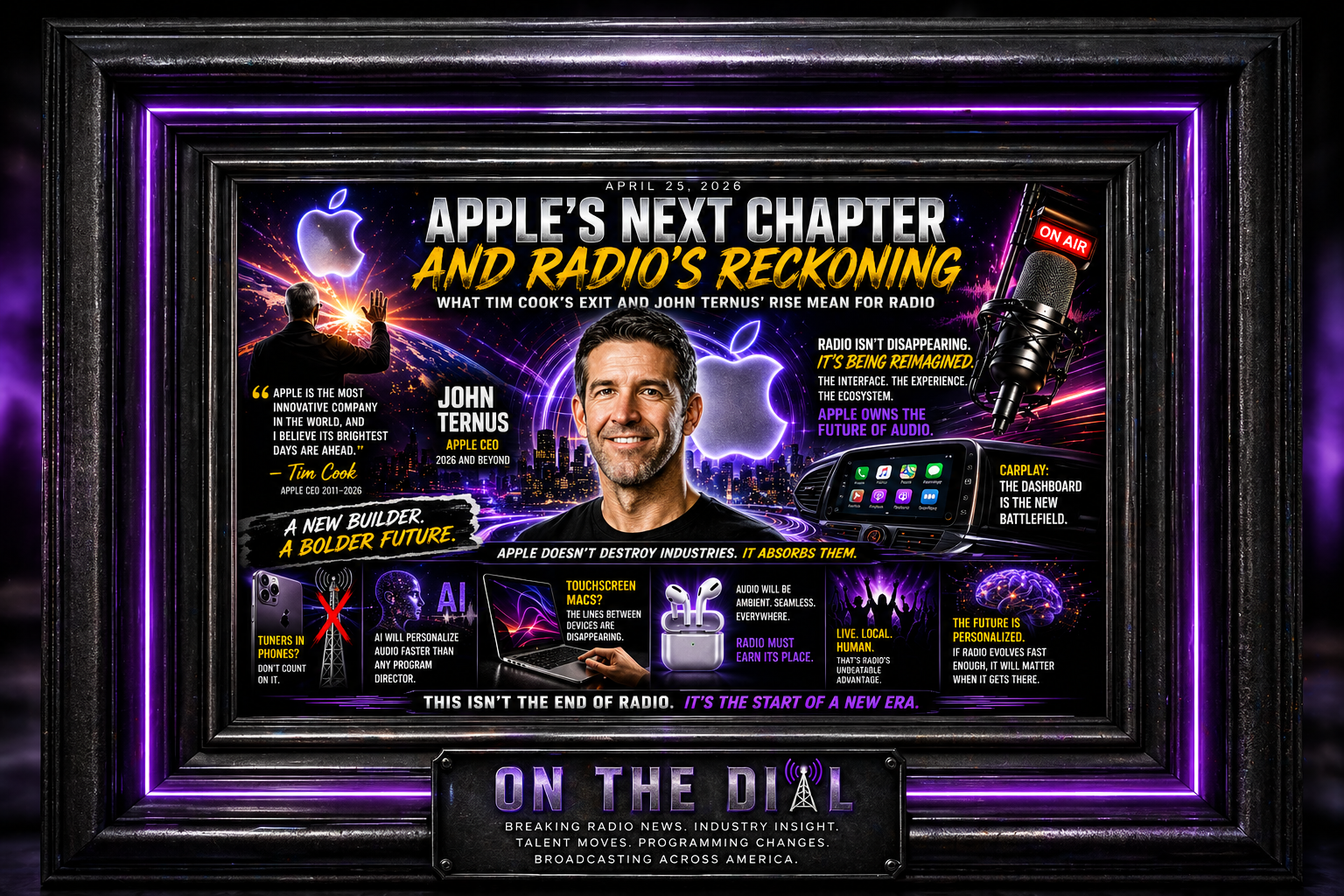
A leadership transition at Apple Inc. is never just about succession—it’s about direction, philosophy, and ultimately, who controls the future of how people experience content, and with Tim Cook stepping aside and John Ternus stepping into the CEO role, broadcast radio is staring down one of its most pivotal inflection points in decades whether it realizes it or not. This is not a quiet handoff, and it is certainly not symbolic. This is a shift that signals where Apple is going next—and by extension, where audio consumption is headed.
Cook himself framed the transition with clarity and confidence, saying, “Apple is the most innovative company in the world, and I believe its brightest days are ahead,” a statement that, on the surface, reads like legacy language but underneath reinforces something much more strategic—Apple is not slowing down, it is reloading, and the next chapter is being handed to someone who builds, refines, and reimagines the very devices that shape human behavior.
And that’s where this story becomes very real for radio.
John Ternus is not a services executive. He is not a finance operator. He is a product builder, a hardware architect, and a leader who has helped define the modern Apple experience through Macs, iPads, and Apple Silicon. That matters because Apple has always dictated how content is consumed by controlling the devices people use to consume it, and when a builder takes the top seat, history tells us to expect tighter integration, deeper ecosystem control, and an even more seamless blending of hardware and software that makes everything else feel just a step behind.
So let’s deal with the question that always comes up—are radio tuners coming back to phones? The answer remains no, and not because Apple couldn’t do it, but because it does not align with their strategy. Apple has spent years removing reliance on external systems they cannot monetize or control, replacing them with streaming, subscriptions, and personalized ecosystems that keep the user inside their world. A tuner would break that model. It would shift power away from the platform. And Apple does not build features that reduce its influence over the user experience.
But here is where the conversation gets more interesting, because while Apple is not bringing back traditional radio hardware, it is absolutely positioning itself to redefine the audio experience in ways that make the hardware conversation irrelevant.
The real battleground is the car, and Apple already has a head start. CarPlay is no longer just a convenience feature—it is becoming the interface. It is the front door to everything audio, navigation, communication, and entertainment, and under a hardware-first CEO, it is hard to imagine that Apple does anything other than push deeper into that space with more control, more customization, and more ownership of the in-car experience. For radio, that means the competition is no longer the station across town. The competition is every piece of content sitting inside that interface, from Apple Music to podcasts to algorithm-driven audio streams that are learning the listener faster than any programming meeting ever could.
And this is where the next wave hits. Artificial intelligence is not coming—it is already here, and Apple, while perceived as late to the party, is investing heavily and deliberately. The company’s strength has never been being first; it has been being right when it matters, and if Apple fully integrates AI into its audio ecosystem, the implications for radio are massive. Imagine a listener asking for a specific vibe, a specific energy, a specific type of morning show, and receiving a fully customized, dynamically generated audio experience that adapts in real time. That is not science fiction. That is the logical extension of everything Apple has been building.
Meanwhile, on the hardware side, there is another layer to watch. The long-rumored touchscreen MacBook Pro and iMac concepts gain new life under a leader like Ternus, someone who has already blurred the lines between iPad and Mac. If Apple continues collapsing device categories, making every screen interactive and every experience fluid, then content—including audio—becomes even more ambient, even more integrated into daily life, and even less dependent on traditional structures like scheduled programming.
So what does all of this mean for radio? It means the conversation has to change immediately. This is no longer about protecting the dial. It is no longer about defending legacy systems. It is about positioning within ecosystems. Because Apple does not destroy industries outright—it absorbs them, reshapes them, and reintroduces them on its own terms.
Radio still has one advantage that cannot be easily replicated—live, local, human connection. That is the differentiator. That is the one space where authenticity still wins over algorithms. But everything else—distribution, discovery, personalization—is being redefined in real time, and the companies that understand that shift will find new life inside these platforms while those that resist it risk becoming invisible within them.
This moment is not about fear. It is about clarity. Because as Apple enters a new era under a leader who builds the future with his hands, the question is no longer whether radio fits into that future—it is whether radio is willing to evolve fast enough to matter when it gets there.
On The Dial covers breaking radio industry news, including layoffs, programming changes, talent moves, and broadcast trends across the United States.