


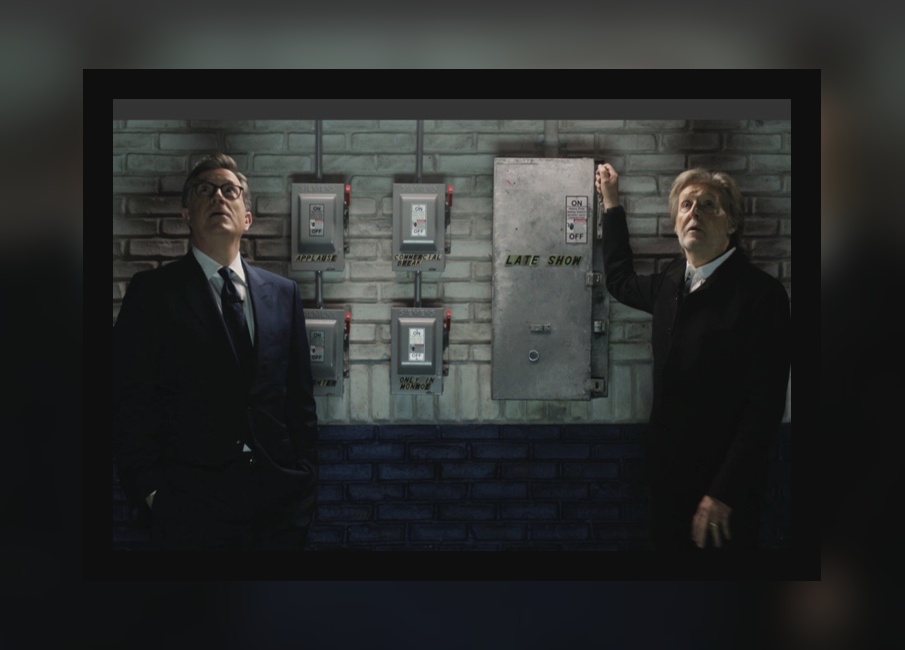
Last night, the lights dimmed inside New York’s legendary Ed Sullivan Theater, and with them, another major chapter in American broadcasting history quietly came to an end.After eleven years hosting CBS’s “The Late Show” and more than two decades as one of the most influential comedic voices in America, Stephen Colbert officially signed off Thursday night in an emotional, unpredictable, star-filled finale that felt less like a television episode and more like the closing scene of an entire era.
The extended broadcast stretched beyond its normal runtime as CBS gave Colbert additional time for one final goodbye following the network’s controversial decision last year to end both “The Late Show with Stephen Colbert” and the historic “Late Show” franchise itself after more than three decades on the air.
And what unfolded during those final moments was equal parts celebration, therapy session, variety show, satire, concert, reunion, and broadcast history lesson.
Paul McCartney emerged as the evening’s final featured guest, bringing the show full circle inside the same Ed Sullivan Theater where The Beatles famously transformed American pop culture generations earlier. By the end of the night, McCartney, Elvis Costello, Jon Batiste, Colbert, staff members, and surprise guests joined together for a performance of “Hello, Goodbye” that instantly became one of late night television’s defining farewell moments.
The finale also featured appearances and cameos from fellow late-night hosts Jimmy Fallon, Jimmy Kimmel, Seth Meyers, John Oliver, Jon Stewart, Bryan Cranston, Ryan Reynolds, Paul Rudd, Tig Notaro, Tim Meadows, Neil deGrasse Tyson, and others as Colbert leaned heavily into surreal comedy, emotional reflection, and self-aware humor throughout the night.
Even during the emotion, Colbert still managed to deliver a subtle final jab toward CBS and Paramount during a comedy segment involving “Peanuts” music licensing, continuing the tension that had hovered over the show ever since CBS announced the cancellation in 2025.
For millions of viewers, however, politics almost felt secondary last night.
What people saw instead was a broadcaster saying goodbye to a nightly relationship that had become part of America’s routine.
And while television audiences know Colbert for “The Colbert Report” and “The Late Show,” radio people understand something many viewers never fully realized: Stephen Colbert’s fingerprints have quietly existed in radio for years.
Long before podcasting became fashionable, Colbert understood the intimacy of spoken-word entertainment and the emotional rhythm of audio storytelling. His timing, pacing, character work, and conversational delivery often mirrored the mechanics of great personality radio more than traditional television hosting.
His collaborations with radio syndicators, public radio appearances, comedy networks, and later podcast-driven projects consistently showed a deep understanding of the spoken-word format and the power of audio connection. During the Hollywood writers strike, Colbert also became part of the wildly successful “Strike Force Five” podcast alongside Fallon, Kimmel, Meyers, and John Oliver, helping raise money for out-of-work staff members while once again proving his ability to dominate beyond traditional television.
But beyond projects and platforms, Colbert represented something broadcasters respect deeply: preparation.
Night after night, whether audiences agreed with him politically or not, Colbert delivered a level of professionalism, intelligence, writing discipline, timing, and showmanship that reminded old-school broadcasters what polished talent actually looks like.
That matters.
Especially now.
Because in an era increasingly dominated by viral clips, rushed content, AI-generated personalities, shrinking staffs, and disposable entertainment, Stephen Colbert still approached late night like a craftsman.
And last night felt like America realizing those craftsmen are disappearing faster than anyone wants to admit.
The bigger loss may not simply be Colbert himself.
It may be what his departure symbolizes.
David Letterman gone.
Jay Leno gone.
Conan O’Brien gone from network late night.
James Corden gone.
Trevor Noah gone.
And now Colbert.
One by one, the larger-than-life personalities that once made late night television feel essential continue fading away as the entertainment industry moves toward fragmented streaming audiences, algorithm-driven content, shorter attention spans, and cheaper programming models.
Last night was not simply the end of a television show.
It was another funeral for appointment media.
Another reminder that America no longer gathers around television and radio together the way it once did.
Yet somehow, for one final night, Stephen Colbert made it feel that way again.
And that may ultimately become his greatest contribution of all.
On The Dial covers breaking radio industry news, including layoffs, programming changes, talent moves, and broadcast trends across the United States.