


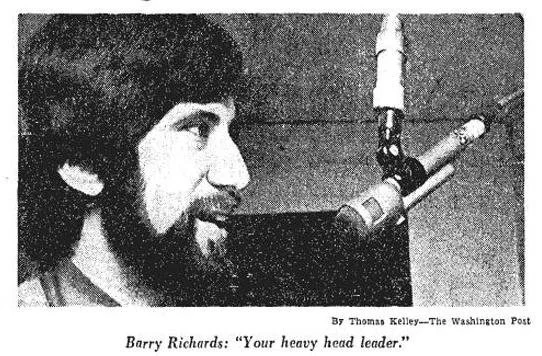
There are broadcasters who had great careers, and then there are broadcasters whose careers read like somebody dared them to see how many corners of the entertainment business they could change before they were finished. Barry “The Reazar” Richards belonged firmly in that second group. Richards died Saturday, August 15, at 83 following complications from a recent series of strokes, closing a remarkable life that moved through radio, television, concert promotion, record promotion and artist development — often years before the rest of the industry figured out where entertainment was heading.
And if you’re unfamiliar with Barry Richards, don’t mistake that for Richards being insignificant.
You probably recognize pieces of the radio and music culture he helped push forward.
Before Multiplatform Was a Buzzword Barry Richards Was Already Doing It
Today we hold conferences about becoming a “multiplatform personality.”
Barry Richards might have laughed.
Because he was doing versions of that before anybody had Wi-Fi.
Richards worked on-air and in programming in markets that included Washington, Baltimore, New Orleans, Los Angeles, Fresno and Spokane, crossing geographic boundaries almost as easily as he crossed musical ones. His résumé included stations such as WKTK in Baltimore, WEAM and WKYS in Washington, WAIL in New Orleans, KGFJ/KUTE in Los Angeles and KBOS in Fresno.
But here’s where Richards becomes fascinating.
Radio wasn’t enough.
He took music to television.
And he didn’t wait for MTV to tell him that was a good idea.
Barry Saw Music Television Coming Before Music Television Became an Industry
Think about the period we’re talking about.
No YouTube.
No TikTok.
No MTV.
No endless artist video channels.
Yet Richards was experimenting with music-centered television programming combining personalities, artists, performances and contemporary culture.
His television work included programs in Washington, Baltimore, New Orleans and Los Angeles, with concepts spanning Rock, Soul, Disco and music video programming.
That’s not merely somebody finding another television gig.
That’s somebody recognizing something fundamental:
People didn’t just want to hear the music. They wanted to see the culture surrounding it.
Today that seems obvious.
Back then?
Not nearly as much.
And Then Look at the Music
This is where the résumé becomes ridiculous.
Richards’ career connected him with the promotion of artists including Led Zeppelin, Black Sabbath, Alice Cooper, Jethro Tull, Joe Cocker, Steppenwolf, Edgar Winter, Johnny Winter and others, while his work also stretched deeply into R&B, Soul, Disco, Rhythmic and Urban music.
Read those names again.
This wasn’t somebody sitting safely inside one musical lane.
Rock.
R&B.
Disco.
Top 40.
Rhythmic.
Urban.
Progressive.
Barry Richards seemed considerably more interested in asking:
Is it exciting?
That’s a programming philosophy we could use a little more of today.
Because Barry Richards Apparently Didn’t Believe Music Needed Permission to Sit Next to Other Music
And perhaps that’s one of the most important pieces of his legacy.
Richards worked during an era when radio’s musical boundaries could be enormously rigid, yet parts of his programming career were built around crossing them.
His work at WEAM in Washington during the 1970s became associated with an approach that allowed Black and white artists to coexist on the same radio station at a time when programming practices frequently kept those worlds separated.
Think about what that means.
Forget the format labels for a second.
Forget consultants.
Forget research.
Forget the music categories printed on the record.
What happens if the audience simply likes the song?
That question sounds almost rebellious again in 2026.
Maybe that’s why Richards’ career feels so relevant.
The Alternative Perspective Is That Radio Could Use a Few More Barry Richards Types Right Now
Radio has become incredibly good at minimizing risk.
Maybe too good.
Research it.
Test it.
Analyze it.
Protect the quarter-hour.
Don’t scare anybody.
Don’t play anything unfamiliar.
Don’t let the personality talk too long.
Don’t break the format.
Don’t color outside the lines.
And then broadcasters wonder why younger audiences sometimes describe terrestrial radio as predictable.
Barry Richards came from another philosophy.
Make something happen.
That doesn’t mean every experiment worked.
It doesn’t mean modern programmers should throw research into the parking lot.
It means radio occasionally needs people willing to recognize that the next great idea probably doesn’t look exactly like the previous great idea.
Richards spent a career moving toward what interested him.
Sometimes radio.
Sometimes television.
Sometimes concerts.
Sometimes records.
Sometimes another market.
Movement was apparently part of the DNA.
He Was Also a Promoter in the Truest Sense of the Word
There’s a difference between marketing something and believing in it enough to push everybody else to pay attention.
Richards became deeply involved in concert and record promotion, using his understanding of programmers and audiences to help artists gain exposure.
That makes perfect sense.
Who understands how to pitch a radio programmer better than someone who was a radio programmer?
He understood the person behind the desk because he’d occupied the chair.
He understood the personality because he’d opened the microphone.
He understood the audience because he’d spent years trying to hold one.
That’s an education no marketing textbook can completely duplicate.
And Somewhere Along the Way He Helped Raise Another Generation of Music Entrepreneur
There’s another fascinating part of the Richards legacy.
His son Gary Richards became enormously influential in electronic music as Destructo, building a career as a DJ, producer and events executive and founding HARD Events.
That feels remarkably appropriate.
The father spent his life refusing to keep music inside conventional boxes.
The son went on to build his own place in another evolving music culture.
The beat continued.
But Today This Isn’t Really About Formats or Ratings
Today it’s about a family.
Richards leaves behind his wife Debra, sons Gary and Paul, their spouses, and grandchildren Riley, Steven, Capri and Walker. His son Steve preceded him in death in 2004. Richards’ family says he died peacefully surrounded by those closest to him. A private family ceremony is planned, with a larger Celebration of Life expected later.
That’s where all the call letters stop mattering.
The television shows stop mattering.
The concerts stop mattering.
The records stop mattering.
Because behind The Reazar was Barry.
A husband.
A father.
A grandfather.
A person whose family now has to experience the enormous silence that follows a life filled with so much noise.
To Debra, Gary, Paul and the entire Richards family, we offer our deepest condolences.
What Radio Should Remember About Barry Richards
Don’t simply remember the stations.
Remember the curiosity.
Don’t simply remember the artists.
Remember the willingness to champion them.
Don’t simply remember the television programs.
Remember that he was experimenting with visual music culture before an entire industry would eventually form around it.
Don’t simply remember the markets.
Remember that every move gave him another audience to entertain.
And don’t reduce his career to the wonderfully outrageous nickname The Reazar.
Remember what made the nickname matter.
There was somebody behind it willing to take chances.
Radio Was Supposed to Have People Like This
Characters.
Experimenters.
Promoters.
Instigators.
People who occasionally made management nervous.
People who heard something everybody else dismissed and wondered whether everybody else might be wrong.
People who could program Rock today, understand R&B tomorrow and recognize that the listener didn’t necessarily care which industry category somebody had assigned to the record.
That’s part of how radio evolved.
And perhaps the greatest tribute this industry could give Barry Richards isn’t merely remembering what he did.
It’s allowing another Barry Richards to happen.
Give somebody permission to experiment.
Let a young programmer try something weird.
Let a personality develop an identity.
Let somebody play the record nobody can quite categorize.
Let somebody build the television show, stream, podcast or platform that executives don’t completely understand yet.
Because somewhere right now there’s probably another strange kid with an outrageous idea who sees where media is going before the rest of us do.
Don’t program that person out of the building.
Rest Easy Reazar
From Washington to Baltimore.
From New Orleans to Los Angeles.
From Fresno to Spokane.
From radio studios to television cameras.
From concert stages to record promotion.
Barry Richards didn’t simply spend decades working around music.
He chased it wherever it went.
That’s one hell of a life.
And one hell of a legacy.
An On The Dial Perspective
Barry “The Reazar” Richards represents something broadcasting can never afford to lose: fearless curiosity. His career didn’t stay obediently inside radio, one format or even one medium. He followed music into television, concerts, promotion and emerging cultural movements because apparently nobody convinced him he wasn’t supposed to. Radio in 2026 could learn something from that. Innovation rarely begins with somebody asking permission to repeat what already works. It begins with someone hearing, seeing or imagining something the rest of us haven’t caught up with yet. Barry Richards spent a lifetime doing exactly that.
To Debra and the entire Richards family, our hearts are with you.
And to Barry Richards:
The records eventually stop spinning.
The influence doesn’t.
Rest well, Reazar.
#OnTheDial #BarryRichards #TheReazar #RIPBarryRichards #RadioLegend #RadioHistory #RadioPioneer #MusicHistory #Top40Radio #UrbanRadio #RhythmicRadio #ProgressiveRock #MusicTelevision #MusicPromotion #ConcertPromotion #RadioPersonality #RadioProgrammer #RadioPeople #Broadcasting #MusicIndustry #WashingtonDCRadio #BaltimoreRadio #LosAngelesRadio #NewOrleansRadio #RadioStillMatters