


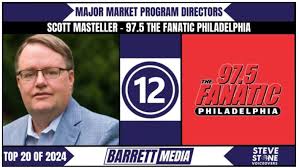
There are programmers who manage radio stations, programmers who build radio stations, and then there are the rare ones whose fingerprints quietly wind up on people, shows and brands scattered across the country long after they have left the building. Scott Masteller belongs in that last group. After a career spanning more than four decades, stretching from local radio control rooms to ESPN’s national operation and eventually into one of America’s most unforgiving sports-radio battles, Masteller has decided that 2026 will be his final year behind the programming desk. The Program Director of Beasley Media Group’s 97.5 The Fanatic WPEN-FM Philadelphia will retire at the end of the year.
And this time, apparently, he means it.
Because Scott Masteller has tried this retirement thing before.
RADIO WOULDN’T LET HIM LEAVE
Philadelphia Was The Encore
When Masteller arrived at The Fanatic in January 2024, this wasn’t supposed to be the beginning of another decade-long adventure.
He had already stepped away from the daily programming grind at WBAL in Baltimore.
He had already earned the right to slow down.
Then Philadelphia called.
And apparently there are some radio markets capable of making a programmer look at retirement and say
Well maybe one more
😂
Philadelphia was that market for Masteller.
Beasley needed an experienced spoken-word programmer for 97.5 The Fanatic, and Masteller had spent a career preparing for exactly that kind of assignment.
The Fanatic wasn’t some sleepy sports station requiring a few clock adjustments.
It was fighting SportsRadio 94WIP.
In Philadelphia.
That’s the radio equivalent of deciding retirement has gotten boring and entering a cage match.
The Philadelphia Business Journal reported his appointment in January 2024 as Beasley turned to a veteran radio executive to lead the brand.
And Scott Walked Straight Into The Fight
Philadelphia sports radio isn’t normal sports radio.
Let’s establish that immediately.
This is a market where an Eagles third-down decision can generate approximately eleven hours of radio.
A Phillies bullpen move can become a municipal emergency.
A Sixers trade rumor can ruin lunch.
The Flyers can lose three straight games and somebody’s uncle in Delco is ready to personally restructure the front office.
😂
Philadelphia doesn’t casually consume sports.
PHILADELPHIA PROSECUTES SPORTS
And sports radio is where the trial takes place.
Every.
Single.
Day.
Masteller understood something important when he arrived.
The Fanatic couldn’t become WIP.
Trying to manufacture somebody else’s station is usually the fastest way to guarantee you’re always going to be the other station.
So he went to work on 97.5.
And There Was Plenty Of Work
During Masteller’s tenure, The Fanatic continued evolving its lineup as Beasley searched for the right combinations of personalities and programming.
There were pairings.
There were departures.
There were returns.
There were experiments.
There was the reunion with Mike Missanelli.
There was the eventual return of Jon Marks.
Bill Colarulo’s role grew.
Shows changed.
Talent moved.
And through it all, Masteller’s job wasn’t simply filling boxes on a programming grid.
It was trying to stabilize and differentiate a sports brand operating across the street from one of America’s most formidable sports-radio institutions.
That’s a programmer’s job that requires both confidence and humility.
You need enough confidence to change things.
And enough humility to understand that copying the market leader isn’t a strategy.
But Philadelphia Is Only The Final Chapter
If you’re young enough to know Scott Masteller primarily from The Fanatic, understand something.
THIS MAN HAS BEEN AROUND
😂
And I mean that with enormous respect.
Before Philadelphia.
Before Baltimore.
Before Bristol.
Before ESPN Dallas.
There were radio stations.
Real radio stations.
Different markets.
Different competitive circumstances.
Different call letters.
Different problems waiting for somebody to solve them.
Masteller programmed 630 WLAP in Lexington.
He programmed 570 KISN in Salt Lake City.
He programmed 1080 KFXX in Portland.
Those assignments helped build the programmer who would eventually get one hell of a telephone call.
ESPN Was Building Something In Dallas
In 2001, Masteller joined ESPN to help launch ESPN 103.3 KESN Dallas Fort Worth.
Stop there.
Because with twenty-five years of hindsight, it’s easy to look at ESPN Radio as this enormous established sports-media institution and forget what the sports-radio landscape looked like when many of these brands were being constructed.
Local ESPN affiliates weren’t merely flipping a switch.
Somebody had to build them.
Position them.
Staff them.
Coach them.
Sell the concept locally.
Integrate national ESPN programming without turning the local station into a satellite dish with commercials.
And in Dallas, there was another tiny complication.
The Ticket existed.
😂
Welcome to town, Scott.
Again, Masteller apparently has never been particularly interested in easy radio assignments.
Then Bristol Called
Five years after arriving in Dallas, Masteller moved into ESPN’s Connecticut headquarters.
Now the canvas got considerably larger.
He became Senior Director of Radio Content, working inside the national ESPN Radio operation through 2014.
Think about that period.
Sports radio was exploding.
ESPN was one of the most powerful brands in American sports media.
The relationship between television, radio, digital and personality-driven sports content was changing rapidly.
And Masteller was sitting inside that machine.
This wasn’t merely programming a station anymore.
This was content strategy.
Talent development.
National programming.
Understanding what could work across markets that had absolutely nothing else in common except sports.
And perhaps most importantly
COACHING PEOPLE
That became one of the recurring themes of Masteller’s career.
Because Great Programmers Don’t Just Program Stations
They program people.
That sounds strange until you’ve actually worked in radio.
A clock can be fixed in fifteen minutes.
A stopset can move.
A sweeper can be rewritten.
A feature can disappear tomorrow.
A music category can change.
Those are mechanics.
People are harder.
A great programmer can listen to a host and hear the show that personality could become.
Then comes the difficult part.
Helping them get there.
Not turning them into the programmer.
Not turning them into another host.
Making them a better version of themselves.
That’s coaching.
And it is becoming a frighteningly scarce skill in radio.
Baltimore Got The Next Chapter
After ESPN, Masteller eventually landed at Hearst’s legendary 1090 WBAL Baltimore, taking over programming responsibilities in 2015.
And once again, look at the assignment.
WBAL.
One of American radio’s great heritage call signs.
News.
Talk.
Sports.
Baltimore.
Ravens.
Orioles.
Navy football.
A radio station where spoken-word programming isn’t merely filler between commercials.
It is the product.
Masteller’s responsibilities extended into the sports networks surrounding those franchises and institutions.
That requires another level of programming discipline.
Play-by-play isn’t just another show.
There are affiliates.
Networks.
Talent.
Pregames.
Postgames.
Rights relationships.
Sponsors.
Hard outs.
Very expensive people occasionally running overtime.
😂
It’s radio engineering, programming and diplomacy rolled into one.
Then Came Retirement Number One
By 2022, Masteller stepped away from the full-time WBAL programming chair.
He remained involved in sports programming on a reduced basis.
He could consult.
He could coach.
He could enjoy life.
The daily grind was supposed to be behind him.
Forty-plus years in broadcasting will make a person start thinking maybe it’s time to stop worrying about tomorrow morning’s show.
And then Beasley called.
Philadelphia
Of course it was Philadelphia.
If you’re going to come out of semi-retirement, why choose something relaxing?
😂
Let’s choose one of America’s most competitive sports-radio markets.
Let’s take on WIP.
Let’s work with an audience famous for having opinions about absolutely everything.
Let’s rebuild.
Let’s coach.
Let’s experiment.
Let’s do radio again.
And Masteller said yes.
That Says Something About Radio People
People outside this business sometimes don’t understand it.
Why come back?
Why keep doing it?
Why tolerate the ratings?
The budget meetings?
The lineup problems?
The personalities?
The social-media complaints?
The listener who has apparently discovered your personal cellphone number?
😂
Because radio gets into you.
There is something intoxicating about walking into a building while yesterday’s show is still being dissected and tomorrow’s show hasn’t been invented yet.
Every day starts empty.
Then somebody turns on a microphone.
And you’ve got to make something happen.
Masteller Came Back To Develop People
That’s arguably the most meaningful piece of his Philadelphia chapter.
Talk to people around The Fanatic and a recurring description emerges of a programmer who listens.
Not simply to the station.
To the people making it.
That matters.
A host can tell when the Program Director is merely waiting for the meeting to end.
Talent can also tell when the PD actually cares whether the show improves.
The Fanatic’s Ricky Bottalico has publicly described Masteller as unusually accessible and willing to go back, listen to a segment and provide useful feedback when a personality needs another set of ears.
That’s not glamorous.
There is no press release announcing
PROGRAM DIRECTOR LISTENED TO AIRCHECK
😂
But that’s the job.
Or at least it used to be.
Radio Needs More Of That
We talk constantly about the future of radio.
AI.
Streaming.
Podcasting.
YouTube.
Connected cars.
Smart speakers.
Digital revenue.
Video.
Social.
All important.
But somewhere in all that technological conversation, radio cannot forget something remarkably primitive.
Somebody still has to make the talent better.
Somebody has to listen.
Somebody has to say that segment was six minutes too long.
Somebody has to ask why the host buried the best story.
Somebody has to recognize chemistry.
Somebody has to tell a personality when they’re brilliant.
Somebody has to tell them when they’re not.
Somebody has to protect talent.
Somebody has to challenge talent.
That’s a Program Director.
Capital P.
Capital D.
And That Is What Makes This Retirement Bigger Than Philadelphia
Scott Masteller’s résumé reads like a road map through several generations of American spoken-word radio.
Lexington.
Salt Lake City.
Portland.
Dallas.
Bristol.
Baltimore.
Philadelphia.
Local radio.
National radio.
News talk.
Sports talk.
Network programming.
Play-by-play.
Talent development.
Station strategy.
Analog radio becoming digital radio becoming multiplatform content.
He’s watched the industry reinvent itself several times.
And somehow
THE MICROPHONE SURVIVED EVERY VERSION
The Fanatic Is Different Than The Station He Inherited
That may ultimately be the fairest way to judge his Philadelphia chapter.
Not whether he defeated WIP.
That’s an overly simplistic scoreboard for a programmer walking into a deeply entrenched competitive situation.
The better question is whether 97.5 The Fanatic found a clearer version of itself.
Masteller has spent his tenure adjusting personalities, restoring familiar voices where appropriate, developing newer ones and pushing the brand beyond the old idea that a sports station’s audience begins and ends with an FM ratings report.
The modern sports-radio brand lives everywhere.
Radio.
Streaming.
YouTube.
Social video.
Podcasts.
Clips.
Phones.
Cars.
Wherever the audience decides to consume it.
That transition has been happening throughout sports media, and The Fanatic has been living directly inside it.
Now The Programmer Gets To Make One Last Clock
That’s the image I keep coming back to.
Radio programmers spend their lives staring at clocks.
Hour opens.
Segment lengths.
Breaks.
Benchmarks.
Hard outs.
Network joins.
Top of hour.
Bottom of hour.
Reset.
Repeat.
Every hour has a structure.
Every show eventually ends.
And sometime near the end of December, Scott Masteller will walk through one more broadcast day knowing something is different.
This time the clock isn’t resetting tomorrow.
The On The Dial Perspective
There is a tendency when veteran broadcasters retire to reduce an entire career to a list of call letters.
Don’t.
The call letters matter.
But the people matter more.
There are broadcasters working today who became better because Scott Masteller sat down and listened to them.
There are shows that improved because he heard something.
There are programming decisions carrying pieces of lessons he taught somebody twenty years ago.
There are people running radio stations today who learned by watching people like Masteller run them yesterday.
THAT IS THE REAL LEGACY OF A PROGRAMMER
Transmitters eventually get replaced.
Studios get remodeled.
Formats change.
Call letters move.
Companies merge.
Ratings books become historical documents.
But lessons travel.
And Radio Is Losing Another Teacher
Not today.
We’ve still got him through the end of 2026.
There are still Eagles Mondays to survive.
Phillies conversations.
Sixers arguments.
Flyers mornings.
Lineup decisions.
Airchecks.
Meetings.
Ratings.
Digital conversations.
Probably several conversations beginning with
Scott do you have a minute
😂
But the finish line is visible now.
And this time, after more than four decades of radio repeatedly finding another reason for Scott Masteller to stick around, he gets to decide where the clock stops.
From Lexington to Salt Lake City.
Portland to Dallas.
Dallas to Bristol.
Bristol to Baltimore.
Baltimore to Philadelphia.
From local stations to ESPN.
From ESPN back to local radio.
From retirement back into the fight.
That’s one hell of a trip.
So when Scott Masteller finally walks out of 97.5 The Fanatic at the end of this year, don’t simply say a Program Director retired.
Say a radio man finished the shift.
A programmer.
A coach.
A builder.
A teacher.
One of those people who understood that the equipment has never been the magic of this business.
THE PEOPLE ARE
Enjoy the final months, Scott.
Take the last aircheck.
Have the last talent meeting.
Move the last segment.
Fix the last clock.
Then shut the office door.
For once, don’t worry about tomorrow’s show.
Somebody you taught will handle it.
On The Dial
#ScottMasteller #975TheFanatic #PhiladelphiaRadio #SportsRadio #RadioProgramming #BeasleyMedia #ESPNRadio #OnTheDial