


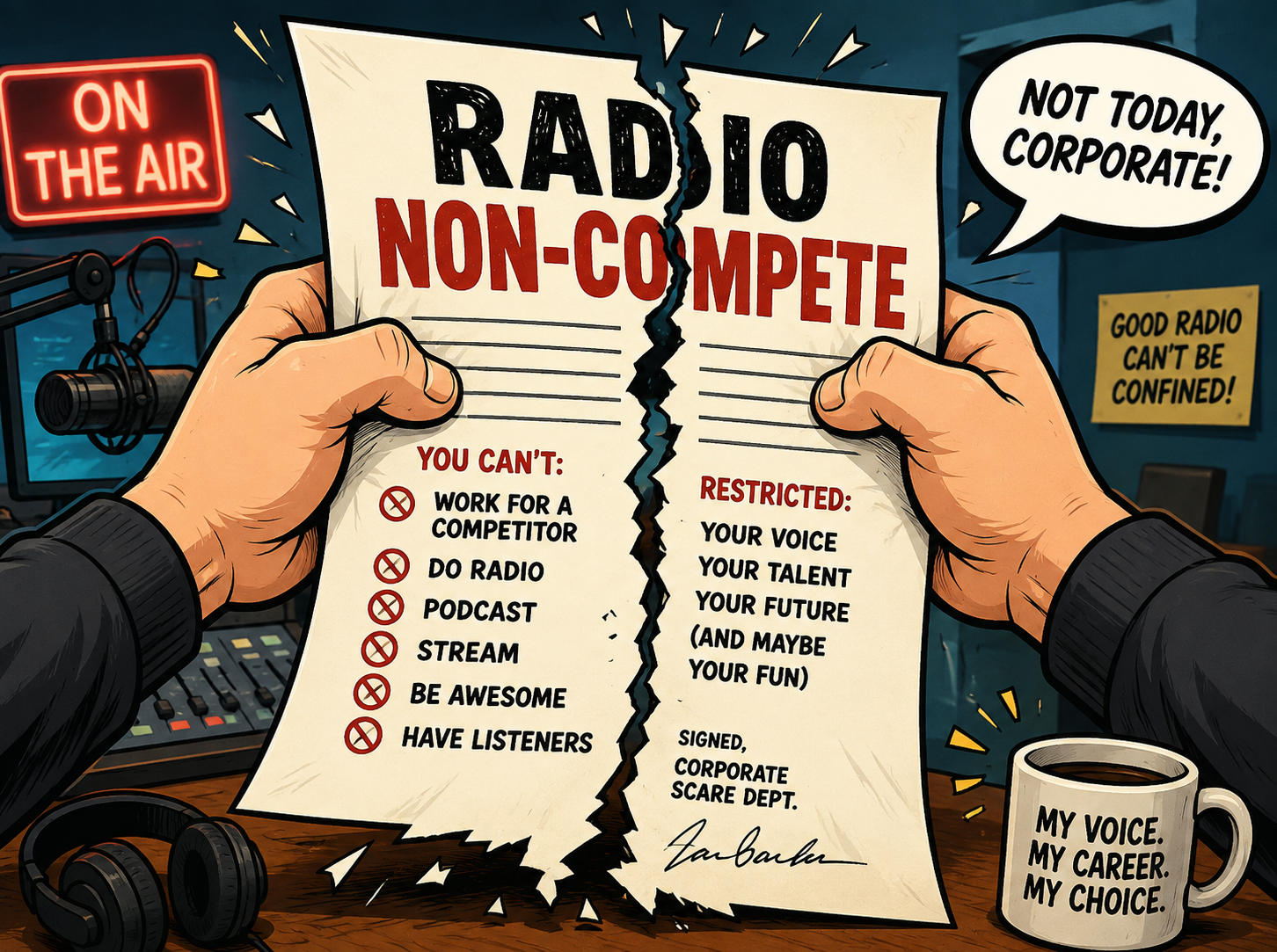
There is something about radio non-competes that becomes harder to defend the longer you think about it.
A broadcaster gives a company five years. Maybe ten. Maybe twenty. They wake up at 3:30 every morning, move their family across the country, build relationships with listeners, represent advertisers, work station events, answer texts from the Program Director at midnight, cover emergencies, survive ownership changes and somehow keep smiling through every new corporate initiative.
Then one morning they get called into the office.
HR is waiting.
Management closes the door.
The speech begins.
Your position is being eliminated.
The paycheck stops. The benefits eventually disappear. The keycard doesn’t work anymore. The company email gets shut down. Sometimes the personality’s photograph disappears from the station website before they’ve even made it home.
But apparently the relationship isn’t completely over.
Because sometimes the company that just decided it no longer wants to employ you still wants a say in who gets to employ you next.
And THAT is where radio needs to have a serious conversation.
Non Competes Are More Complicated Than People Think
First, let’s get something straight.
Not every non-compete is automatically enforceable.
Not every non-compete is automatically worthless either.
The FTC attempted to create a sweeping nationwide prohibition on most employment non-competes, but that rule was blocked in federal court and is not in effect. That leaves state laws, individual contracts and the specific circumstances surrounding each case enormously important.
So when somebody in the break room confidently announces:
“Those things aren’t enforceable anymore.”
Don’t build your family’s financial future around that sentence.
Maybe yours isn’t.
Maybe it is.
Maybe portions of it are.
Maybe the circumstances surrounding your termination affect what happens.
Maybe your state has substantial restrictions on non-competes.
Maybe your contract contains other provisions entirely.
You know who should answer those questions?
A qualified employment attorney familiar with the law where you work.
Because the words matter.
The Worst Time To Understand Your Contract Is After The Lawyer Letter Arrives
Radio has already seen some very public battles involving restrictive agreements.
One prominent example involved former Dallas sports personalities Dan McDowell and Jake Kemp following their departure from Cumulus’ KTCK. When the pair launched their independent Dumb Zone podcast, their former employer challenged the venture under contractual restrictions, and the dispute eventually escalated well beyond an uncomfortable telephone call before ultimately being resolved.
That case should have made every radio personality in America look at their employment agreement differently.
Because in 2026, what exactly constitutes a competitor?
Another FM station?
Sure.
But what about a podcast?
YouTube?
A livestream?
Subscription content?
An independent digital morning show?
Social media?
A personality doesn’t necessarily need another transmitter to compete for the same audience anymore.
THE INTERNET CHANGED THE ENTIRE GAME.
So when your contract defines words like competitor, competitive activity, media, content or market, don’t skim them.
Read them.
Then read them again.
Because Here Is Where This Gets Absolutely Ridiculous
There are legitimate things companies have every right to protect.
Trade secrets.
Confidential information.
Proprietary business information.
Certain customer relationships.
Nobody is suggesting a Program Director should walk out Friday carrying confidential company research and hand it to the competitor Monday morning.
Nobody is suggesting contracts should mean nothing.
And if an employee voluntarily leaves while under contract and immediately does something they specifically agreed not to do, that’s a different conversation.
But layoffs are different.
Position eliminations are different.
The COMPANY decided the relationship was over.
That’s where this becomes difficult to swallow.
The company says:
We don’t need you anymore.
Okay.
We’re not paying you anymore.
Okay.
Your benefits are ending.
Okay.
Turn in your keycard.
Okay.
Pack your office.
Okay.
And we’d really prefer that you not immediately earn another paycheck doing the thing you’ve spent your entire adult life learning how to do.
WAIT.
WHAT?
You cannot throw somebody off the boat and then get angry because they’re swimming toward another ship.
If The Talent Is Dangerous To Your Competitor Maybe The Talent Had Value
Here’s the contradiction.
If the morning personality wasn’t valuable enough to keep…
why are you worried about the station across town hiring them?
If the Program Director was expendable…
why does it matter if the competitor wants that programmer?
If the salesperson wasn’t necessary…
why are you terrified they’ll sell against you?
And if listeners supposedly aren’t going to care that the personality disappeared…
why spend money worrying about where that personality appears next?
At some point, pick a lane.
Because telling someone they’re no longer valuable enough to receive your paycheck while simultaneously treating their talent as too valuable to be allowed near your competitor is one fascinating piece of corporate logic.
And Please Stop Thinking The Listeners Will Forget Them
COME ON.
Radio spent decades teaching personalities to build relationships.
Be authentic.
Share your life.
Talk about your family.
Meet listeners.
Attend community events.
Answer messages.
Post videos.
Build social audiences.
Start podcasts.
Become a brand.
CONNECT WITH PEOPLE.
Then somebody eliminates the show and apparently hopes six months later the audience develops collective amnesia.
That’s not how relationships work.
If somebody woke me up every morning for twelve years, I don’t suddenly forget who they are because their photograph disappeared from a website.
Listeners remember the person who made them laugh driving to work.
They remember the personality who talked about losing a parent while they were experiencing the same thing.
They remember the marriages.
The babies.
The divorces.
The illnesses.
The championships.
The terrible seasons.
The snowstorms.
The fundraisers.
The inside jokes.
That’s the entire reason personality radio works.
If the broadcaster did the job correctly, listeners weren’t simply consuming content.
They developed a relationship.
And relationships don’t expire because somebody in corporate changed the programming grid.
And If The Audience Really Will Forget Them Then Why Bother
Here’s where the logic completely collapses.
If listeners genuinely won’t care about the personality six months from now…
why restrict them?
Let them go across town.
Apparently they’re harmless.
But if you’re convinced thousands of listeners might follow them to another station…
Congratulations.
You just demonstrated exactly how valuable the relationship between that personality and the audience actually was.
Maybe THAT conversation should have happened before the layoff.
Broadcasters Have Responsibility Here Too
Now let’s turn the microphone around.
Because companies aren’t the only ones responsible for this mess.
Radio people…
READ THE DARN CONTRACT.
Every page.
Not just the salary.
Not just vacation.
Not just the bonus.
Not just the start date.
Not just the paragraph describing the fantastic opportunity you’re accepting.
Read the section explaining how that fantastic opportunity ends.
What happens if you resign?
What happens if they terminate you?
What happens if your position is eliminated?
Does a restriction survive a layoff?
How long does it last?
What geographic area does it cover?
What qualifies as competition?
Does it cover podcasts?
Streaming?
Social media?
Television?
Independent content?
Working behind the scenes for another broadcaster?
What happens if the station is sold?
Which state’s law governs the agreement?
What remedies does the company claim if it believes you’ve violated it?
THAT BORING STUFF BECOMES EXTREMELY INTERESTING WHEN YOU’RE UNEMPLOYED.
Be Especially Careful About What You Sign On The Way Out
This may be even more important.
Imagine the situation.
You walked into work expecting a normal Tuesday.
Thirty minutes later you’re unemployed.
You have a mortgage.
Car payments.
Children.
Maybe prescriptions.
Maybe health insurance your family desperately needs.
You’re trying to process what just happened.
Then somebody slides a severance agreement across the table.
There’s money attached.
There may also be conditions attached.
DO NOT PANIC SIGN.
Understand exactly what you’re receiving and exactly what you’re agreeing to give up in return.
If somebody wants you unavailable to competitors for a period of time, that’s significant.
Your ability to work has value.
Your ability to earn has value.
Your professional freedom has value.
Understand exactly what you’re exchanging before you exchange it.
And If Somebody Says We Never Enforce That
Oh, fantastic.
Then let’s change it.
Funny how quickly the room can become quiet.
If somebody tells you:
“Don’t worry about that. It’s just standard language.”
Great.
Then discussing or modifying it shouldn’t be a problem.
If you’re told:
“We’ve never enforced that.”
Wonderful.
Then ask why it needs to remain exactly as written.
Don’t rely on reassuring conversations that aren’t reflected in the agreement you’re actually signing.
Because your contract isn’t primarily written for the day everybody is celebrating your arrival.
It’s written for the day the relationship falls apart.
A Cease And Desist Letter Does Not Automatically Mean Somebody Won
Another important distinction:
A cease-and-desist letter is a legal demand.
It is not automatically a court judgment.
The company may believe the agreement has been violated.
The former employee may disagree.
Attorneys may negotiate.
The restriction may be challenged.
The parties may settle.
Or litigation may follow.
What happens depends on the contract, applicable law and specific circumstances.
So don’t ignore a legal letter.
But don’t automatically assume the argument is over because somebody printed it on expensive stationery either.
GET REAL LEGAL ADVICE.
An On The Dial Perspective
Here’s where I land.
Protect legitimate confidential information.
Absolutely.
Protect actual trade secrets.
Absolutely.
Protect legitimate business interests when the law allows it.
Absolutely.
And if somebody genuinely violates a lawful contractual obligation, address the specific circumstances.
But if YOU eliminate somebody’s position…
LET THEM WORK.
If YOU decide you don’t need them…
LET THEM WORK.
If YOU stop paying them…
LET THEM WORK.
If YOU remove their benefits…
LET THEM WORK.
If another broadcaster believes they’re worth hiring…
LET THEM WORK.
If another station believes listeners want to hear them…
LET THEM WORK.
Radio has enough trouble attracting and retaining talented people without creating another reason for broadcasters to wonder whether taking a job today might prevent them from earning a living after the company eliminates that job tomorrow.
This Business Is Already Brutal Enough
Radio people move across America for these jobs.
They sell houses.
They leave friends.
They move spouses.
They pull kids out of schools.
They arrive in cities where they don’t know another human being because somebody heard an aircheck and believed in them.
And then things change.
Ratings change.
Management changes.
Ownership changes.
Budgets change.
Formats change.
Corporate strategies change.
Suddenly the broadcaster who moved 1,500 miles for the opportunity is unemployed through no decision of their own.
And now we’re potentially going to tell that person:
You can’t immediately work over there either.
Come on.
If there’s a legitimate enforceable contractual reason, let qualified lawyers sort through it.
But as an industry philosophy?
WE SHOULD WANT TALENT TO STAY IN RADIO.
We should want the morning personality to find another morning show.
We should want the programmer to program again.
We should want the producer to produce again.
We should want the salesperson to sell again.
Every talented person who gets pushed completely out of broadcasting takes experience, creativity and institutional knowledge with them.
Radio cannot complain about a talent shortage while simultaneously making it harder for talented people to remain employed in radio.
Read Every Single Word Before You Sign
That’s the biggest takeaway.
The next time somebody slides an employment agreement across the desk, slow down.
Read it.
Understand it.
Ask questions.
Negotiate where appropriate.
Get qualified legal advice when the stakes warrant it.
Understand what happens if you leave.
And most importantly…
UNDERSTAND WHAT HAPPENS IF THEY MAKE YOU LEAVE.
Because your voice has value.
Your creativity has value.
Your experience has value.
Your audience relationship has value.
Your career has value.
And your ability to earn your next paycheck has enormous value.
Radio companies absolutely deserve to protect legitimate business interests within the boundaries of applicable law.
But if a company decides somebody isn’t part of its future…
maybe it shouldn’t be so determined to control theirs.
You fired them.
You stopped paying them.
You decided you could operate without them.
Then absent a legitimate and enforceable reason otherwise…
GET OUT OF THE WAY AND LET THEM MAKE GREAT RADIO SOMEWHERE ELSE.
#OnTheDial #RadioNonCompetes #NonCompete #RadioContracts #RadioTalent #RadioCareers #RadioLayoffs #RadioJobs #EmploymentContracts #BroadcastLaw #RadioLaw #RadioPeople #OnAirTalent #ProgramDirectors #MorningRadio #LocalRadio #BroadcastRadio #RadioIndustry #RadioBusiness #KnowYourContract #ReadBeforeYouSign #LetThemWork #KeepTalentInRadio #RadioStillMatters
This article is industry commentary and general information, not legal advice. Non-compete laws and the enforceability of individual agreements vary by jurisdiction, contractual language and circumstances. Anyone facing an actual contractual dispute or cease-and-desist demand should consult a qualified employment attorney.