


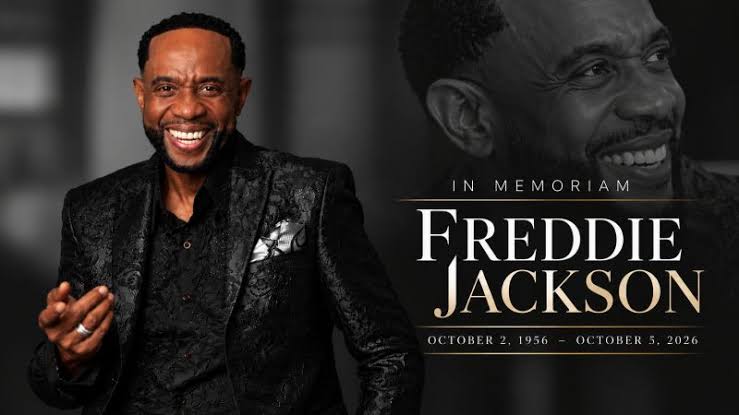
In 1985, a young man from Harlem walked into the lives of millions of Black radio listeners and gave them something they didn’t know they were missing. His voice was warm, unmistakably soulful, and capable of turning an ordinary love song into something that felt deeply personal. When Freddie Jackson released Rock Me Tonight (For Old Times Sake), he didn’t simply introduce himself to the music business. He began a relationship with Black America that would last more than four decades.
That relationship ended in heartbreak Monday, October 5, when Jackson passed away just days after celebrating his birthday. His family announced his death Tuesday, remembering a man whose affection for his audience was every bit as genuine as the music he shared with them. Funeral arrangements have not yet been announced, and the family has not disclosed a cause of death.
For those of us who have spent our lives loving Black radio, this one hurts.
Freddie Jackson was part of the soundtrack of our lives. He was there when people fell in love, when relationships ended, when couples found their way back to one another, and when somebody sitting alone needed a song that understood what they were feeling. His music became part of weddings, anniversaries, family gatherings, Saturday-night parties, and those wonderful late-night radio hours when the right record could make everything else in the world disappear.
And Black radio understood Freddie Jackson from the very beginning.
His story started in Harlem, where the young Jackson sang gospel at White Rock Baptist Church. It was there that he developed his voice and met Paul Laurence, the songwriter and producer who would become essential to his recording career. Jackson later worked the New York club circuit, performed with Mystic Merlin, and sang behind Melba Moore before Capitol Records gave him the opportunity to record under his own name.
What I love about that history is how much of it belongs to Harlem.
This wasn’t an artist who emerged from nowhere with a carefully manufactured image. Freddie came out of a neighborhood that had already given America some of its greatest music. He grew up watching performers like Aretha Franklin, Gladys Knight and James Brown at the Apollo Theater, learning from entertainers who understood how to reach an audience without sacrificing the soul of a song.
Even after achieving international success, Jackson maintained a connection with his home church. In a touching report from PIX11 following his death, longtime White Rock members remembered the occasions when the famous singer would return and graciously perform during services. To them, he remained someone who belonged to the congregation and the neighborhood.
I think that says a great deal about the man.
When Rock Me Tonight arrived in 1985, Black radio was enjoying an extraordinary period of musical creativity. Luther Vandross was changing contemporary soul music, Anita Baker was emerging, Whitney Houston was introducing herself to the world, and artists like Alexander O’Neal, The S.O.S. Band, Loose Ends and Atlantic Starr were helping define a new generation of R&B.
Freddie walked into that environment and somehow made room for himself.
The title track from his debut album spent six weeks atop Billboard’s R&B singles chart. You Are My Lady followed it to number one, and suddenly programmers had an artist whose records were not simply working in rotation. They were becoming part of the station’s identity.
His debut album went platinum. So did Just Like the First Time, the follow-up that delivered Tasty Love, Have You Ever Loved Somebody and Jam Tonight. By the time his extraordinary run had played out, Jackson had accumulated ten number-one R&B singles and established himself among the defining male vocalists of his generation.
Those numbers are impressive, but they don’t tell the whole story.
The real story happened between the records.
It happened when a personality on WBLS in New York introduced Freddie to a listener who had never heard him before. It happened when Washington listeners turned to WHUR or WKYS looking for music that understood their evening. It happened in Philadelphia, Chicago, Detroit, Cleveland, Atlanta and countless other markets where Black radio stations served as cultural institutions, connecting audiences with artists who reflected their lives.
The Quiet Storm deserves special recognition in this story.
That programming tradition began at Howard University’s WHUR in Washington in 1976, with Melvin Lindsey creating a musical presentation that became enormously influential throughout Black broadcasting. By the time Freddie Jackson arrived on the scene, stations across the country had embraced the idea that romantic music deserved its own place on the radio, presented by personalities who knew how to create an atmosphere rather than simply play a collection of slow songs.
Freddie’s music seemed made for that environment.
Consider You Are My Lady. There was tenderness in his delivery, but there was also conviction. Freddie sounded like a man who meant what he was singing. The arrangement gave him room to breathe, and he understood exactly how to use that space. You could hear the gospel influence in his phrasing, particularly when he allowed a note to rise and then gently brought it back down.
That was a skill.
And there was nothing accidental about it.
He could also change the atmosphere entirely. Jam Tonight gave programmers a record that could energize a room, while Tasty Love and Nice ‘N’ Slow brought the sensual side of contemporary R&B into focus. Freddie understood that being a great soul singer meant having the ability to move an audience emotionally, whether the tempo was fast or slow.
But perhaps his greatest contribution was the confidence he placed in the Black audience.
In a revealing 1988 interview with the Los Angeles Times, Freddie discussed the enormous commercial pressure Black artists faced when attempting to cross over to mainstream Pop radio. He wanted that success, certainly, but he was deeply concerned about changing his sound so dramatically that the people who had supported him from the beginning would no longer recognize the music.
He spoke about the differences between Black radio and mainstream Pop programming, the adjustments producers sometimes requested, and his determination to preserve the musical identity that had made him successful. His position was clear: reaching a larger audience would be wonderful, but losing the audience that made him a star would be too great a price.
I wish more people in today’s music business understood that philosophy.
Black radio was not a consolation prize for Freddie Jackson.
It was home.
And there is something especially important about that distinction.
For generations, Black radio has introduced, supported and sustained artists whose work deserved far greater recognition than the mainstream industry sometimes provided. Programmers, music directors and personalities developed relationships with recording artists that went well beyond chart positions. They understood their listeners, recognized the music those listeners connected with, and helped build careers that lasted.
Freddie Jackson was one of the great examples of what happened when that relationship worked.
His music sold millions. His records crossed over to Pop audiences. He received Grammy nominations and performed before audiences around the world. Yet the foundation of his success remained firmly planted in the community that first embraced him.
And he never seemed embarrassed by that.
There was also another side to Freddie’s story that deserves to be remembered today.
In 2024, he publicly revealed that he was living with kidney disease. Rather than keep that battle entirely private, he became involved with the National Kidney Foundation and used his experience to encourage awareness and greater understanding of the disease. He wanted his personal challenges to become an opportunity to help somebody else.
His family has not identified kidney disease as the cause of his death, and it would be irresponsible to make that connection without confirmation. What we do know is that Freddie chose to speak openly about a serious health challenge at a point in his life when he could easily have remained silent.
That deserves respect.
So does the affection his fellow artists continue to express for him.
Melba Moore, who played such an important role in his early career, remembered their friendship following his passing. She recalled the humor he brought into recording sessions and the special relationship they developed while working together, including their successful duet A Little Bit More. Her words remind us that beyond the records and the awards was a man whose colleagues genuinely enjoyed being around him.
And perhaps that is where we should spend some time reflecting.
Black radio has lost an extraordinary number of important voices over the years. We have said goodbye to singers, musicians, producers, programmers and personalities whose contributions helped create the industry we know today.
Each departure reminds us that the music we grew up with came from real people. People with families, friendships, illnesses, disappointments and personal struggles that often remained invisible while their records were climbing the charts.
Freddie gave us decades of beautiful music.
But there was a human being behind every one of those songs.
Today, New York’s WBLS, a station whose own history is inseparable from the development of contemporary Black radio, is among the outlets recognizing his passing. That feels especially appropriate for a Harlem native whose records became part of the musical heritage WBLS has spent generations preserving.
I hope programmers throughout the country take a moment to do more than add a few Freddie Jackson records to their music logs.
Tell his story.
Remember what those records meant.
Give listeners an opportunity to share their memories.
Play the music that introduced us to Freddie, but also revisit the album cuts and later recordings that remind us how much more he contributed than the handful of familiar hits.
And if you’re a young broadcaster who wasn’t around when those records were new, spend some time studying this period of Black radio history.
You will discover an industry in which local personalities helped shape national musical tastes, where programmers trusted their ears, and where a great song could build a relationship between an artist and an audience that lasted an entire lifetime.
You will also discover Freddie Jackson.
A kid from Harlem who learned to sing in church.
A young performer who worked his way through New York clubs.
A background vocalist who eventually found his own spotlight.
A platinum-selling artist who helped define contemporary R&B.
And a man who understood that being loved by your own community was something worth protecting.
There are songs Freddie recorded more than forty years ago that can still stop a conversation today. Put on Rock Me Tonight and watch what happens when somebody recognizes those opening moments. Watch how quickly people begin remembering where they were, who they were with, and what life felt like when they first heard it.
That’s the kind of connection every broadcaster hopes to create.
Freddie achieved it repeatedly.
On behalf of Steven Mills and our entire On The Dial family, I extend our deepest condolences to Freddie Jackson’s family, friends, fellow artists and the millions of listeners who welcomed his music into their lives.
And to every Black radio professional who ever put a Freddie Jackson record on the air, whether you were working mornings in New York, afternoons in Chicago, evenings in Philadelphia or a Quiet Storm shift somewhere in the middle of America, you helped make this man’s remarkable career possible.
You also helped preserve music that will continue touching lives long after all of us have played our final record.
Freddie Jackson’s voice will always belong to the history of Black radio.
And the beautiful thing about that history is that it never really stops playing.
Rest peacefully, Freddie. Thank you for the music, the memories and the love.
Joseph “JoJo” Collins
On The Dial
#OnTheDial #FreddieJackson #BlackRadio #RememberingFreddieJackson #RIPFreddieJackson #BlackMusic #RNB #SoulMusic #QuietStorm #UrbanRadio #UrbanAC #WBLS #WHUR #WDAS #Harlem #NewYorkRadio #MelbaMoore #PaulLaurence #RockMeTonight #YouAreMyLady #RadioHistory #BlackMusicHistory #RadioIndustry #Broadcasting