


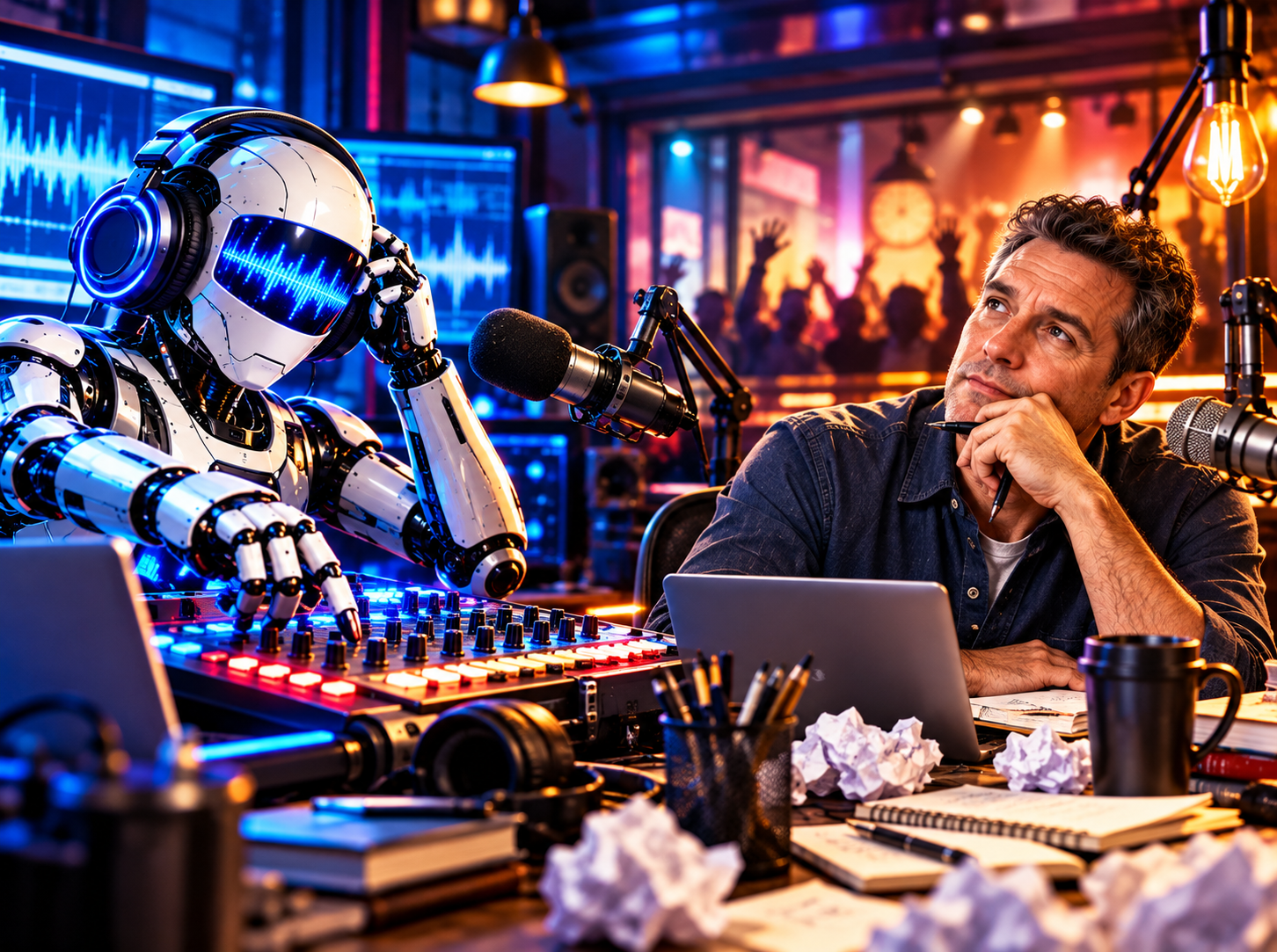
Somewhere in America, a radio station is preparing to put another artificial intelligence personality on the air, and somebody in the corporate office is probably delighted that the new employee won’t require health insurance, vacation time, or a parking space. The software can read liners, deliver weather forecasts, produce promotional material, and keep the music rolling while the people who once occupied those studios wonder what happened to the business they helped build. Meanwhile, in research laboratories and medical facilities around the world, scientists are developing technologies that could someday replace damaged human organs, grow living tissue, and restore biological functions that disease has taken away. Both industries are pushing the boundaries of what machines can accomplish, but there is a rather extraordinary difference in their objectives. Radio is increasingly exploring how to operate without the human being. Medical science is trying to figure out how to keep that human being alive.
And somewhere between those two technological revolutions is a conversation the broadcasting industry ought to be having.
For decades, broadcasters have celebrated every advancement that allowed us to accomplish more with less. We went from turntables and cart machines to hard drives, from satellite receivers to cloud distribution, from live overnight personalities to automation systems capable of operating multiple stations with limited on-site staffing. We can voice-track a shift in Kansas from a studio in California, assemble a commercial in seconds, and distribute programming to hundreds of affiliates without shipping a single reel of tape.
That progress has brought genuine benefits. It has also transformed the economics, employment structure, and culture of radio, sometimes in ways that deserve considerably more scrutiny than they receive.
But here’s the question that ought to stop the next technology conference cold.
If we can devote so much imagination to recreating the human voice, why aren’t we making an equally loud public commitment to preserving the human life behind it?
Congratulations Your New Afternoon Personality Has Never Had a Pulse
Radio’s fascination with artificial intelligence isn’t difficult to understand. The technology can assist with production, transcription, translation, research, scheduling, and content creation. Synthetic speech systems can produce remarkably natural-sounding audio, although quality, reliability, and suitability vary considerably.
Broadcasters are exploring those capabilities because efficiency matters in an industry where operating costs, advertising pressure, and changing audience habits have forced difficult decisions.
The problem isn’t that radio is experimenting with artificial intelligence. Innovation is essential, and the industry’s history is filled with examples of new technology creating opportunities that previously didn’t exist.
The problem would be allowing our imagination to stop at figuring out how many jobs a machine can perform.
Consider what is happening outside the radio business.
The U.S. Food and Drug Administration has approved mechanical devices that help certain patients with serious heart conditions. Ventricular assist devices, for example, can support blood circulation when a weakened heart cannot pump effectively. Artificial heart valves have been used in medicine for decades.
These aren’t speculative inventions waiting for a Hollywood screenwriter to dream them up. They are examples of engineering already being used in patient care, with specific medical indications, risks, and limitations.
At the same time, scientists are investigating regenerative medicine, tissue engineering, three-dimensional bioprinting, and methods of developing biological replacements for damaged human tissue.
A bioprinter can place living cells and supporting materials into carefully designed structures. Researchers use such approaches to study tissues, investigate disease, and explore potential future treatments.
But printing a complete, functioning human organ suitable for routine transplantation is another matter entirely. Scientists still face major challenges involving blood vessels, cell survival, organ function, immune responses, manufacturing, and long-term safety.
In other words, researchers aren’t simply waiting for somebody to install a bigger ink cartridge.
They are attempting to solve some of the most complicated problems in human biology.
And they deserve a much bigger audience.
We Have a Format for Everything Except the Future
Broadcasters can tell you which songs are testing, how a station performed among adults 25–54, what the competition is doing across town, and whether the morning show is producing enough social media engagement. Entire departments exist to analyze audience behavior, optimize content, and identify opportunities for growth.
We have consultants who can spend three hours explaining why the word variety should appear twice in a positioning statement.
We have programmers who can identify the precise moment a listener is most likely to change stations.
We have technology capable of delivering targeted advertising based on audience characteristics, geography, and digital behavior.
And all of that expertise exists inside an industry whose greatest historical strength has been connecting people.
Now imagine what would happen if broadcasters applied that same discipline to a national public-awareness initiative focused on lifesaving medical innovation.
Not a collection of occasional public service announcements tossed into unsold inventory. Not a hastily produced campaign that disappears after the quarterly meeting.
A serious, sustained effort.
Imagine major broadcast companies, independent station owners, national syndicators, podcasters, digital publishers, and streaming platforms coordinating a campaign that introduces the public to credible research involving artificial organs, regenerative medicine, transplantation, and advanced medical devices.
Imagine engineers who usually explain audio processing interviewing researchers who develop medical filtration systems.
Imagine morning shows bringing scientists into conversations that make complex research understandable without turning it into a miracle-cure sales pitch.
Imagine a national broadcast initiative connecting people interested in supporting legitimate medical research with universities, hospitals, and established organizations doing the work.
It wouldn’t require every station to abandon its format.
The country station could still play country music. The classic hits station could still play songs from 1984. The news-talk station could still argue about whatever everybody was arguing about yesterday.
Radio would simply be doing something else at the same time.
It would be using its extraordinary reach to help people understand technologies that may eventually change the course of human illness.
The Scientists Are Building Things We Used to Call Impossible
There is no shortage of legitimate research worth discussing.
Scientists are studying how living cells can be organized into functional tissues. Researchers are developing improved mechanical circulatory support devices and exploring biological materials that may help damaged tissues heal. Investigators are also studying genetically modified animal organs as possible alternatives to conventional human organ transplantation.
These fields are at very different stages of development.
Some medical devices are established treatments. Some engineered tissues have limited clinical applications. Other approaches, including whole-organ bioprinting and transplantation of genetically modified animal organs, face substantial scientific, clinical, and regulatory hurdles.
Experimental procedures should never be confused with treatments available to the general public.
But the larger trajectory is remarkable.
Medicine is no longer limited to treating damaged biological systems exclusively with drugs or replacing them with organs donated by other human beings. Engineers and researchers are investigating additional ways to support, repair, or potentially replace certain functions.
Artificial intelligence is contributing to some of that research.
The National Institutes of Health has described how AI-assisted methods are helping scientists predict protein structures and design proteins with potentially useful biological properties. Researchers are also exploring AI applications in drug discovery and other biomedical fields.
These systems can help scientists generate and evaluate possibilities, but computer predictions still require experimental testing. A convincing simulation is not the same as a treatment demonstrated to be safe and effective in patients.
That distinction matters enormously.
The future of medicine isn’t going to arrive because somebody types create artificial liver into a chatbot and waits for the progress bar to reach 100 percent.
It will arrive through painstaking scientific work, carefully designed studies, medical oversight, investment, and collaboration.
Technology can help researchers ask better questions and explore more possibilities.
It cannot repeal the laws of biology.
Silicon Valley Has the Servers Radio Has the Signal
The technology industry has demonstrated that enormous resources can be mobilized around an ambitious objective.
Artificial intelligence companies invest heavily in specialized computing infrastructure, software development, and research. Technology firms compete to attract engineers, develop new capabilities, and turn complex scientific ideas into products that millions of people can use.
Some of those investments have already produced tools with legitimate scientific applications.
But imagine a broader partnership among technology companies, biotechnology researchers, medical institutions, and broadcasters.
Imagine major technology leaders helping research institutions improve access to computing resources, scientific expertise, and responsible funding.
Imagine AI developers working with medical researchers on problems involving protein modeling, biological materials, and drug discovery, while recognizing that clinical validation remains essential.
Imagine radio and television networks using their platforms to explain what those collaborations have actually accomplished, what remains uncertain, and how the public can support credible work.
And imagine those same networks giving appropriate attention to existing ways of helping patients today.
Because while the promise of future technology is exciting, people are dealing with life-threatening illnesses right now.
A scientific breakthrough that may arrive ten years from now cannot be treated as a solution for somebody who needs medical care this afternoon.
That is precisely why the conversation needs two parts.
We should support the research that may transform medicine tomorrow.
And we should use the communication resources already available to help people access established lifesaving opportunities today.
Radio is uniquely positioned to contribute to the second part.
The Original Social Network Had Call Letters
Long before Facebook, TikTok, Instagram, or X existed, radio was bringing strangers together.
Listeners called stations to request songs, donate money, report emergencies, participate in community events, and help neighbors they had never met.
Local broadcasters organized relief efforts after storms and fires. Stations raised money for children’s hospitals. Personalities helped families facing hardship. Newsrooms provided vital information during disasters, and the federal regulatory framework expressly recognizes broadcasting’s role in communicating emergency information that protects life and property.
Radio didn’t invent human compassion.
But it learned how to amplify it.
A great local personality can introduce an unfamiliar story in a way that makes thousands of listeners feel personally connected to the people involved.
A syndicated host can take that same story into dozens or hundreds of communities.
A podcast can keep the conversation available long after the original broadcast ends.
And a digital publication can provide the context, links, and follow-up information that traditional radio cannot always accommodate.
That combination remains powerful.
It is also something the technology industry should recognize.
Social media platforms can distribute content on an enormous scale, but large audience numbers alone do not guarantee that accurate information reaches the people who can act on it.
Radio’s strength is not simply the number of people it reaches.
It is the relationship between the person speaking and the person listening.
Trust matters when the subject is medicine. So does accuracy.
A responsible broadcast campaign could help listeners understand living organ donation, direct interested individuals to legitimate transplant programs, and introduce audiences to the science behind emerging medical technologies.
It could do all of that without promising miracles or turning patients into promotional props.
And it could remind an industry increasingly fascinated by synthetic voices that the authentic human connection remains its most valuable asset.
The Best Ratings Story Wouldn’t Need a Ratings Book
Consider what broadcasters routinely celebrate.
A station moves from fourth to second in a target demographic. A morning show achieves its highest audience share in three years. A network adds affiliates. A podcast reaches a download milestone. A digital video crosses a million views.
Those achievements matter commercially, and there’s nothing wrong with recognizing them.
But imagine a different kind of success story.
A broadcaster introduces listeners to a credible medical research program, and new donors help fund carefully supervised scientific work.
A national interview encourages people to learn about living organ donation, and some of those listeners begin legitimate donor evaluations.
A radio personality shares an accurate account of a patient’s medical circumstances, and the story eventually reaches someone who can help.
A technology company partners with researchers to improve a scientific tool that contributes to an independently validated medical discovery.
Those outcomes would not fit neatly into a Nielsen ranker.
They would, however, represent an extraordinary return on the trust audiences place in broadcasters.
And unlike the difference between a 4.2 and a 4.3 share, the people whose lives were changed would remember those results forever.
Stop Asking Whether AI Can Replace the Personality
The debate over artificial intelligence in broadcasting will continue, and it should. Questions involving employment, authenticity, disclosure, creativity, and the economics of radio deserve serious attention.
But the conversation needs to become larger than whether a computer can deliver a convincing afternoon shift.
We should be asking what else the technology can help accomplish.
Can advanced computing help scientists develop better medical devices?
Can machine learning assist researchers in investigating diseases and biological processes?
Can broadcasters make legitimate medical innovation more accessible to the public?
Can the industry’s distribution networks connect people with information that might improve or even save their lives?
And can radio, after spending decades learning how to do more with fewer people, demonstrate what it can accomplish when it puts people first?
Those are questions worthy of serious discussion in corporate boardrooms, broadcast conferences, university laboratories, and technology companies.
Because the future of broadcasting cannot be measured only by how efficiently we produce programming.
It should also be measured by what that programming accomplishes.
The most important breakthrough in radio’s next chapter may have nothing to do with a new format, a new ownership group, or an artificial personality.
It may be the moment when somebody hears something on the air that changes the course of another human being’s life.
We’ve already figured out how to keep a station operating when nobody is in the studio.
Now let’s see what happens when we use everything we’ve built to help keep the people outside that studio alive.
A Personal Note From the Publisher
For more than 30 years, I’ve worked in radio, building stations, programming formats, working with talented broadcasters, and believing in the power of this extraordinary medium. Today, as president and publisher of On The Dial and senior pastor of First Baptist Church in Garden City, Kansas, that belief has become intensely personal.
I’m Rev. Dr. Steven Mills, a two-time cancer survivor who underwent a bone marrow transplant and now lives with end-stage renal disease. I depend on dialysis to stay alive, and my cPRA is 99.9999 percent, making the search for a compatible living kidney donor exceptionally difficult.
I’ve publicly asked Elon Musk, Mark Zuckerberg, Joe Rogan, MrBeast, and other influential figures to help amplify my search. Broadcasters including The TJ Show, Dave Ramsey, Chris Plante, and Esther Dillard have helped bring my story to new audiences, while Joshua Liljenquist and his team have rallied thousands of people around the effort.
I am grateful for every person who has listened, shared, prayed, or contributed.
But I am still searching for a compatible donor.
My campaign website is https://findmyone.org, made possible through David Krissman and The Great Social Experiment, where David invited me to share my story.
Anyone interested in learning about living kidney donation can contact the HCA Midwest Health Living Donor Program:
I believe in the medical breakthroughs scientists are working toward, and I hope they eventually provide new options for people facing life-threatening illnesses. But for patients like me, the need is immediate.
Somewhere, someone may be willing and medically able to help.
After more than three decades in broadcasting, I know how far a message can travel when people decide it matters.
I am praying this one reaches the right person.
Don’t let it stop with you.
Rev. Dr. Steven Mills
President and Publisher, On The Dial
#DontLetItStopWithYou #FindMyOne #DoYouSeeMe #OnTheDial #RadioIndustry #Broadcasting #RadioForGood #RadioSavesLives #ArtificialIntelligence #AIForGood #MedicalInnovation #RegenerativeMedicine #Biotechnology #OrganDonation #LivingDonor #FutureOfMedicine #TechnologyForGood #OneDonorOneLifeOneMoreTomorrow