


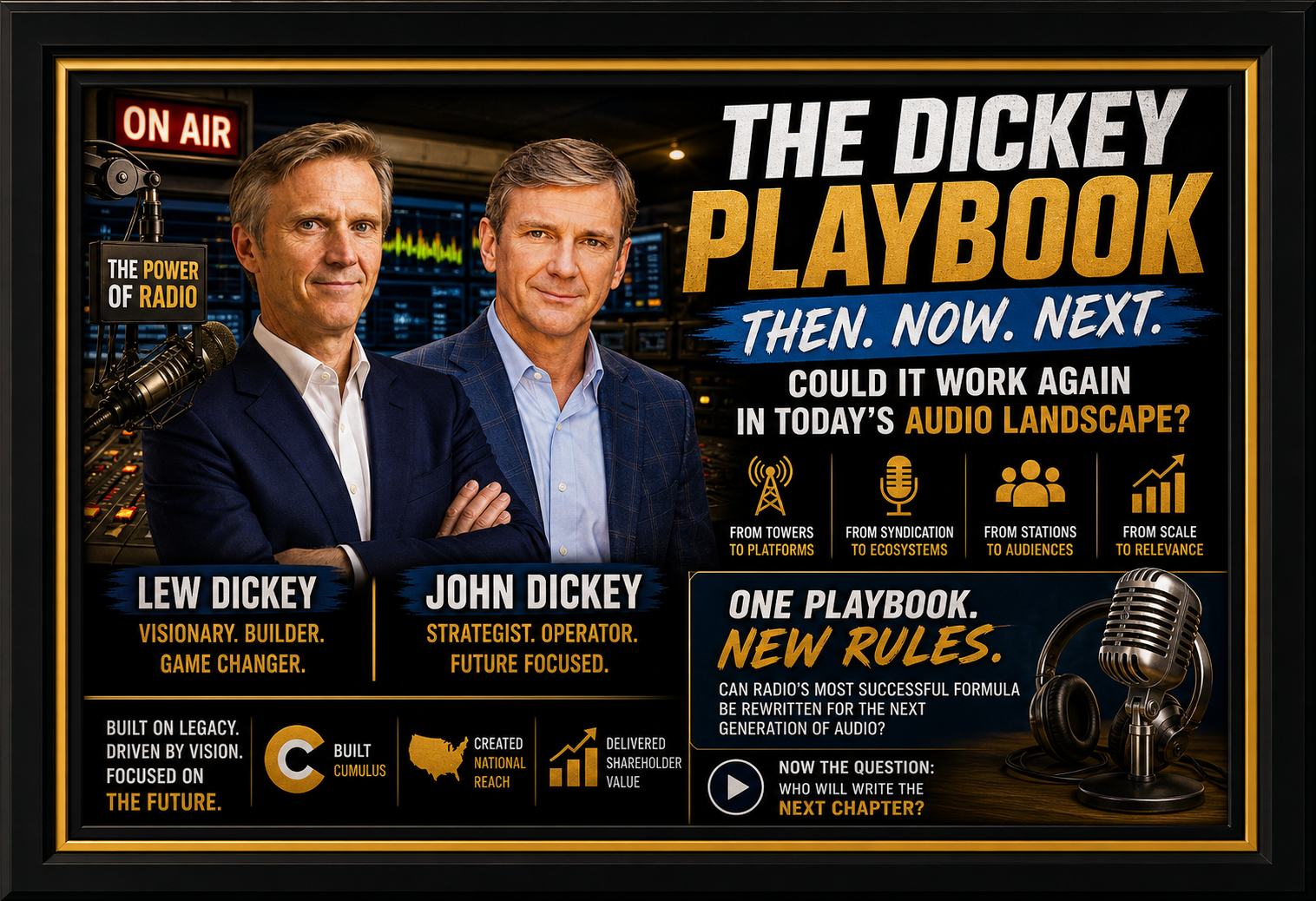
There was a time when scale was the strategy. Bigger clusters, tighter cost controls, national syndication pipelines, and a belief that if you could aggregate enough signals, you could win the game. That time had a name—and in many ways, it had architects. Among them, Lew Dickey and John Dickey.
They didn’t just operate inside the system—they expanded it. Through their leadership at Cumulus Media, the Dickey approach became a defining model of modern broadcast consolidation. Build it big. Run it lean. Feed it content at scale. Repeat.
And for a while, it worked.
Stations were grouped. Markets were maximized. National shows filled dayparts. The math made sense. The margins followed. It was a blueprint built for an era when the competition lived on the same dial and the battle was fought one signal at a time.
But that was then.
Today, the fight isn’t between stations—it’s between ecosystems. The competition isn’t just across town, it’s everywhere. Streaming platforms, podcasts, social media, on-demand audio—listeners aren’t tuning in, they’re choosing in. And that changes everything.
So here’s the question that’s starting to surface quietly in industry circles: could the Dickey playbook work again in this version of the audio business?
Let’s be honest—it would look very different.
The original model relied on ownership scale. Today’s version would require distribution scale. Back then, syndication was the lever. Now, it’s platform reach. The old equation was built on towers and transmitters. The new one is built on data, access, and engagement.
But don’t dismiss the core idea too quickly. Because underneath the mechanics, the strategy still has teeth. Efficiency matters. Reach matters. Content leverage matters. If anything, those principles are even more important now—they just live in a different environment.
The challenge is that the ground shifted.
Back then, you could standardize programming across markets and win. Today, audiences expect personalization. Back then, cost control was king. Today, talent and authenticity drive connection. Back then, the asset was the station. Now, the asset is the audience relationship.
And that’s where the playbook runs into friction.
Because while scale still matters, scale without identity doesn’t travel the way it used to. You can aggregate signals all day—but if the content doesn’t resonate, the audience has options. Endless options. And they’re one tap away.
At the same time, look around the industry and you’ll see something familiar starting to re-emerge. Larger players consolidating influence. Networks expanding beyond traditional boundaries. Content being repurposed across multiple platforms.
It’s not the same playbook—but it rhymes.
The real difference? Control.
The Dickey era was built on controlling infrastructure. Today’s winners are controlling distribution and attention. That’s a different kind of power—and it requires a different kind of strategy.
So could it work again?
Yes—but not as a copy. Only as an evolution.
A modern version of that playbook wouldn’t just buy stations—it would build platforms. It wouldn’t just syndicate shows—it would create content ecosystems. It wouldn’t just chase scale—it would chase relevance at scale.
And that’s the pivot.
Because the next empire builder in radio—or whatever we choose to call it now—won’t look like the last one. They’ll move faster. They’ll think wider. And they’ll understand that the dial is no longer the destination—it’s just one of many entry points.
The Dickey playbook changed radio once.
The question now is who’s bold enough—and smart enough—to rewrite it for what comes next.
On The Dial covers breaking radio industry news, including layoffs, programming changes, talent moves, and broadcast trends across the United States.