


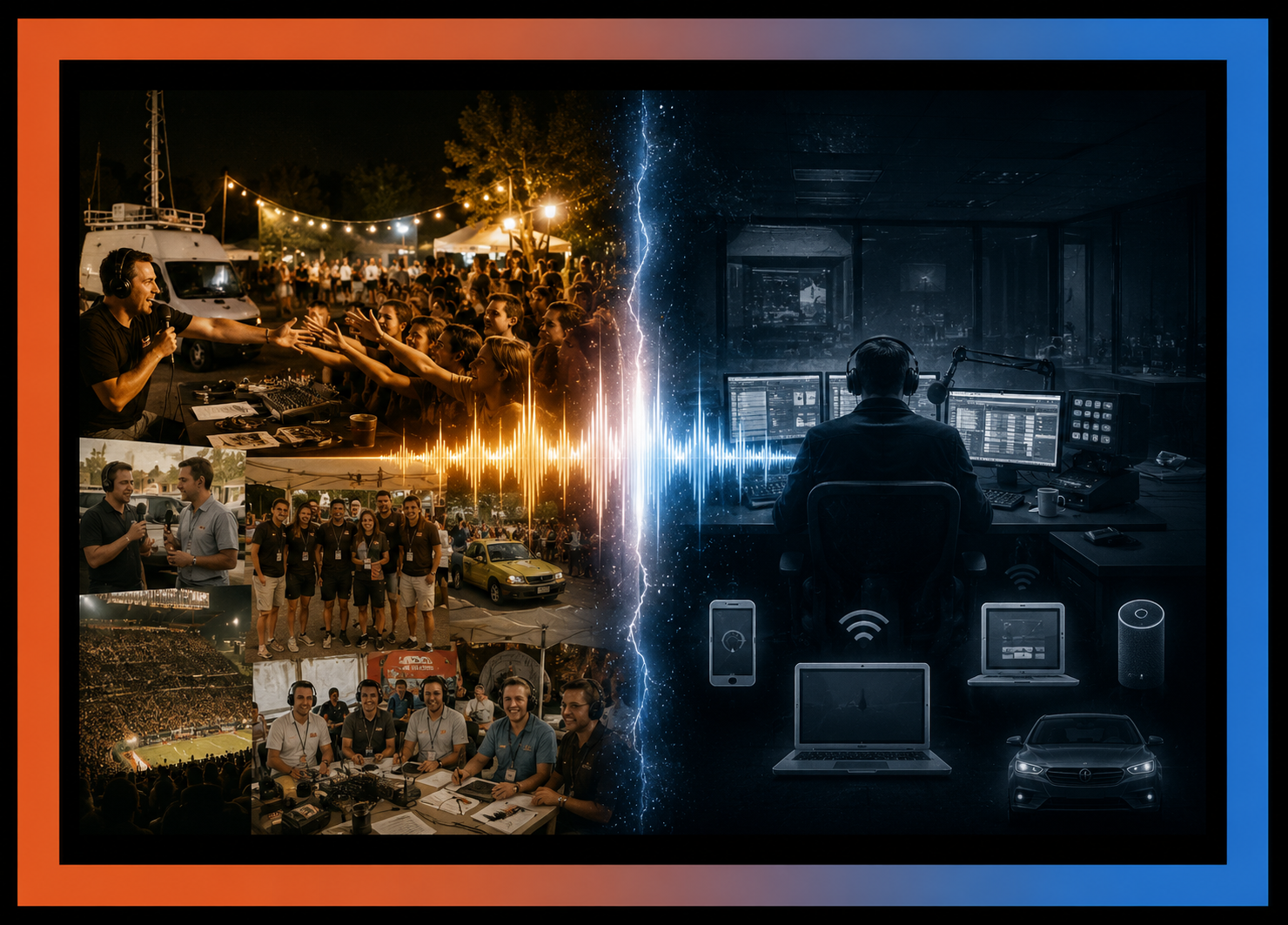
Radio did not lose its magic because listeners stopped loving it. Radio lost part of its magic when too many operators forgot what made listeners fall in love with it in the first place. Before the dashboards, the syndication clocks, the budget cuts, the empty buildings and the “send me a recap” culture, radio was alive. It had faces. It had vans. It had remotes at grocery stores, high school gyms, car lots, county fairs and community fundraisers. It had jocks who knew the mayor, the barber, the school principal and the kid who won tickets three summers in a row. Radio was not just something people heard. It was something people saw, touched, trusted and felt.
That version of radio was built on presence. The midday host was not just a voice between songs. The afternoon personality was not just reading liner cards over a tight post. The street team was not just handing out bumper stickers. They were ambassadors. They made the station look bigger than the transmitter. They turned a frequency into a relationship. They showed up when somebody needed help, when a business needed traffic, when a school needed energy, when a family needed a miracle and when a town needed somebody to say, “We are here with you.”
The painful part is that the audience is still there. Terrestrial radio has not disappeared. Pew Research reported that 82% of Americans ages 12 and older listened to terrestrial radio in a given week in 2022, based on Nielsen data published by the Radio Advertising Bureau. That number matters because it destroys the lazy argument that nobody listens anymore. People still listen. The question is whether we are giving them enough reason to care.
What changed was not one thing. It was consolidation, debt, digital competition, fractured ad dollars, corporate efficiency, shrinking staffs and the slow erosion of local habit. The industry learned how to do more with less, and then kept cutting until “more with less” became “everything with almost nobody.” The Bureau of Labor Statistics reported that radio broadcasting stations had about 52,680 employees in May 2024, with announcers and DJs making up about a quarter of that workforce. That number tells the story behind the story: smaller buildings, thinner teams and fewer people available to be both on the air and in the streets.
The money changed too. BIA Advisory Services projected U.S. local advertising revenue at $171 billion in 2025, but noted growth was being driven mainly by digital media. Radio is still fighting inside the local ad ecosystem, but the competition is no longer just the station across town. It is Google, Meta, TikTok, streaming audio, CTV, podcasts, influencers, email marketing and every platform promising trackable results before lunch.
That does not mean radio is dead. It means radio has to stop pretending yesterday’s structure can solve today’s problem.
On The Dial President/Publisher Steven Mills said the industry’s next chapter has to be built on balance, not nostalgia.
“We do not need to rebuild radio exactly the way it was,” Mills said. “We need to recover the parts of radio that made people believe in us: local trust, visible service, real personalities, creative promotions and the courage to show up. The future is not going back. The future is getting back to good with the tools, budgets and people we actually have.”
That is the key. Balance.
Stations may not be able to rebuild 1998 staffing levels, but they can rebuild a 1998 attitude. Every station does not need a 12-person street team, but every station needs a street plan. Every personality cannot be everywhere, but every personality can be somewhere consistently. Every promotion does not need a giant prize closet, but every promotion should feel like it belongs to the market and not some spreadsheet in another time zone.
Start with one weekly community touchpoint. One high school. One nonprofit. One neighborhood business. One listener-facing appearance that is not just a sales obligation. Put talent back in the room with real people. Record content while there. Turn the remote into video. Turn the video into social. Turn the social into sales proof. Turn the sales proof into the next partnership.
That is how radio stretches limited staff without pretending people are machines.
The new street team may be part-time, digital-first and sponsor-supported. The new live broadcast may include a phone, a wireless mic and a branded backdrop instead of a full marti setup. The new community calendar may live on the website and become a weekly on-air feature. The new promotion may be built around local experiences instead of impossible cash. The new personality may win not by talking longer, but by sounding like they actually live there.
Radio cannot out-algorithm the algorithm. It can out-human it.
The industry still has reach. It still has trust. It still has immediacy. It still has the car. It still has local brands that mean something. But the next win will not come from simply saying “we’re local” while the building is locked, the phones are unanswered and the talent is invisible. Local has to be seen. Local has to be heard. Local has to have fingerprints.
The answer is not to choose between heritage listeners and new listeners. The answer is to respect both. Keep the music and familiar voices that built the brand, but stop acting like younger listeners will discover the station by accident. Meet them on video. Meet them at events. Meet them through local causes. Meet them through schools, concerts, sports, food, faith, culture and shared civic pride.
Radio used to be the front porch of the community.
It can be again.
But this time, the porch needs Wi-Fi, video, sponsorship strategy, social clips, smarter scheduling and enough old-school heart to make people believe the light is still on.
On The Dial believes radio does not need a funeral. It needs a reset. The stations that win next will be the ones brave enough to sound human, show up locally and remember that the strongest signal has never only come from the tower. It has always come from trust.
On The Dial covers breaking radio industry news, including layoffs, programming changes, talent moves, and broadcast trends across the United States.