


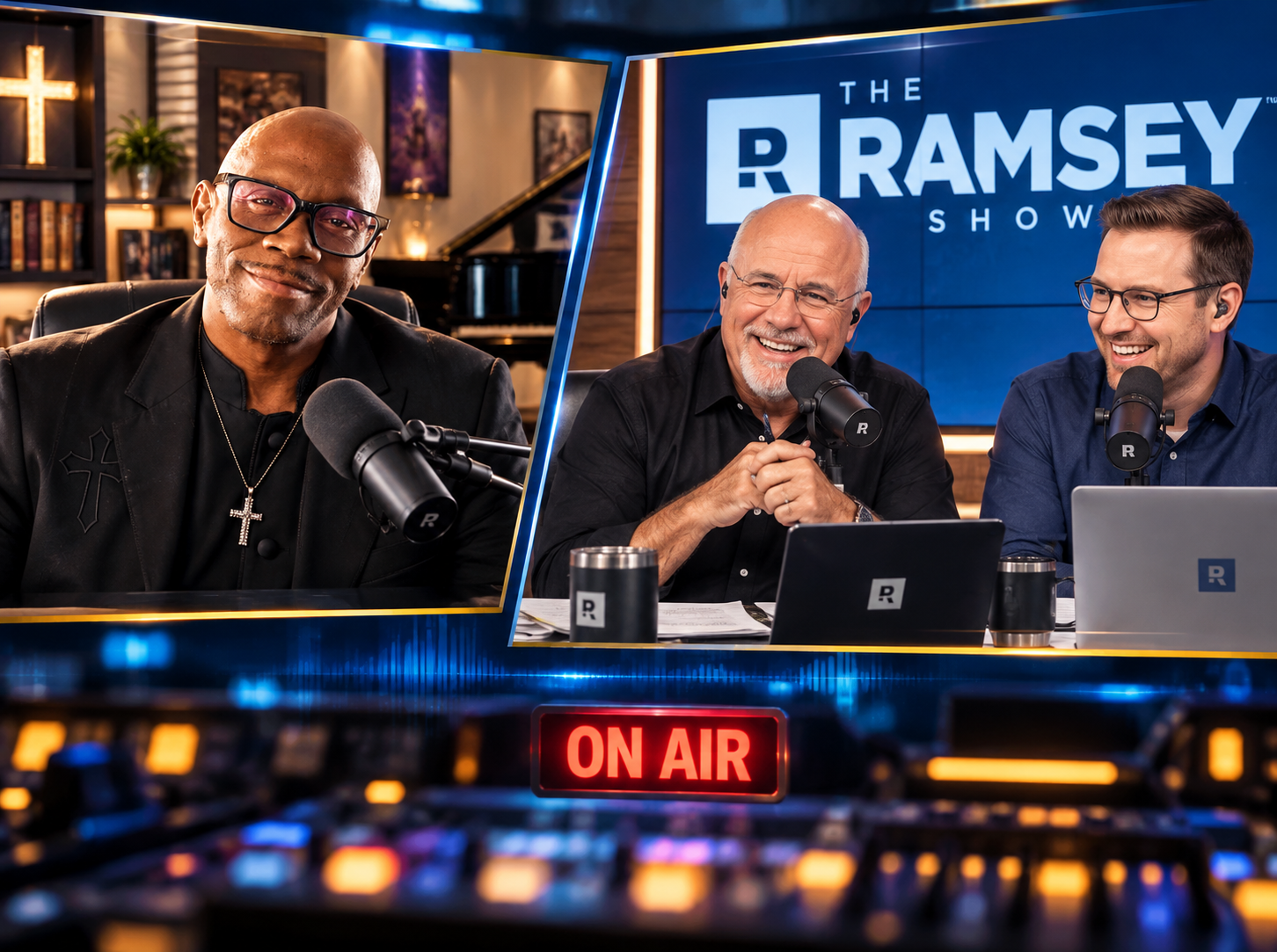
I’ve spent more than three decades in radio, and during that time I’ve learned that a microphone can do some remarkable things. It can bring strangers together, comfort someone driving home after a terrible day, raise money for a family that has lost everything, or introduce an entire community to someone they otherwise would never have known. I’ve witnessed the extraordinary generosity that can happen when the right person tells the right story at the right time. But after 30 years of working to reach audiences, I never imagined that I would become the person desperately hoping a radio conversation might help save his own life. On Monday, October 12, 2026, I found myself speaking with Dave Ramsey and George Kamel on The Ramsey Show, asking a question about faith, financial responsibility, and what happens when catastrophic illness takes nearly everything a family has worked a lifetime to build.
I was nervous. Not because I was talking to Dave Ramsey, although I’ve admired his work for years. I’ve been around enough studios and microphones to know how broadcasting works. I was nervous because I knew what this opportunity represented. Somewhere beyond that telephone connection were people I would never meet, driving down highways, sitting in offices, working in their homes, and listening to a conversation that could potentially introduce my story to the one person I’ve spent months trying to find.
A compatible living kidney donor.
And before that conversation ended, I was able to tell Dave Ramsey and his listeners about FindMyOne.org.
For some people, that might sound like a small accomplishment. For me, it was another chance at tomorrow.
The Phone Call That Meant More Than Anyone Could Know
When Dave welcomed me to the program, he introduced me as Steven from Wichita, Kansas. George Kamel was alongside him in the studio, and suddenly, after years of listening to this nationally syndicated program, I was the person on the other end of the telephone.
I began by telling Dave what I genuinely felt. It was a pleasure to speak with him. I’ve been a longtime listener, and as both a pastor and a broadcaster, I have tremendous respect for the work he has done encouraging people to take responsibility for their finances.
Then I mentioned Proverbs 22:7.
“The rich rules over the poor, and the borrower is servant to the lender.” (NKJV)
It’s a passage Dave has referenced throughout his career, and it’s a scripture I know well as a pastor. I believe in stewardship. I believe in financial responsibility. I believe in preparing for the future, living within our means, and doing everything possible to protect the people God has entrusted to our care.
But my life has brought me face-to-face with a question that doesn’t fit neatly into a financial workbook.
What happens when you don’t borrow your way into financial trouble? What happens when you simply get sick?
I explained that I had survived cancer twice. I had endured a bone marrow transplant. I had exhausted nearly $300,000 in retirement savings, and I was now fighting kidney failure just to stay alive.
Then I asked Dave the question that had been weighing on my heart.
“How do we apply biblical financial wisdom when somebody hasn’t been irresponsible, but has simply been overwhelmed by the circumstances beyond their control?”
And I followed it with something even more personal.
“How do I remain a good steward of what God has given me when the cost of surviving has taken nearly everything that we have?”
That wasn’t a question I had dreamed up to get on national radio. It was the reality my wife and I wake up to every morning.
I Didn’t Lose Everything Chasing a Lifestyle I Lost It Fighting to Live
There is a difference between financial irresponsibility and financial devastation. I wanted Dave to understand that difference because I believe millions of Americans are living somewhere between those two realities, trying to do the right thing while the cost of medical care threatens to consume everything they’ve worked for.
My journey began with Hodgkin’s lymphoma. Cancer is a frightening word under any circumstances, but the treatments that follow can be just as life-changing as the diagnosis itself. I underwent chemotherapy and a bone marrow transplant, and eventually I was able to say something every cancer patient longs to say.
I survived.
Then came colon cancer.
Once again, there were doctors, hospitals, treatments, difficult conversations, and the constant uncertainty that comes when your body becomes a battlefield. Once again, my family and I did what we had to do to get through it.
And once again, I survived.
But survival came at a tremendous cost.
The treatments that helped keep me alive also contributed to the damage that eventually destroyed my kidney function. Today, I have end-stage renal disease. I depend on peritoneal dialysis at home multiple times a day. My body no longer performs one of its most basic functions without medical intervention.
I am 48 years old.
I am a husband.
I am a father.
I am the Senior Pastor of First Baptist Church in Garden City, Kansas.
And I am trying to find a way to stay alive long enough to continue being all those things.
The financial consequences have been staggering. There were periods during my cancer journey when I did not have health insurance, something I clarified during my conversation with Dave. Those periods left us exposed to enormous medical expenses.
Even today, with Medicare coverage, the financial burden continues.
I told Dave that my medical billing can reach approximately $150,000 in a month before insurance payments and that I have faced around $2,300 in monthly medical expenses. Those figures are difficult for people to comprehend until they find themselves on the receiving end of the bills.
Imagine spending decades building a retirement, making plans for the future, and believing you’ve created some measure of security for your family.
Then imagine watching that security disappear, not because you bought expensive cars, took extravagant vacations, or lived beyond your means, but because you wanted to keep breathing.
That’s the reality I was trying to explain.
The Moment Dave Ramsey Understood What Had Happened
Dave began asking questions about my insurance coverage. He wanted to know where my health insurance had been during these years of treatment. He asked why I was on Medicare at 48, and I explained the cancer treatments, kidney damage, and complete renal failure.
I could hear him working through the circumstances, trying to understand how someone could lose such a substantial amount of money while facing ongoing medical treatment.
Then the conversation reached a moment I won’t soon forget.
Dave acknowledged how exhausted I must be after everything I’ve experienced.
He told me what a terrible series of events I had endured.
And he said he was sorry.
Not once, but repeatedly throughout the conversation.
Now, I know Dave Ramsey has built a career on direct advice. He’s known for telling people difficult truths, challenging their financial decisions, and encouraging them to take control of their lives. That approach has helped countless people.
But on Monday, I wasn’t looking for someone to tell me I should have skipped a restaurant meal or saved another hundred dollars.
I was looking for someone to understand that sometimes the math of survival simply doesn’t work.
And Dave recognized that.
When I explained that there had been a period during my cancer treatments when I was uninsured, he acknowledged how easily those medical expenses could reach several hundred thousand dollars.
He didn’t pretend the situation was simple.
He didn’t offer me some miraculous formula for restoring everything that had been lost.
He listened, he asked questions, and he tried to offer perspective.
At one point, he said, “I don’t have a good answer for you.”
Those words might sound disappointing to someone who didn’t hear the conversation. To me, they were meaningful because they were sincere.
Sometimes the most honest answer is acknowledging that another person’s circumstances are extraordinarily difficult and that there isn’t an easy way to undo what has happened.
Dave also expressed his hope that I would find a kidney and somehow be able to work through the financial consequences of this illness.
I appreciated that.
I appreciated being heard.
And I appreciated the fact that he allowed the conversation to become something more than a discussion about dollars and cents.
The Kidney Search That Has Become a Race Against Time
During our conversation, Dave asked about my medical circumstances, and I explained something that makes my situation especially difficult.
My cPRA is 99.9999%.
For those unfamiliar with transplant medicine, cPRA stands for calculated panel reactive antibody. It estimates the percentage of potential donors whose tissue antigens are likely to be incompatible with a transplant candidate because of preexisting antibodies.
In ordinary language, my immune system is so highly sensitized that finding a compatible kidney is extraordinarily difficult.
That number is not simply a statistic on a medical report. It has become one of the biggest obstacles standing between me and the future I want with my family.
A person can have the right blood type, be in excellent health, and be willing to donate, yet still not be compatible with me. The search requires careful medical testing, and the transplant team must determine whether a potential donor can safely donate and whether the transplant could work.
I am blood type O-positive, and I am searching for a compatible living donor.
My health has also become more complicated. Recently, my cardiologist confirmed significant heart damage associated with my kidney disease. I worry about what additional complications could mean for my ability to receive a transplant if this search continues much longer.
There are days when I am frightened.
There are nights when I lie awake thinking about my family and wondering what the next year will look like.
There are moments when the physical exhaustion of dialysis seems almost secondary to the emotional exhaustion of knowing that somewhere in the world there might be a person who could help me, but I have no idea how to reach them.
That’s why I continue to tell my story.
That’s why I continue making telephone calls, sending emails, reaching out to broadcasters, contacting celebrities, and asking people to share.
And that’s why being able to say FindMyOne.org on The Ramsey Show mattered so much.
Five Words That Could Change Everything
Near the end of my conversation with Dave, I explained that I had launched FindMyOne.org because I am desperately trying to locate a compatible kidney donor.
I told him that my story is already spread across the internet. People have shared videos, written articles, offered prayers, and contributed financially.
And yet, despite all of that attention, we still haven’t found the person who can donate a compatible kidney.
I described my search as being like looking for one person in a million.
Then I said the website again.
FindMyOne.org.
I don’t know whether Dave realized what those words meant to me at that moment.
I don’t know whether George understood how many hours I’ve spent trying to get that website in front of another audience.
And I certainly don’t know who might have been listening somewhere across America.
But I do know what it meant to me.
For a few moments, my kidney search was part of a conversation on one of the country’s most recognizable financial talk programs.
People who may never have heard of Steven Mills, First Baptist Church in Garden City, or the extraordinary challenge of finding a compatible kidney donor had an opportunity to hear about my situation.
And perhaps someone will visit the website.
Perhaps someone will tell a friend.
Perhaps someone will discover that living kidney donation is possible and decide to begin the evaluation process.
I cannot promise that any of those things will happen.
But I know they cannot happen unless people hear the story.
That is the reason I keep going.
George Kamel Offered Something Practical Too
I also want to recognize George Kamel, who participated in the conversation and suggested that I contact Chapter, a Medicare advisory service, to review my insurance coverage.
He explained that the company helps people understand Medicare plans and may be able to identify options that could improve future coverage.
It was a practical suggestion, and I appreciated it.
There is no insurance policy that can undo the financial damage already experienced. There is no simple way to restore years of savings that have been spent on medical care.
But there may be opportunities to better manage what comes next, and I am willing to explore those possibilities.
George’s suggestion reminded me that even when someone cannot solve the biggest problem in your life, they may still be able to point you toward something that helps.
That’s worth recognizing.
From Joshua Liljenquist to National Radio Audiences
The journey that brought me to Dave Ramsey’s program did not begin Monday afternoon.
It began with a medical crisis, a desperate search, and the kindness of people who decided my life was worth their time.
Joshua Liljenquist and his team helped introduce my story to an enormous audience. Joshua’s original video brought attention to a situation that had previously been known primarily to my family, friends, church, and community.
The response was extraordinary.
People began sharing the video, praying, reaching out, and contributing to a GoFundMe campaign that has now raised more than $75,000 toward the enormous expenses associated with my medical journey.
I am profoundly grateful for every donation, whether it was five dollars or five hundred dollars. Every gift represented someone who took time out of their own life to care about mine.
The story continued to spread.
KAKE-TV in Wichita covered my situation. KMBC 9 in Kansas City shared my journey. Other television stations, broadcasters, and digital platforms helped introduce the story to people who had never heard of me.
On October 2, The TJ Show gave me an opportunity to talk about my health, the donor search, and FindMyOne.org. That interview subsequently became available through multiple podcast platforms, including Apple Podcasts, iHeart, and Spreaker.
David Krissman invited me to share my story through The Great Social Experiment and helped create FindMyOne.org as a central place where people can learn about my situation and find information about becoming a donor.
I’ve also reached out to individuals whose influence reaches far beyond anything I could accomplish on my own.
Elon Musk.
MrBeast.
Mark Zuckerberg.
Joe Rogan.
And others who possess the ability to place a message in front of millions of people with a single post.
My challenge to them is simple.
We can build rockets. We can develop artificial intelligence. We can connect billions of people through technology. We can create videos that reach millions of viewers in a matter of hours.
Can we use that extraordinary power to help find one compatible kidney donor and save one human life?
I don’t need someone famous to write me a check.
I need someone with a voice to help me find the person who may be able to give me another chance at living.
And on Monday, Dave Ramsey gave me another opportunity to reach people.
What I Wish Every American Understood About Medical Debt
One of the most important things to come out of my conversation with Dave was the recognition that medical catastrophe can destroy financial security even when someone has tried to live responsibly.
I believe deeply in financial stewardship. I have preached it. I have taught it. I have tried to practice it.
But illness doesn’t ask whether your retirement account is adequately funded.
Cancer doesn’t check your credit score before entering your life.
Kidney failure doesn’t wait until you’ve paid off every bill.
And dialysis doesn’t stop because the family budget has reached its limit.
When you are fighting to survive, the decisions become painfully different.
You don’t ask whether a medical treatment fits comfortably into your retirement plan.
You ask whether the treatment might give you another year with your family.
You don’t ask whether another hospital visit is convenient.
You ask whether missing that appointment could put your life in danger.
You don’t measure the value of a treatment only by the number printed on the bill.
You measure it by the possibility of being present for another birthday, another Christmas, another church service, another ordinary Tuesday afternoon with the people you love.
I want Americans to understand that there are people all around them who are doing everything they can to remain financially responsible while facing medical circumstances that would overwhelm almost anyone.
And sometimes those people need help.
Not because they failed.
Because they are human.
As a pastor, I believe the same Bible that teaches us financial wisdom also calls us to compassion.
Galatians 6:2 tells us, “Bear one another’s burdens, and so fulfill the law of Christ.” (NKJV)
I have spent much of my ministry encouraging people to carry one another’s burdens.
Today, I am the person asking others to help carry mine.
That is humbling.
But it has also taught me something beautiful about the generosity of strangers.
I Am Not Asking the World to Save Only Me
There is something I want to make very clear.
Yes, I desperately need a kidney.
Yes, I am frightened about what could happen if I cannot find a compatible donor.
Yes, I want more time with my wife, my daughter, my congregation, and the people who have become such an important part of my life.
But I also know there are thousands of other people facing kidney failure and waiting for transplants.
Some of them have families just like mine.
Some are raising young children.
Some are grandparents hoping for a few more years.
Some are people who have never had the opportunity to tell their story on television, radio, or social media.
And some are fighting battles every bit as serious as mine without the support network I’ve been blessed to experience.
If telling my story doesn’t save my life, I pray that it helps save someone else’s.
I mean that with everything in me.
If someone hears my conversation with Dave Ramsey and decides to become a living kidney donor for another patient, something wonderful will have happened.
If someone visits FindMyOne.org and learns about organ donation for the first time, that matters.
If a family begins discussing the possibility of helping someone who is waiting for a transplant, that matters.
And if someone shares this article with one person who turns out to be compatible with me, that could change everything.
This is bigger than a radio interview.
It’s bigger than one pastor in Kansas.
It’s about what happens when people decide that another person’s life is worth caring about.
What You Can Do Right Now
I am asking everyone who reads this to take one meaningful action.
First, please visit FindMyOne.org. Learn about my medical circumstances, watch the videos, and understand why finding a compatible kidney has become so difficult.
Second, consider becoming a living kidney donor. My living-donor evaluation is handled through HCA Midwest Health. Potential donors can learn about the process directly from the transplant program, which determines medical eligibility and compatibility.
Patient: Steven Mills
Date of Birth: December 23, 1977
Blood Type: O-positive
Third, please share my story. Send it to your family, friends, church members, coworkers, and anyone you know who might be willing to help. You do not need a million followers to make a difference. Sometimes all it takes is reaching the right person.
Fourth, if you are financially able, please consider supporting Joshua Liljenquist’s GoFundMe campaign. The contributions have helped us address substantial medical and everyday expenses during a period when illness has consumed our financial resources.
Finally, if you have connections in media, entertainment, technology, or broadcasting, please help us reach another audience. I’m asking people with platforms of every size to consider sharing this story. The more people who hear it, the greater the opportunity to reach someone willing to be evaluated.
You can also hear my October 2 interview on The TJ Show:
Dave Ramsey Couldn’t Give Me a Kidney But He Gave Me Something I Needed
As I think back on Monday’s conversation, I keep returning to the strange journey that brought me there.
I spent decades working in radio, building audiences, developing programming, and believing in the extraordinary connection that exists between a broadcaster and the people listening.
Then cancer entered my life.
Then it came back.
Then came a bone marrow transplant, more treatments, kidney failure, dialysis, and the financial devastation that followed.
And suddenly, after a lifetime of being the person behind the microphone, I became the person hoping someone behind another microphone might help me reach the world.
I didn’t call Dave Ramsey expecting him to restore my retirement savings.
I didn’t expect him to solve my medical problems.
I didn’t expect him to promise something he couldn’t deliver.
I hoped he would listen.
I hoped he would understand.
And above all, I hoped I would have the opportunity to tell his listeners where they could learn about my desperate search for a kidney.
He listened. He expressed compassion. George offered practical advice. And I got to say FindMyOne.org.
I am thankful for every moment of that conversation.
To Dave Ramsey, George Kamel, and everyone at The Ramsey Show, thank you for taking my call and allowing me to tell part of my story.
To Joshua Liljenquist and his team, thank you for believing this story deserved to be heard.
To David Krissman, thank you for helping create a place where people can learn how to help.
To the journalists, broadcasters, friends, church members, and strangers who continue sharing my journey, thank you for refusing to let this story disappear.
And to my family, who has endured every frightening diagnosis, every hospital stay, every financial setback, and every uncertain tomorrow alongside me, I love you more than words could ever adequately express.
I don’t know how this chapter of my life will end.
I don’t know whether the person who could donate a compatible kidney is listening to Dave Ramsey, scrolling through Facebook, watching a television interview, or reading these words right now.
But I believe that person may be somewhere out there.
And until I find them, I intend to keep telling this story.
Because somewhere between the microphones, the medical bills, the prayers, and the people who continue showing kindness, there is still hope.
There is still a family worth fighting for.
There is still a congregation I want to serve.
There is still music I want to play.
There are still people I want to love.
And there are still tomorrows I desperately want to see.
I survived cancer twice. I didn’t come this far just to stop fighting now.
On Monday, Dave Ramsey heard my story.
Now I’m asking you to help make sure it reaches the person who needs to hear it most.
ONE DONOR. ONE LIFE. ONE MORE TOMORROW.
DON’T LET IT STOP WITH YOU.
With gratitude, faith, and a determination to keep fighting,
#DoYouSeeMe #FindMyOne #DontLetItStopWithYou #LoveOutLoud #DaveRamsey #TheRamseyShow #KidneyDonorAwareness