

–An On The Dial Editorial by Rev. Dr. Steven Mills–
I’ve spent more than three decades in radio learning how to get people’s attention. I’ve programmed stations, launched formats, worked with some extraordinarily talented personalities, studied audience behavior, and spent countless hours figuring out how to get somebody to stop what they’re doing and listen. I’ve worked in markets including Kansas City, Omaha, Tulsa, Wichita, Topeka, and Atlanta, and I’ve had the privilege of being part of an industry that knows how to turn an ordinary story into something that reaches thousands, sometimes millions, of people. But after everything I’ve learned about audiences, broadcasting, programming, and marketing, I’m sitting here in Garden City, Kansas, facing the greatest communications challenge of my life. And for the first time in my professional career, I have to admit that I’m not entirely sure how to solve it.
I need to reach one person.
Not just anybody. Not someone who can offer me a new broadcasting opportunity, increase my audience, or help grow this publication. I need to reach the person who may have a kidney compatible with mine, a person who could potentially save my life.
And after months of trying to get that message in front of enough people, something occurred to me that probably should have occurred to me a long time ago.
Why am I spending so much time chasing people who have large social media audiences when I could be asking the company that operates those platforms to help me?
That’s how I arrived at the decision to make a public appeal to Mark Zuckerberg and Meta.
And I know exactly what some people are probably thinking.
Steve, you really think Mark Zuckerberg is going to stop what he’s doing and help a pastor in Kansas find a kidney?
I don’t know.
But I know something else.
If I don’t ask, the answer is already no.
My name is Steven Mills. I’m 48 years old, the Senior Pastor of First Baptist Church in Garden City, Kansas, the President and Publisher of On The Dial, a husband, a father, and a two-time cancer survivor. I’ve survived Hodgkin’s lymphoma, undergone a bone marrow transplant, and later fought colon cancer. Those experiences changed my life in ways I cannot begin to explain, but I came through them believing that I had been given another opportunity to live, serve, and hopefully make some kind of difference in this world.
Unfortunately, the treatments that helped save my life also caused devastating damage to my kidneys.
Today, I live with end-stage renal disease. I perform peritoneal dialysis at home, my heart has suffered damage associated with my kidney disease, and the physical demands of treatment have become part of virtually every aspect of my daily routine.
But my situation comes with another complication that makes the search for a transplant extraordinarily difficult.
My calculated panel reactive antibody level, or cPRA, is 99.9999%.
For people unfamiliar with kidney transplantation, cPRA is a measure used to estimate how much of the potential donor population may be immunologically incompatible with a patient. The closer that number gets to 100%, the more difficult finding a suitable donor generally becomes.
In my case, it’s about as close to 100% as you can get.
My medical team has explained the rarity of my situation in terms approaching one in a million. That isn’t a guarantee that exactly one person in a million will qualify as my donor; the actual matching and medical evaluation are more complicated than that. But the underlying reality is unmistakable.
Finding a kidney my body can safely accept is exceptionally difficult.
And while that search continues, dialysis is helping keep me alive.
I’ve often thought about how strange this entire situation is. I survived two cancers, endured a bone marrow transplant, spent years fighting to recover from those experiences, and now find myself struggling with the consequences of treatments that once saved me.
I don’t regret fighting cancer. I don’t regret undergoing the treatment that gave me more years with my family. I’m grateful for the medical professionals who helped me survive.
But I would certainly like to get a few more years out of the deal.
Preferably a whole lot more.
I have a wife named Eunique and a 13-year-old daughter named Arizona-Callie. She’s growing up much faster than I’m comfortable admitting, and there are days when I look at her and wonder how many important moments I might miss if this search doesn’t produce a donor in time.
I want to see her graduate. I want to watch her build a life. I want to be present when she celebrates the accomplishments that are still ahead of her, and I want to be available when things don’t go quite the way she planned.
I want to continue pastoring my church. I want to play the piano, write about radio, spend time with my family, and enjoy the simple privilege of waking up in the morning without wondering whether my health is going to allow me to do what I had planned.
Those aren’t particularly extravagant ambitions.
But right now, they mean everything to me.
Over the past several months, I’ve tried just about every communications strategy I can think of to get my story in front of the right people.
I’ve written to radio personalities, television producers, journalists, entertainers, celebrities, business leaders, social media creators, and people who have experienced serious medical challenges themselves. I’ve contacted people I know personally and people who have absolutely no reason to know who I am.
I’ve written heartfelt emails, short messages, long messages, follow-up messages, and the occasional message that probably made somebody wonder whether I ever sleep.
Quite frankly, when you’re performing dialysis and worrying about your future, sleep isn’t always particularly cooperative.
And I haven’t been doing this alone.
Josh Liljenquist and his team stepped into my life and helped tell my story through an emotional video that reached an extraordinary audience. People from across the country began sending messages, sharing the video, offering prayers, contributing financially, and helping introduce my situation to people I never could have reached on my own.
Television stations including KAKE in Wichita, KMBC in Kansas City, and KETV in Omaha helped bring attention to the search. My journey has been discussed through additional television and radio coverage, including a national interview on The TJ Show that aired October 2.
That interview was especially meaningful to me because radio has been such an important part of my life. I’ve spent years trying to make other people’s stories interesting and accessible to listeners. Suddenly, I was the person on the other end of the interview, trying to explain why finding the right audience could literally become a matter of life and death.
David Krissman, through The Great Social Experiment, invited me to share my journey on his platform and helped bring together a website that could serve as a central destination for people wanting to understand what’s happening.
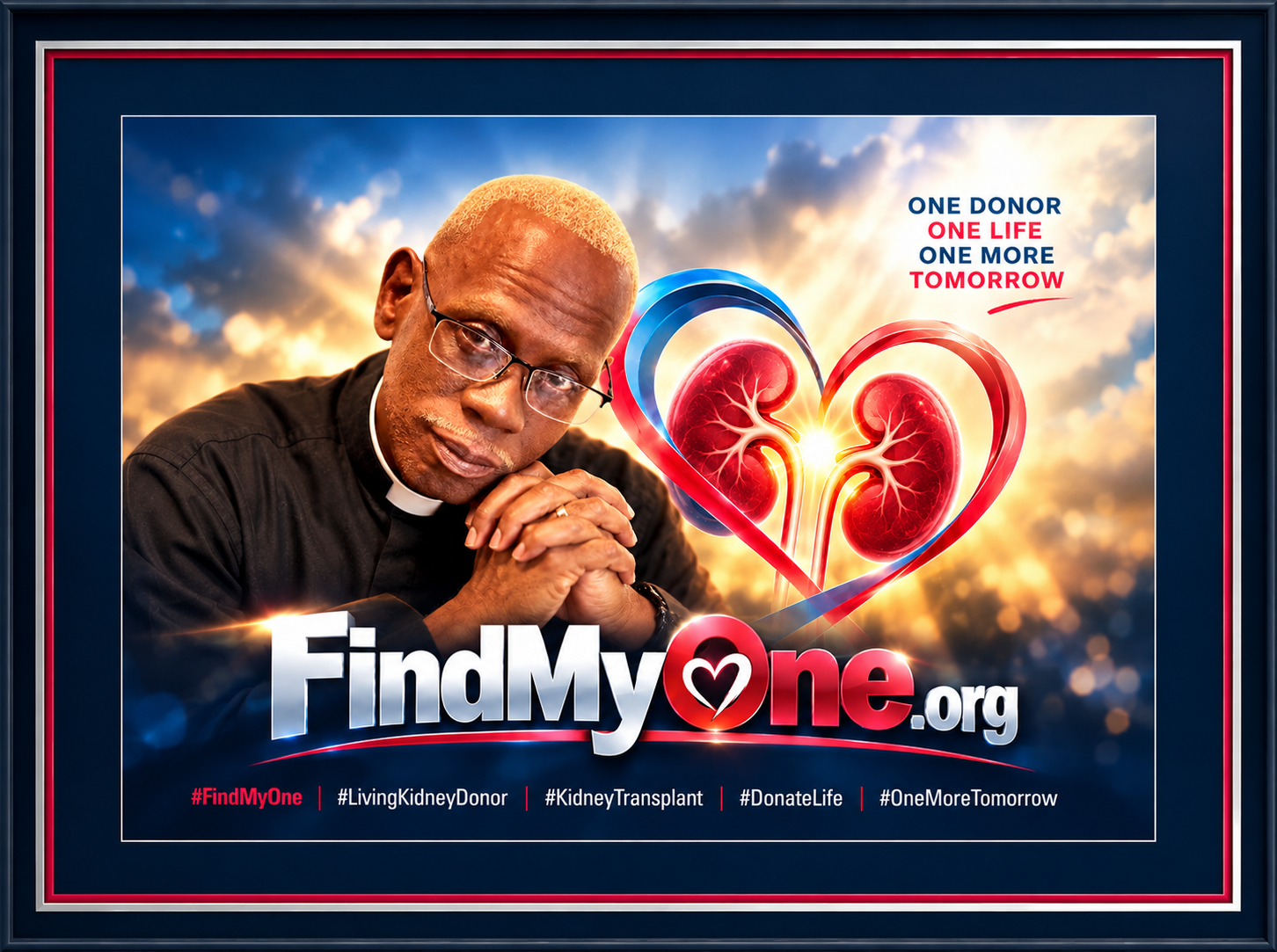
We called it FindMyOne.org.
That name wasn’t chosen because it sounded good in a marketing meeting.
It was chosen because it explains exactly what we’re trying to accomplish.
I need to find my one.
And despite all the progress, the interviews, the incredible generosity, and the millions of people who have encountered some part of my story, we still haven’t found the compatible kidney that could change my life.
That’s the part that keeps me thinking.
As a broadcaster, I understand the difference between reach and results. A radio station can deliver an enormous audience without necessarily convincing that audience to take a particular action. A digital campaign can generate millions of impressions without reaching enough people who are able or willing to respond to its message.
And a video about a sick pastor can accumulate an extraordinary number of views without ever reaching a medically suitable living kidney donor.
That’s not a failure of the people who watched it.
It’s the enormous difficulty of the search itself.
But it tells me that we need to keep expanding the audience.
And that’s where Mark Zuckerberg and Meta come into this story.
Facebook, Instagram, Threads, and WhatsApp connect people across countries, communities, generations, and cultures. Meta has developed extraordinary technology for helping people discover content, find communities, and communicate with individuals they may never have encountered otherwise.
Its systems can identify interests, recommend material, facilitate sharing, and distribute conversations at a scale that would have been unimaginable when I began my radio career in 1995.
I’ve spent my professional life working with transmitters, ratings, formats, and broadcast signals. Meta operates in a world where the potential reach of a message extends across the globe.
Surely there’s an opportunity here to use that reach for something extraordinary.
And here’s what makes this appeal especially interesting.
Mark Zuckerberg has already demonstrated an interest in using Facebook to support organ donation.
On May 1, 2012, Zuckerberg and Sheryl Sandberg announced an initiative that allowed Facebook users to identify themselves as organ donors and connect with registration resources. They discussed the importance of raising awareness and the ability of social connections to help address real-world problems.
That was fourteen years ago.
Long before Meta became the collection of platforms and technologies it is today, its leadership understood that social media had the potential to help people facing medical emergencies.
So my request isn’t entirely new territory for the company.
I’m asking Meta to apply that same spirit of connection to an individual living-donor search, with the involvement of appropriate medical professionals and respect for everyone’s privacy.
And I have to believe that would be a remarkable story.
Imagine a company whose technology connects billions of people helping a father in Kansas reach the one medically compatible donor who might give him another chance at life.
Imagine being able to tell my daughter that the same technology she sees people using for entertainment, photographs, videos, and conversations helped her daddy find the person who could save him.
And imagine the possibilities beyond my own situation.
There are other families facing difficult donor searches, other patients spending their days attached to dialysis equipment, and other people trying to get their stories heard before their medical conditions become more serious.
A thoughtful, voluntary organ-donation awareness effort could make a difference for people far beyond me.
That’s where I see an opportunity for Meta to do something genuinely meaningful.
And Mark, if you happen to read this, I want to make something perfectly clear.
I’m not asking you to write me a check.
I’m not asking you to personally find a kidney or interfere with the medical process that determines donor eligibility.
I’m asking whether your company might consider helping my story reach more people.
Perhaps that means working with organizations experienced in organ-donation awareness. Perhaps it means finding an appropriate way to highlight my search, encouraging voluntary sharing through its platforms, or helping connect the message with communities interested in learning about living donation.
I don’t presume to tell Meta’s leadership exactly how to accomplish that. The company has people who understand its technology and communication capabilities far better than I do.
What I’m asking for is an opportunity to explore whether those capabilities could help.
And there’s a very important distinction in that request.
I don’t need Meta to decide who is medically compatible with me. I need help reaching people who may be willing to ask the transplant team whether they could be.
Doctors and transplant professionals must make those decisions. Potential donors deserve complete medical information, independent evaluation, privacy, and the freedom to decide without pressure.
But none of that can begin unless people know the opportunity exists.
That’s where visibility becomes essential.
I recognize that the company has countless priorities, and I certainly understand that Mark Zuckerberg receives more requests for attention than most of us could imagine.
But I also believe that the value of any communications technology should be measured by more than how effectively it sells advertising, generates engagement, or keeps people scrolling.
I’ve spent thirty years believing radio is valuable because it connects people. I’ve watched broadcasters raise money for families after tragedies, bring communities together during emergencies, and introduce people to causes they would never have known existed without hearing about them on the air.
Now I find myself asking whether the largest social media platforms can help accomplish something similar.
If a broadcaster with a microphone can make a difference in somebody’s life, imagine what could happen when technology capable of connecting billions of people becomes part of the effort.
And before anybody suggests that this is simply an attempt to attract celebrity attention, let me explain something else.
I’ve reached out to people including Glenn Beck, Robin Roberts, Selena Gomez, George Lopez, Tyler Perry, and numerous other well-known individuals. Some have personal experiences with serious illness or transplantation. Others have large platforms and a history of helping people.
My hope has never been that a celebrity would magically solve my medical condition.
My hope has been that someone with a large enough audience might help introduce my story to the person I haven’t yet reached.
There’s a difference.
I’m not chasing fame. I’m chasing another chance to live.
And there’s also the financial side of this journey.
Through incredible generosity, Josh’s GoFundMe has raised tens of thousands of dollars to help with the expenses associated with my medical care and maintaining some stability for my family.
I am deeply grateful for every contribution.
But those expenses are ongoing. Medicare covers much of my qualifying medical care, but it doesn’t cover everything. I still face significant out-of-pocket obligations, the cost of traveling approximately 80 miles each way for medical appointments, and the financial strain that comes from years of cancer treatment and kidney disease.
My retirement savings, accumulated during decades of work, were consumed by my medical battles.
I don’t share that to make anyone feel guilty.
I share it because people need to understand what it means to fight a disease this serious for this long.
I’m not living some comfortable life while asking strangers to finance things I don’t need.
I’m trying to stay healthy enough to receive a transplant, support my family, and remain here for the people who depend on me.
And I want to be clear that the request I’m making of Meta is different from the financial support we’re seeking through the fundraiser.
The fundraiser helps sustain the journey.
The donor search is about changing its destination.
I want to get to the point where this story is no longer about another medical setback, another dialysis complication, or another exhausting effort to find somebody willing to share a video.
I want to be able to write the story about the person who was medically cleared to help me.
I want to write about the transplant.
I want to write about recovery, about going back to work, about standing in the pulpit, and about celebrating the people whose kindness gave me an opportunity to continue living.
And I would love nothing more than to write a headline that reads:
MARK ZUCKERBERG AND META HELP KANSAS PASTOR FIND EXTREMELY RARE KIDNEY MATCH
Can you imagine?
From a broadcasting and communications perspective, the possibilities are extraordinary. But from a husband’s and father’s perspective, the meaning of that headline would be considerably more personal.
It would mean I might get more time with Eunique.
It would mean more opportunities to watch Arizona-Callie grow up.
It would mean more Christmas mornings, more birthdays, more sermons, more music, and more ordinary Tuesdays when absolutely nothing remarkable happens.
I’ve learned to appreciate those ordinary days in ways I never understood before getting sick.
And that is really what this whole campaign is about.
It’s not about becoming an internet sensation.
It’s not about achieving another million views or collecting the largest possible number of followers.
It’s about using the extraordinary communications tools available to us to accomplish something that matters in the real world.
My story has already demonstrated what ordinary people can do when they decide to help somebody they’ve never met.
Josh Liljenquist didn’t have to become involved. David Krissman didn’t have to offer his platform. Radio and television personalities didn’t have to make room for another interview. Thousands of people didn’t have to donate, pray, share, or write encouraging messages.
But they did.
And I believe there are more people willing to help if we can get the story in front of them.
So I’m making this request publicly, here at On The Dial, on Facebook, Instagram, Threads, and anywhere else people might be willing to listen.
Mark Zuckerberg and Meta, will you help me find my one?
Not through a shortcut in medical matching. Not by compromising anyone’s privacy. And not by promising an outcome nobody can guarantee.
Simply by helping an exceptionally difficult kidney-donor search reach more people who may be willing to learn about living donation.
And to the broadcasting industry I’ve spent most of my adult life serving, I have a request for you as well.
Please help me carry this message.
If you own a station, manage a cluster, program a format, host a radio show, publish an industry newsletter, produce a podcast, or have an audience of any size, please consider sharing this story.
If you have a connection to someone at Meta, please consider making an introduction.
If you know a person who works in technology, public relations, media, or charitable outreach who could help bring this request to the right people, I’d be grateful for the opportunity to connect.
And if you have no industry connections at all, you can still help by sharing https://findmyone.org with people who haven’t heard my story.
I know that doesn’t guarantee we’ll find a donor.
But it creates another possibility, another conversation, and another opportunity for someone to learn about a search they didn’t know existed.
And at this point in my life, those possibilities matter more than I can adequately express.
I’ve spent a lifetime trying to make audiences care about the things coming through their radios.
Now I’m asking the audience to care about something happening on the other side of my microphone.
I don’t know whether Mark Zuckerberg will ever read this article. I don’t know whether someone at Meta will take an interest, or whether this appeal will reach a person who knows exactly how to help.
But I know that as long as I’m able to speak, write, and keep fighting, I’m going to continue trying.
My family deserves that effort.
My daughter deserves that effort.
And I believe my life is worth that effort, too.
For years, I’ve told broadcasters that great communication isn’t measured only by the number of people who hear a message. It’s measured by what happens because they heard it.
Today, I’m living that principle in a way I never imagined.
I don’t need the whole world to know my name.
I need the right person to hear my story.
And maybe, just maybe, the company that has spent years bringing the world closer together can help make that happen.
Mark, if this reaches you, I’m not asking for the world. I’m asking for the chance to remain in it.
How to Help Steven Find His One
Find My One — The complete story and campaign
Josh Liljenquist’s Original Video
https://www.lemon8-app.com/@joshlilj/7669122830998569486?region=us
Steven’s October 2 Interview on The TJ Show
Financial Support — Josh Liljenquist’s GoFundMe
https://www.gofundme.com/f/help-pastor-steven-fight-for-his-life-p74hx
HCA Midwest Health Living Kidney Donor Program
https://www.hcamidwest.com/patient-resources/living-donor-program
Patient: Steven Mills
Date of Birth: December 23, 1977
Blood Type: O-positive
cPRA: 99.9999%
All potential living donors must be independently evaluated by the transplant program. Donor eligibility and medical compatibility can only be determined by qualified transplant professionals.
From the bottom of my heart, thank you for helping me keep this story moving. Please share it, send it to someone who may be able to help, and don’t assume that someone else will do it.
I still believe my one is out there.
I just need to find that person.
ONE DONOR. ONE LIFE. ONE MORE TOMORROW.
#OnTheDial #MarkZuckerberg #Meta #FindMyOne #DoYouSeeMe #DontLetItStopWithYou #KidneyDonorNeeded #LivingKidneyDonation #LoveOutLoud #OneDonorOneLifeOneMoreTomorrow #KansasPastor