


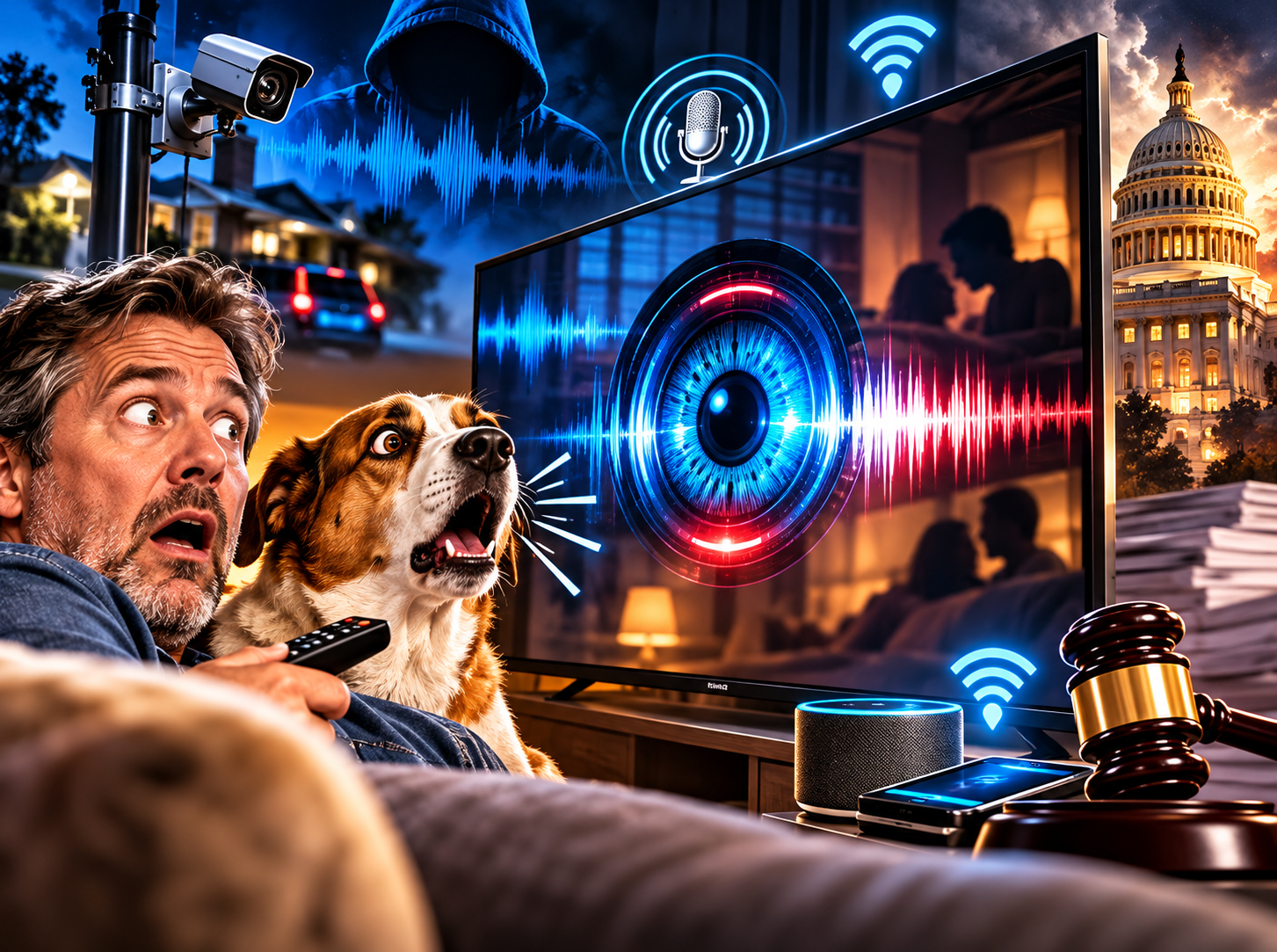
ON THE DIAL | SPECIAL INVESTIGATION AND COMMENTARY | OCTOBER 28, 2026 – STEVEN MILLS
There was a time when buying a television was a relatively uncomplicated experience. You brought the thing home, plugged it into the wall, connected an antenna or cable box, and spent the evening arguing with your family about what everybody wanted to watch. The television didn’t know your name, didn’t need your email address, didn’t ask permission to collect information about your household, and certainly wasn’t supposed to develop an interest in what your dog was doing on the other side of the living room. But somewhere between the invention of high-definition television and the arrival of artificial intelligence, the television industry apparently decided that simply showing us pictures wasn’t nearly ambitious enough.
Now our televisions can connect to the internet, communicate with other devices, recognize what we’re watching, recommend what we should watch next, and potentially collect information that most Americans probably never imagined their living room appliances would know.
And according to a disturbing new investigation involving a Samsung television, the questions may extend well beyond what we’re watching.
We need to talk about what these things might be hearing.
Because a cybersecurity researcher recently started investigating why his television seemed to know an uncomfortable amount about him.
What he reportedly discovered has raised questions about microphones, artificial intelligence, connected household devices, advertising profiles, and just how much information modern televisions are capable of collecting.
And somewhere in America, a dog is probably sitting on the couch thinking:
I barked three times, and now this family is getting advertisements for premium dog food. I didn’t authorize any of this.
LADIES AND GENTLEMEN, WE MAY HAVE REACHED THE POINT WHERE EVEN THE FAMILY DOG NEEDS A PRIVACY POLICY.
It started with advertisements that seemed a little too personal
The researcher, who uses the online name log4j, says he became suspicious after noticing unusually specific advertisements appearing on his relatively new 2025 Samsung television.
Instead of simply ignoring them, he began examining the software inside the television.
And this is where the story becomes considerably more interesting.
According to technical findings he began publishing October 21, his investigation uncovered software components associated with voice processing, automatic content recognition, device discovery and detailed usage reporting.
He also identified what appeared to be event counters related to sounds such as dogs barking and babies crying.
Even more concerning was his allegation that a Samsung television without its own microphone could identify microphones available through certain connected devices, potentially including soundbars and Bluetooth accessories.
EXCUSE ME?
You mean I can buy a television without a microphone, bring it home believing I have eliminated one potential privacy concern, and still have to ask whether the television can communicate with another device that does have one?
That’s a question worth investigating.
And it deserves an answer that doesn’t require an engineering degree, a cybersecurity certification, and three uninterrupted evenings reading a privacy agreement.
Now, before everybody starts unplugging the television and dragging it into the backyard, an important distinction must be made.
The researcher has not conclusively demonstrated that Samsung televisions secretly record private household conversations through connected microphones or use those conversations to target advertisements.
The existence of microphone-related software, sound-detection counters or connected-device discovery capabilities does not establish that private conversations are being recorded or transmitted.
Samsung already advertises certain AI features designed to recognize sounds such as a barking dog or crying baby and alert the owner. Those legitimate functions may explain some of the software being examined.
Independent reporting has also emphasized that the most alarming allegations remain unproven.
But that doesn’t mean we should dismiss the investigation.
It means we need more of it.
Because the question isn’t simply whether a television CAN recognize a barking dog. It’s what happens to the information after the television recognizes it.
Does that information remain inside the device?
Does it travel to a company server?
Can it become part of an advertising profile?
Can other applications access it?
Can consumers turn the feature off completely?
And most importantly, do people understand what they’ve agreed to when they first turn on the television?
Those are legitimate questions.
And manufacturers should be prepared to answer them.
Somewhere your television may know more about your viewing habits than your own family
Let’s talk about something that is not speculation.
Modern smart televisions can collect detailed information about viewing behavior through technology known as Automatic Content Recognition, or ACR.
ACR can identify programming appearing on a television, including content delivered through certain external devices. Depending on the manufacturer and the privacy choices made by the consumer, that information can be used for recommendations, audience measurement and advertising.
Samsung acknowledges that its optional ACR system can collect viewing history, device identifiers and IP addresses when enabled. Samsung says users can disable the feature and that ACR does not record or watch the content displayed on the television.
Other television manufacturers have similar technologies, although their settings, data practices and consent procedures differ.
Consumer Reports has repeatedly warned that smart television data collection can be difficult for consumers to understand or control.
Think about the implications.
Your television may know you watched three episodes of a crime drama.
It may recognize that you switched channels during a commercial.
It may help an advertising system determine which promotions are most relevant to your household.
And while those capabilities are different from recording private conversations, they demonstrate how much information can be gathered from an appliance most people still think of as a screen.
We bought a television to watch television. Somewhere along the way, television started collecting information about us.
And I would like to know who approved that particular programming change.
Because I don’t remember receiving a ballot.
I don’t remember attending a public hearing.
And I certainly don’t remember signing up for the My Television Knows Too Much About Me Premium Package.
Yet here we are.
Now imagine your television knowing when you’re arguing with your spouse
This is where we move from documented technology into questions about what future devices could potentially do.
A microphone-equipped system with sufficiently advanced sound recognition might be able to identify environmental noises, distinguish speech from background sounds, or detect patterns associated with particular activities.
Whether any specific television currently performs those functions, stores the results, or shares them for advertising must be established through independent testing.
But the underlying technology makes the questions reasonable.
And frankly, a little unsettling.
Imagine a married couple having an argument in the living room.
Nobody’s watching television.
The screen is sitting there looking innocent.
The husband says something he probably should have kept to himself.
The wife responds.
The argument continues.
And suddenly, the next morning, an advertisement appears for couples counseling.
OH, ABSOLUTELY NOT.
Now, to be clear, we have no evidence that this Samsung television actually did that.
But the possibility of increasingly sophisticated household audio analysis raises a legitimate privacy concern.
Because if a connected device can classify a dog barking, what safeguards prevent future software from classifying other household sounds?
And who gets to decide which classifications are acceptable?
What happens when someone is crying?
What happens during a private family disagreement?
What happens when a parent is discussing a child’s medical needs?
And what happens when two consenting adults decide it’s time for a little romantic privacy?
DOES THE TELEVISION NEED TO BE EXCUSED FROM THE ROOM?
Because I have some serious concerns about a future in which a television might know that a husband and wife are having what I will politely describe as lovey-dovey time.
I don’t need my television knowing that.
I don’t need Samsung knowing that.
I don’t need the refrigerator sending a congratulatory notification.
And I certainly don’t need my phone lighting up the next morning with an advertisement for candles, chocolate-covered strawberries and a weekend getaway.
SIR, I WAS TRYING TO WATCH THE EVENING NEWS. WHY IS MY ENTERTAINMENT CENTER ACTING LIKE THE NEIGHBORHOOD GOSSIP?
Again, those are hypothetical examples, not documented Samsung practices.
But privacy safeguards are supposed to address potential misuse before it becomes an established business model.
Not afterward.
And outside your house the cameras may be keeping score
Now let’s expand the conversation beyond the living room.
Because while consumers are trying to understand what their televisions and connected devices are collecting inside their homes, another debate is unfolding on streets across America.
That debate involves automated license plate recognition systems, including cameras supplied by Flock Safety.
Flock’s license plate recognition cameras can capture vehicle license plates, vehicle characteristics, locations and timestamps. The company says its standard ALPR systems do not use facial recognition, and it describes restrictions on data access and retention.
These cameras are not the same technology as a smart television microphone.
And there is no evidence in this case that Flock’s license plate systems are communicating with Samsung televisions or building combined profiles of what people do inside their homes.
But consider the larger privacy question.
One system can document when a vehicle passes a particular location.
Another can collect information about television viewing habits.
A smartphone may maintain location history.
A doorbell camera can record activity outside a home.
A connected speaker may process voice commands.
And an advertising platform may combine information obtained from multiple sources to create a more detailed picture of consumer behavior.
The danger isn’t necessarily that every device is secretly talking to every other device. It’s that information from different systems can become much more revealing when someone combines it.
Imagine a hypothetical world in which one organization could establish when you arrived home, another could identify the entertainment you watched, and a third could associate your household with certain purchasing interests.
That combination could reveal considerably more than any single data point.
Now add an improperly secured camera, an excessive retention policy, an unauthorized database search or a company that decides consumer information is simply another revenue opportunity.
Suddenly, the issue becomes much larger than whether somebody’s television recognized a barking dog.
We’re talking about the boundaries between public observation, private behavior and commercial surveillance.
And those boundaries deserve protection.
I don’t want a future where the camera knows when I got home, the television knows what I watched, the refrigerator knows what I ate, and the bathroom scale is apparently preparing a quarterly performance review.
At some point, somebody needs to remind these appliances that they’re supposed to work for us.
Not supervise us.
Radio has been measuring listeners for years and now even the PPM deserves a question
Now let’s bring this discussion directly into the broadcasting industry.
For years, radio broadcasters have relied on audience measurement systems to understand listening behavior and help advertisers evaluate the reach of their campaigns.
One of the most recognizable tools is Nielsen’s Portable People Meter, commonly known as the PPM.
The PPM is designed to detect inaudible identification codes embedded in participating audio broadcasts. That allows the measurement system to determine exposure to encoded stations and programming without requiring listeners to maintain a traditional listening diary.
The important distinction is that a PPM is not designed to record and transcribe every private conversation around its wearer. Detecting embedded broadcast codes is fundamentally different from creating recordings of household speech.
But the PPM still raises an interesting philosophical question.
What does meaningful consent look like when people carry technology that detects audio in their surroundings?
Panelists voluntarily participate in audience measurement, and the equipment has a defined research purpose. That’s materially different from a consumer discovering an unexpected microphone function inside an appliance.
Still, broadcasters should care deeply about this discussion.
We understand the commercial value of knowing what audiences hear.
We understand why advertisers want better information.
We understand why companies invest enormous sums in measurement technology.
But we should also understand that the desire for better data does not automatically justify collecting everything technology makes possible.
That principle applies to television manufacturers, digital advertising companies, connected-home platforms and audience measurement providers alike.
If a device detects audio, consumers deserve a clear explanation of what it detects, what it stores, what it transmits and who receives the resulting information.
And if a company claims its device does not retain conversations, independent verification should be welcomed rather than feared.
Because transparency isn’t supposed to be an inconvenience.
It’s supposed to be part of earning trust.
The lawyers may eventually have a field day and history tells us why
If future investigations establish that companies secretly captured private conversations, improperly accessed connected microphones or transmitted sensitive household information without valid consent, the legal consequences could be substantial.
Depending on the facts and applicable laws, those consequences could include consumer protection investigations, privacy litigation, regulatory penalties and demands for changes to how devices operate.
But it would be premature to declare that the Samsung research has already proven such violations or that a wave of lawsuits is inevitable.
The industry does, however, have a precedent it cannot ignore.
In 2017, Vizio agreed to a $2.2 million settlement with the Federal Trade Commission and New Jersey authorities after allegations that its smart televisions collected detailed viewing information from millions of consumers without proper knowledge or consent.
The settlement required stronger disclosures, affirmative consent and changes to the company’s privacy practices.
Federal Trade Commission
That wasn’t a hypothetical privacy debate.
That was an actual government enforcement action involving smart television data collection.
And it demonstrates why these questions matter.
The technology industry has already been warned that a television’s ability to collect information does not automatically give its manufacturer permission to collect it secretly.
The unanswered question is whether today’s increasingly sophisticated devices have moved beyond the privacy safeguards established during an earlier generation of connected television technology.
If they have, regulators should investigate.
If they haven’t, manufacturers should be able to demonstrate that through independent technical testing.
Either way, consumers deserve more than reassuring advertising language.
They deserve verifiable answers.
Seven things you can do before your television knows your next move
The good news is that consumers are not completely powerless. You can reduce unnecessary collection without giving up every convenience of modern technology.
1. Turn off Automatic Content Recognition. On many Samsung televisions, look under Settings, All Settings, General & Privacy, and Terms & Privacy for Viewing Information Services. Disable it if you don’t want your viewing behavior used through that feature. Menu names vary by model.
2. Review voice recognition and microphone permissions. Disable voice assistants you don’t use. Some Samsung televisions have a physical microphone switch along the lower edge of the set. If yours does, check whether it’s on.
3. Check the devices connected to your television. Review soundbars, Bluetooth accessories, smart speakers, cameras and streaming equipment. Remove pairings you no longer need, and check each device’s privacy settings independently.
4. Limit personalized advertising. Look for advertising preferences, tracking settings and device advertising identifiers. Where available, disable interest-based advertising and reset advertising identifiers.
5. Keep your software updated. Security updates can fix vulnerabilities that might otherwise permit unauthorized access. Don’t disable updates simply because you’re concerned about tracking.
6. Separate smart-home devices from sensitive equipment. If your router supports a guest or IoT network with device isolation, consider placing connected appliances there. This can reduce unnecessary access between devices, although it does not stop authorized communication with a manufacturer’s servers.
7. Consider disconnecting the television from the internet. If you primarily use an antenna, cable box or external player, a disconnected television can still function as a display. Disconnecting its Wi-Fi and Ethernet prevents the TV itself from transmitting data over the internet, though a separately connected streaming device can still collect information.
Consumer Reports provides a useful guide to reducing smart TV tracking covering multiple manufacturers.
And please remember that disabling one setting does not necessarily disable every kind of data collection. Different features may have separate permissions.
Samsung and the rest of the industry have some explaining to do
I believe manufacturers should answer a straightforward set of questions publicly, in language ordinary consumers can understand.
When a television recognizes a barking dog or crying baby, exactly what information is created? Is it stored locally or transmitted elsewhere? Does the television ever access microphones in connected accessories? If so, under what conditions and with whose permission? Can audio-derived information influence advertising profiles? What information is retained, for how long, and which outside organizations can receive it?
I also want independent researchers to test these systems under controlled conditions.
Not just one television.
Not just one software version.
Different manufacturers, different models, different connected accessories and different privacy settings.
Test what happens when every optional feature is disabled.
Test what happens while the television appears to be off.
Examine network traffic to determine what information leaves the household, while recognizing that encrypted traffic may require additional analysis.
And publish the results.
Because the consumer should not have to become a cybersecurity investigator just to determine whether the television is respecting the living room.
Samsung has publicly explained its ACR consent controls and has previously stated that its smart televisions do not monitor ordinary living room conversations. Those statements deserve consideration, but the new technical questions deserve current, model-specific answers as well.
This isn’t a demand to eliminate every useful smart-home feature.
A device that alerts a parent to a crying baby may provide a valuable service.
A television that helps someone with limited mobility operate equipment through voice commands can be genuinely beneficial.
A home security system can help protect property and people.
But useful technology must remain accountable to the people using it.
A feature that helps a family should not quietly become a feature that profiles a family for purposes they never knowingly approved.
We wanted smarter televisions not nosier roommates
The most disturbing possibility in all of this isn’t that artificial intelligence will suddenly become powerful enough to recognize what happens inside a household.
In certain contexts, technology already can recognize sounds, objects, patterns and behavior.
The more important question is who controls those capabilities.
Who determines when they operate?
Who decides which information is necessary?
Who profits from what gets collected?
And what happens when the person who bought the device says no?
There is an enormous difference between a television recognizing a voice command because someone deliberately activated a feature and a device collecting sensitive information without meaningful consent.
That distinction must remain clear.
Because our homes are not advertising laboratories.
Our marriages are not consumer research projects.
Our children are not data points waiting to be monetized.
And our dogs should be allowed to bark without becoming the subject of an advertising analytics meeting.
If my dog barks at the mail carrier, I want the television to continue showing the weather forecast. I do not need a notification that says, “Based on recent household activity, we recommend obedience training.”
And if my wife and I have a disagreement, I certainly don’t want the entertainment center volunteering its opinion.
Steven, based on your recent conversation, perhaps you should apologize.
SIR, YOU ARE A TELEVISION.
YOU DON’T PAY THE MORTGAGE. STAY OUT OF THIS.
And if Eunique and I decide to have a romantic evening, the television’s only responsibility is to display whatever movie we selected.
It does not need to recognize the mood.
It does not need to recommend a playlist.
It does not need to send an activity report.
And it most definitely does not need to ask whether we’d like to share the experience with other household devices.
NO, SAMSUNG. WE WOULD NOT.
All humor aside, this investigation should serve as a warning to the entire connected-device industry.
Consumers are becoming increasingly aware that the appliances in their homes are capable of collecting information far beyond what earlier generations of technology could gather.
Manufacturers have an opportunity to respond with meaningful transparency, stronger controls and independent verification.
Or they can wait until regulators, courts and angry customers begin asking much more expensive questions.
The Samsung allegations require further investigation. They should not be presented as proven secret recording of private conversations.
But the broader privacy concerns are real, and the history of smart television tracking demonstrates that consumer skepticism is not unreasonable.
We’ve reached a point where the smartest thing in the living room might be the person who asks what the television is doing when nobody is watching it.
For radio, the lesson is equally important.
Our industry has always depended on understanding audiences. But there must be a distinction between measuring listening and invading private life.
For technology companies, the message is simple.
Make the products useful.
Make the features transparent.
Make privacy controls understandable.
And when somebody tells the television to stop listening, make absolutely certain it stops.
Because Americans bought these devices to enjoy entertainment, not to invite an invisible advertising executive into every private moment.
And as for the family dog?
I think we owe him an apology.
He’s been barking at suspicious things for years.
Maybe we should have been paying attention to what he was trying to tell us.
On The Dial will continue examining the relationship between broadcasting, connected technology, audience measurement and consumer privacy. We believe technological progress and personal privacy should be able to exist in the same household.
Hashtags
#OnTheDial #Samsung #SmartTV #PrivacyMatters #ConsumerPrivacy #DataPrivacy #SmartHome #Cybersecurity #ArtificialIntelligence #FlockSafety #NielsenPPM #RadioIndustry #Broadcasting #DigitalSurveillance #ConsumerRights #TechnologyNews #PrivacyInvestigation