

It started on late-night television.
It didn’t stay there.
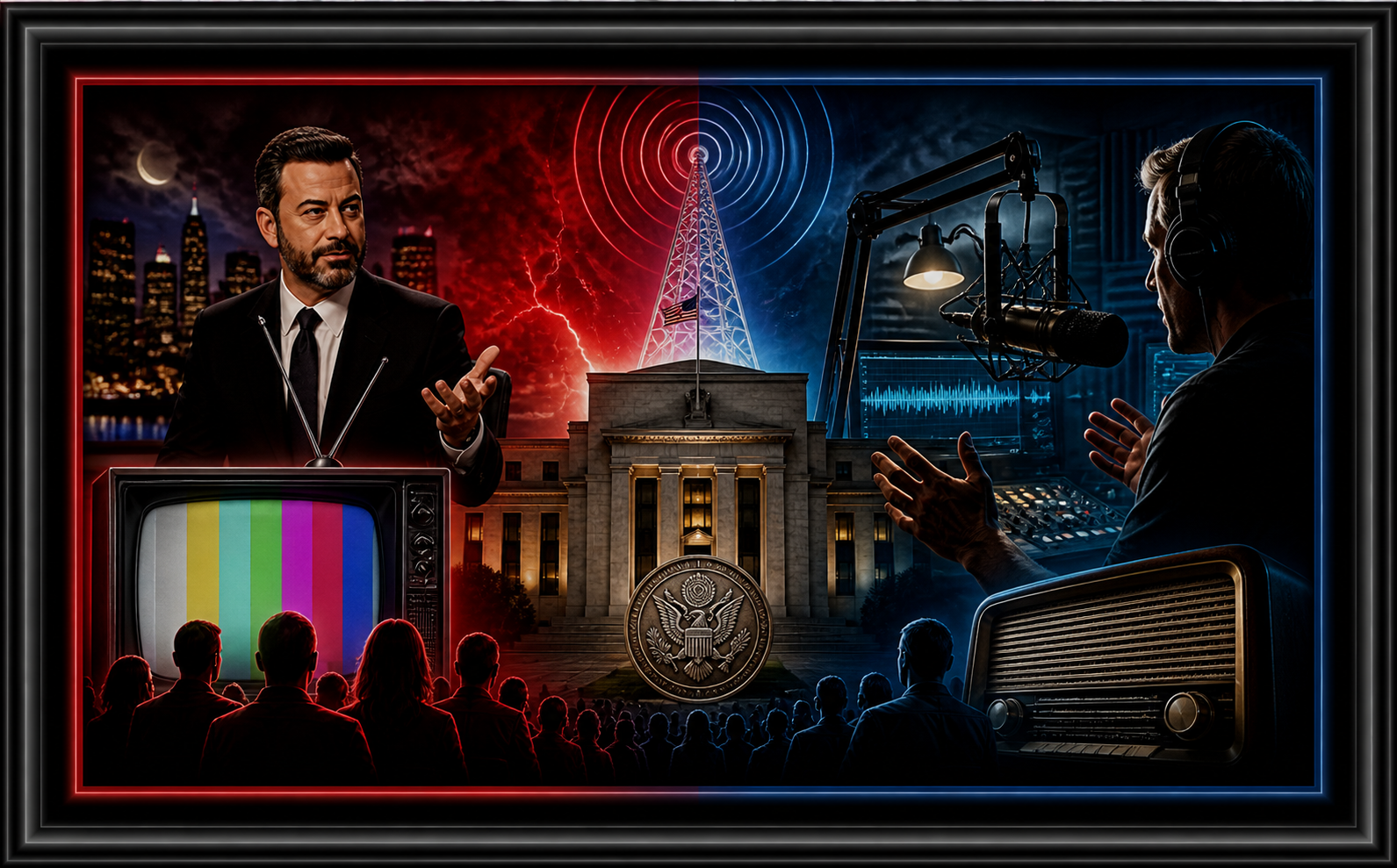
What looked like another headline tied to Jimmy Kimmel and a political dust-up has quickly turned into something much bigger — a signal that’s now echoing far beyond TV and straight into the heart of broadcast radio.
Because when the Federal Communications Commission moves to accelerate license scrutiny for stations tied to a major broadcaster like The Walt Disney Company, every license holder in America notices.
And that includes radio.
Let’s call this what it is.
This isn’t just about one comedian, one segment, or one network.
This is about how power interacts with the public airwaves — and whether the rules are about to get… flexible.
And if the rules get flexible?
Radio gets nervous.
Here’s why.
Every radio station — from the biggest cluster in a major market to the smallest standalone AM — operates under the same fundamental premise:
You don’t own your license.
You hold it.
And you hold it under the expectation that you’re serving the “public interest.”
That phrase has always been broad.
Now, it’s starting to feel… elastic.
The concern isn’t theoretical.
The National Association of Broadcasters has already warned that actions like this could introduce instability into a system that has long depended on predictability.
Predictability in licensing.
Predictability in enforcement.
Predictability in what is — and isn’t — considered a problem.
Take that away?
You don’t just change policy.
You change behavior.
Now let’s bring this into a radio studio.
Morning show.
Drive time.
Mic is hot.
A host leans into a joke. A comment. A take that hits a little harder than usual.
Five years ago, that moment might spark calls, maybe a little controversy, maybe even a ratings bump.
Today?
There’s a new question sitting quietly in the back of the room:
“Is this worth it?”
And that question changes everything.
Because radio isn’t built on safe.
It’s built on personality.
It’s built on edge.
It’s built on that line — you know the one — where a host says something just bold enough to make people lean in.
Push too far, and you get complaints.
Pull too far back, and you get ignored.
That tension is the product.
But what happens when the risk isn’t just audience reaction?
What happens when the perceived risk becomes:
- regulatory attention
- license scrutiny
- added oversight
Even if that risk is small… or unclear…
It’s enough to make operators think twice.
And when operators think twice?
Content gets safer.
Voices get softer.
And radio — the medium that built its legacy on being immediate, real, and sometimes unpredictable — starts to sound a little more… cautious.
Let’s be clear.
No one is saying radio is about to be policed segment by segment.
But perception matters.
And right now, the perception is shifting.
Here’s the bigger picture.
Radio is already navigating:
- audience fragmentation
- digital competition
- revenue pressure
Now add one more variable:
regulatory uncertainty
And suddenly, the challenge isn’t just growing the business.
It’s protecting it.
This is where the story flips.
Because radio has been fighting to stay relevant in a world dominated by streaming, social media, and on-demand content.
What radio still has — and what those platforms don’t — is:
- live connection
- local immediacy
- unfiltered personality
That’s the edge.
That’s the differentiator.
That’s the reason people still tune in.
But if that edge gets dulled?
If that personality gets filtered?
If that immediacy gets second-guessed?
Then radio isn’t just competing with digital platforms anymore.
It starts to sound like them.
And that’s a fight it can’t win.
So yes, this started with Jimmy Kimmel.
But it didn’t stay with Jimmy Kimmel.
It became a moment where broadcasters — including radio — are quietly reassessing the environment they operate in.
Not panicking.
Not overreacting.
But paying attention.
Because in this business, the biggest changes rarely come with flashing lights and breaking news banners.
They come with subtle shifts.
A new question asked in a meeting.
A hesitation before a segment airs.
A decision to play it just a little safer.
And those shifts?
They add up.
Bottom line:
This isn’t a TV story.
It’s a broadcast story.
And if you’re in radio today, the takeaway isn’t fear.
It’s awareness.
Because the mic is still on.
The audience is still there.
The opportunity is still real.
The only question now is:
Will radio keep saying what needs to be said…
…or start wondering if it should say it at all?
On The Dial covers breaking radio industry news, including layoffs, programming changes, talent moves, and broadcast trends across the United States.