


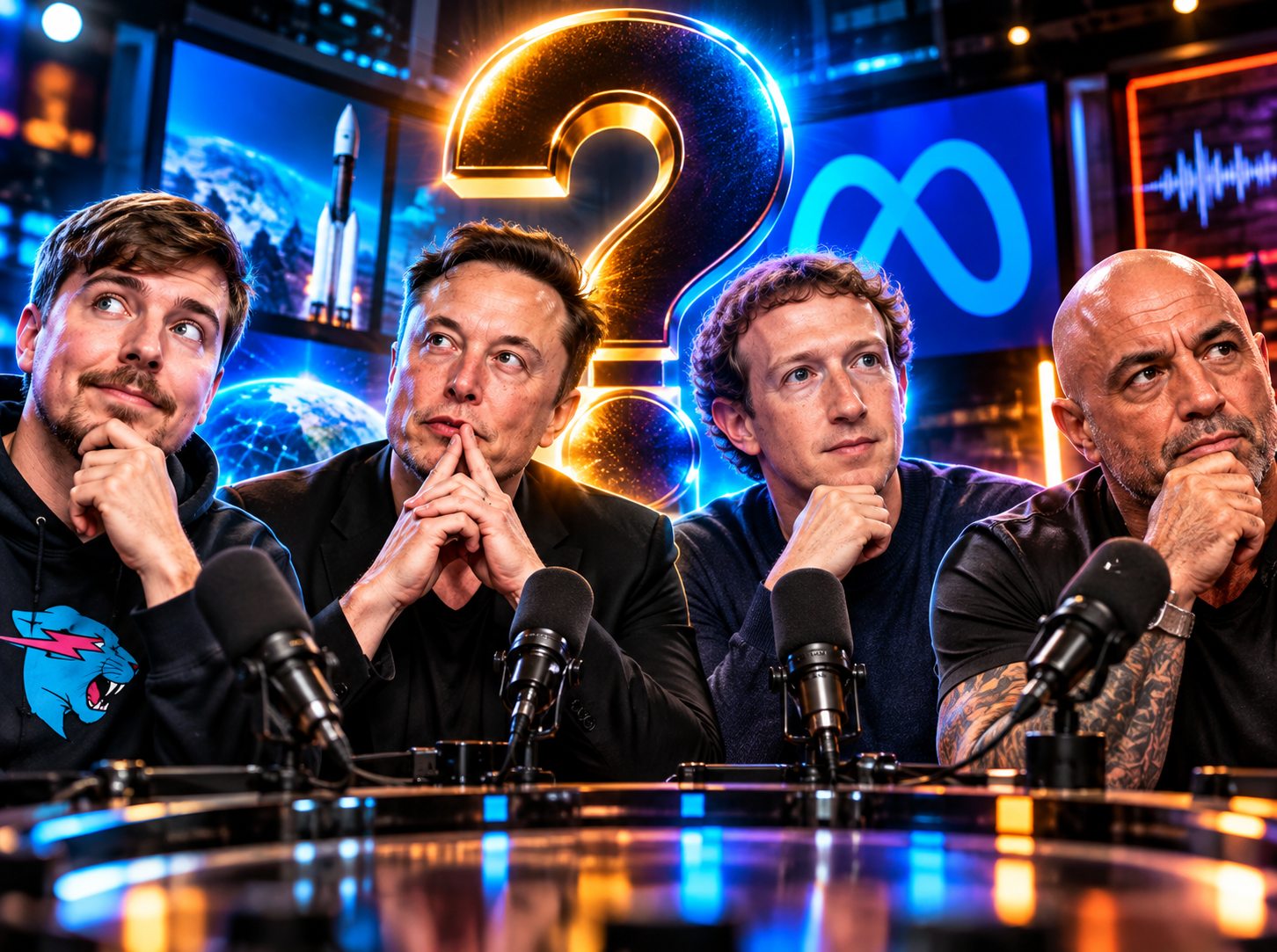
–An Open Challenge to Elon Musk, Mark Zuckerberg, Joe Rogan, MrBeast and the Greatest Technological Minds of Our Time–
By Steven Mills | President and Publisher, On The Dial
I was visiting with my new friend TJ Taormina, host of the nationally syndicated TJ Show, when our conversation took a turn that has occupied my thoughts ever since. TJ has been kind enough to help share my story with his listeners, and as we talked about the extraordinary difficulty of finding a kidney that my body can accept, he began throwing out ideas about technology, artificial intelligence, and some of the most influential people on the planet. What started as a conversation between two radio guys eventually became a question that I haven’t been able to shake. We live in a world where billionaires are building rockets, developing brain implants, training artificial intelligence systems, and attempting scientific breakthroughs that would have sounded ridiculous twenty years ago. With all that intelligence, money, technology, and ambition at our disposal, why am I still struggling to find one compatible human kidney?
And the more I thought about it, the more I realized that perhaps I’ve been asking the wrong people the wrong question.
My name is Steven Mills. I’m a 48-year-old pastor in Garden City, Kansas, a husband, a father, a broadcaster with more than thirty years of experience, and a two-time cancer survivor. I’ve survived Hodgkin’s lymphoma, undergone a bone marrow transplant, and later survived colon cancer. Unfortunately, the treatments that saved my life also contributed to the destruction of my kidneys, leaving me dependent on dialysis while searching for a transplant.
My heart has also suffered damage associated with kidney disease, and my medical situation has become increasingly serious.
But here’s what makes my situation so unusual.
My cPRA is 99.9999%.
That’s not a typo, and it’s not a statistic I invented to make this story more dramatic.
It is a measure of how difficult finding an immunologically compatible kidney may be. In my case, previous medical treatments have left me with an extraordinarily high level of sensitization, meaning my immune system recognizes and may attack tissue from an overwhelming majority of potential donors.
My doctors have described the difficulty in terms approaching one in a million.
That’s not a mathematical promise that exactly one person in a million can donate to me. Actual transplantation involves blood compatibility, antibody testing, crossmatching, donor health, and other medical considerations.
But the point remains.
I need a kidney, and finding one my body can safely accept is incredibly difficult.
So here’s my question.
Elon Musk, can artificial intelligence help us solve this?
I’m serious.
You have helped build electric vehicles that challenged an entire automobile industry. SpaceX has demonstrated reusable rocket technology that changed the economics of spaceflight. Neuralink is investigating technology that allows people with paralysis to control computers using signals from their brains.
Your xAI organization has developed Grok, an artificial intelligence system intended to help people investigate information, reason through questions, and understand complicated subjects.
And here I am, sitting in Kansas, hooked to dialysis equipment, wondering whether the technology that is changing so many parts of the world could help identify a path toward the kidney transplant I desperately need.
I’m not suggesting that somebody should type my medical information into Grok and expect a compatible donor’s name to appear on the screen.
I know better than that.
I’m asking whether the people developing these technologies might be willing to bring their expertise to a problem that has become almost overwhelming for one ordinary family.
Could AI help researchers examine difficult transplant-matching questions more efficiently? Could it help qualified transplant professionals evaluate opportunities within existing donor exchange systems? Could it assist with carefully designed public outreach that reaches people who have never considered living kidney donation? Could the technology help coordinate research groups, medical institutions, and charitable organizations that might otherwise never work together on the same problem?
I don’t pretend to know which of those ideas might be practical.
That’s precisely why I’m asking the people who do.
I’ve spent my career in radio programming. I understand audiences, marketing, communication, music, personalities, and the mechanics of getting a message heard.
But I don’t design artificial intelligence systems.
I don’t build medical devices.
I don’t conduct genetic research.
And I certainly don’t know how to create a functioning human kidney in a laboratory.
What I do know is that there are people in this world with extraordinary knowledge, resources, and the ability to bring together specialists who might see possibilities that I cannot.
And I would like those people to take a serious look at my situation.
Elon, here’s the challenge.
Take an extremely difficult transplant case involving a 48-year-old father from Kansas and ask what artificial intelligence can realistically contribute.
Not a publicity stunt pretending to solve a problem that medicine hasn’t solved.
A legitimate collaboration involving transplant physicians, researchers, immunologists, computational scientists, and people who understand the enormous complexity of organ donation.
If Grok can help researchers analyze information or identify promising avenues for investigation, wonderful. If the answer is that the technology isn’t yet capable of contributing directly to my case, then perhaps your team could still help raise awareness among people who might be willing to explore living donation.
Either way, we would learn something worthwhile.
And maybe, just maybe, we would help save a life.
There’s another part of this conversation with TJ that really caught my attention.
He started talking about the remarkable advances in biotechnology, including companies attempting to recreate characteristics of animals that disappeared thousands of years ago.
You’ve probably seen the stories about Colossal Biosciences and its work involving the extinct dire wolf.
The Texas company used ancient genetic information and modern gene-editing techniques to produce gray wolves carrying selected traits associated with dire wolves. The company described the achievement in terms of de-extinction, although scientists have debated that characterization because the resulting animals are genetically engineered gray wolves rather than exact reproductions of the extinct species.
The distinction matters scientifically.
But the underlying technological work remains fascinating.
Researchers analyzed ancient genetic material, identified particular traits, and used biotechnology to create living animals exhibiting those characteristics.
And sitting here thinking about all of that, I couldn’t help asking another question.
If scientists can use genetic technology to recreate characteristics of an animal that disappeared thousands of years ago, how close are we to developing replacement organs for people who are dying today?
I’m not suggesting those scientific problems are remotely equivalent. Creating a transplantable kidney is an extraordinarily complicated undertaking involving blood vessels, filtration structures, immune compatibility, and the ability of an organ to perform essential functions within a human body.
We cannot currently print a fully functional, clinically approved human kidney on demand.
But scientists are investigating regenerative medicine, tissue engineering, organoids, biofabrication, and other technologies that could eventually change transplantation.
So I would like to ask the people leading those efforts something.
What would it take to accelerate that work?
What resources are missing?
What collaborations haven’t happened?
And what could be accomplished if some of the world’s most ambitious technology companies decided that solving human organ failure deserved the same determination they bring to their other projects?
I love animals. I think the scientific possibilities surrounding conservation and genetic research are fascinating.
But I’d be lying if I said I wouldn’t be a little more excited about hearing that somebody had found a way to create a functioning kidney my body could accept.
That would get my attention in a hurry.
And I suspect it would get the attention of millions of other people waiting for life-saving transplants, too.
Now let me bring Mark Zuckerberg into this conversation.
Mark, I’ve already publicly asked you and Meta to help bring attention to my donor search. I’m asking again because I believe your company’s communication capabilities could make a real difference.
And there’s something important about your history that makes this request particularly relevant.
Back in 2012, you and Sheryl Sandberg announced a Facebook initiative designed to encourage organ-donor awareness. The concept was straightforward. Social media could help people share their intentions, encourage conversations about donation, and connect potential donors with registration resources.
That effort was associated with a remarkable immediate increase in online organ-donor registrations.
So this isn’t some completely foreign idea for Meta.
Your company recognized more than fourteen years ago that social connections could have a direct impact on organ-donation awareness.
Mark, I’m asking whether we can take that idea one step further.
Could Meta help create an appropriate, voluntary awareness effort that introduces my story to people who may be interested in living kidney donation?
Could Facebook, Instagram, and Threads become part of a medically responsible campaign that directs interested individuals to qualified transplant professionals?
Could we demonstrate that the value of social media extends beyond engagement, advertising, and entertainment?
Imagine a technology company that connects billions of people helping one father reach the person whose kidney might save his life.
That’s a story I would love to write.
And it wouldn’t just be a great story for me.
It could inspire other patients and families to consider possibilities they haven’t yet explored.
I also want to invite another person into this conversation.
Joe Rogan, what do you think?
You have built an extraordinary audience around long-form conversations that often explore science, medicine, technology, human potential, and ideas that challenge conventional thinking.
I’m not asking you to endorse an unproven medical treatment, promote a miracle cure, or pretend artificial intelligence can accomplish something it cannot.
I’m asking whether a conversation about the future of organ transplantation, medical innovation, and the extraordinary difficulty of finding a compatible kidney might be worth having.
Imagine bringing together a leading transplant specialist, a biotechnology researcher, an artificial intelligence expert, and a patient whose case demonstrates just how difficult transplantation can become.
There would be plenty to discuss.
Why do certain patients become so highly sensitized? What can be done through kidney-paired donation? Where are researchers making progress? What possibilities might emerge through artificial intelligence and regenerative medicine? And what prevents those breakthroughs from reaching patients sooner?
Those are real questions with meaningful scientific answers.
And they deserve an audience.
Joe, you’ve had conversations about subjects far more complicated than my medical situation. I would be grateful if you’d consider helping introduce this one to people who might have the expertise or connections to make a difference.
And then there’s MrBeast.
Jimmy Donaldson has built an extraordinary audience by creating entertaining videos, organizing ambitious projects, and finding ways to turn large-scale participation into compelling stories.
Jimmy, I have a different kind of challenge for you.
I’m not asking you to give away a car, build me a house, or organize some elaborate spectacle.
I’m asking whether you could help bring attention to an extremely rare living-kidney-donor search.
Imagine a thoughtfully produced story following the effort to locate a medically compatible donor, introducing people to the science of transplantation, and helping viewers understand how living donation actually works.
It wouldn’t have to manufacture drama.
My medical situation has provided more than enough of that.
And the best part is that the outcome wouldn’t have to depend on a contest or a prize. The value would come from educating people, reaching potential donors, and perhaps helping other patients along the way.
If a compatible donor were eventually found through the effort, the result would speak for itself.
If one weren’t found immediately, the awareness generated could still have lasting value.
One of the world’s largest audiences helping search for one extraordinarily rare match.
Tell me that isn’t a compelling challenge.
But I’m not stopping there.
I’d like the attention of the people at TechCrunch, the teams reporting on artificial intelligence and biotechnology, the editors at major national publications, and the journalists covering the companies spending billions of dollars trying to change what technology can accomplish.
I believe there’s a larger story here than the medical circumstances of one pastor in Kansas.
We’re living in a period when artificial intelligence companies are attracting enormous investment, developing increasingly powerful systems, and telling the world that these technologies will transform science, medicine, and human productivity.
That’s exciting.
But what does that transformation actually look like for somebody who needs help right now?
How do we move from impressive demonstrations to meaningful applications?
What happens when we place a real human problem in front of people who are building the systems expected to shape our future?
And are those systems capable of doing anything useful today, rather than simply promising extraordinary results tomorrow?
I would love for a technology publication to examine those questions.
Not because I want to embarrass anyone or suggest that a billionaire is personally responsible for my medical situation.
I’m asking because I genuinely believe this is the kind of challenge that could bring together people who otherwise might never have a reason to collaborate.
And it doesn’t have to begin with some futuristic medical breakthrough.
There are already legitimate avenues worth exploring.
Kidney-paired donation programs can help some patients find compatible kidneys even when their willing donors aren’t directly compatible. Highly sensitized patients may require especially complex matching, and transplant specialists have developed sophisticated approaches to evaluating those cases.
Perhaps there are existing research programs, institutions, or medical specialists who could offer additional insight into my situation.
Perhaps greater awareness could bring forward a potential donor who would never otherwise learn that I exist.
Perhaps there are medical professionals already working on precisely the kinds of challenges I’m describing.
The first step doesn’t have to be inventing a new kidney. It might simply be connecting the right people.
And if artificial intelligence can assist with that process under proper medical supervision, I’d welcome the opportunity to explore it.
I’m not interested in replacing physicians with computers. My health is too important for that, and I have tremendous respect for the transplant professionals who have been working to help me.
I want to give those professionals every legitimate opportunity to succeed.
That’s the challenge I’m presenting.
And I want to be clear about something else.
I’m not demanding that Elon Musk, Mark Zuckerberg, Joe Rogan, MrBeast, or anybody else personally save my life.
I’m asking whether they’re willing to consider using their knowledge, resources, influence, or audiences to help address a problem that has become extraordinarily difficult for me to solve.
Those are very different requests.
I’m also not suggesting that any of these people have an obligation to respond simply because they are successful or wealthy.
But I do believe that some of the most extraordinary things in human history have happened because somebody with the ability to make a difference decided to take an interest in a problem that seemed too difficult.
And I have to keep believing there’s somebody out there who will take an interest in mine.
Over the past several months, I’ve been blessed by thousands of people who have supported my journey. Josh Liljenquist and his team helped tell my story through a video that reached an enormous audience. Radio and television stations have shared my circumstances. David Krissman invited me onto The Great Social Experiment and helped make FindMyOne.org available as a central place for people to understand my situation.
TJ Taormina and The TJ Show brought my story to national radio listeners, and our recent conversation helped inspire the very article you’re reading now.
I’m grateful for all of them.
I’m grateful for every person who has shared a video, made a donation, offered a prayer, written an encouraging message, or tried to connect me with someone who might help.
But despite that extraordinary generosity, the search continues.
And so do the financial pressures.
Medicare helps pay for covered medical treatment, but it doesn’t cover every expense associated with living with a serious illness. I travel considerable distances for medical appointments, continue undergoing dialysis, and face expenses that have placed an enormous burden on my family.
I’ve exhausted retirement savings accumulated through years of work while surviving cancer and kidney disease.
Financial contributions have helped enormously, but the need continues as long as the medical battle does.
My request to these technology and media leaders is primarily about visibility, research connections, and the possibility of finding a transplant.
The fundraising effort is a separate but equally real need that helps sustain my family and medical journey while we continue searching.
I want people to understand both.
But what I want more than anything is to live.
I want more mornings with my wife. I want to watch my daughter grow up. I want to continue pastoring my congregation, playing music, writing about the broadcasting industry, and doing the things I’ve spent my adult life doing.
I want to enjoy another Christmas, another birthday, another completely ordinary afternoon when the most important decision I have to make is what we’re having for dinner.
I’m not interested in becoming famous because I’m sick.
I’m interested in getting well enough to enjoy being alive.
And I cannot help wondering whether the most powerful tools humanity has ever developed might be able to help me do that.
So I’m putting this challenge in writing.
Elon Musk, could Grok and the people developing artificial intelligence help identify a legitimate path forward?
Mark Zuckerberg, could Meta help my story reach a potential living kidney donor through the extraordinary communication platforms you’ve built?
Joe Rogan, could a conversation involving leading medical and technology experts bring attention to the scientific challenges that patients like me face?
MrBeast, could your creative team and enormous audience help turn this difficult search into a meaningful organ-donation awareness effort?
And to the researchers, engineers, biotechnology companies, and technology journalists reading this, could you help explore what is scientifically possible rather than simply accepting that the problem is too difficult?
I’m not asking anybody to promise a miracle.
I’m asking people who have spent their careers challenging limitations to help me understand whether there are possibilities we haven’t yet discovered.
And if the answer to some of these questions is no, that’s okay.
Tell me what isn’t possible.
Tell me what science still needs to accomplish.
Then help me identify what we can do right now.
Because I don’t have the luxury of waiting twenty years for medicine and technology to reach some extraordinary new milestone.
I need help in the present.
And I believe there’s an opportunity to use the resources we already have in ways that could make a real difference.
Imagine the headline if we succeeded.
ARTIFICIAL INTELLIGENCE AND THE WORLD’S BIGGEST TECHNOLOGY PLATFORMS HELP FIND AN EXTREMELY RARE KIDNEY MATCH FOR KANSAS FATHER
That’s a headline I’d be proud to publish.
Not because my name would be in it, but because it would demonstrate something extraordinary about what happens when people with very different talents and resources decide to work together.
A broadcaster brings the story.
Medical professionals provide the expertise.
Technology specialists explore the possibilities.
A large audience helps carry the message.
And somewhere, perhaps, a willing and medically compatible donor enters the picture.
That isn’t science fiction.
It’s a challenge to see whether communication, medical science, and technology can accomplish something meaningful together.
I don’t know whether Elon Musk will read this.
I don’t know whether Mark Zuckerberg will respond.
I don’t know whether Joe Rogan or MrBeast will ever hear my name.
And I certainly don’t know whether somebody working in artificial intelligence or biotechnology will look at my medical situation and recognize an opportunity I haven’t considered.
But I know that if we don’t ask the questions, we’re not going to learn the answers.
I’ve spent more than thirty years using microphones to reach people.
Now I’m asking the people who are developing the future of technology to help me reach the one person who could change mine.
Elon, Mark, Joe, Jimmy, and anyone else who has the ability to help: Here is your challenge.
Can the extraordinary technology and human ingenuity we celebrate every day help one father in Kansas find a way to live?
I’m ready to work with you.
I’m ready to listen.
And I’m ready to do everything medically appropriate and reasonably possible to give this search another chance.
But I need somebody to open the door.
Because while the world is busy developing technology that promises to change tomorrow, I’m still fighting to be here when tomorrow arrives.
And from the very bottom of my heart, I would be grateful for your help.
MY STORY AND THE SEARCH FOR MY KIDNEY
David Krissman invited me to share my journey through The Great Social Experiment and helped establish this central resource.
JOSH LILJENQUIST’S ORIGINAL VIDEO
https://www.lemon8-app.com/@joshlilj/7669122830998569486?region=us
MY OCTOBER 2 INTERVIEW ON THE TJ SHOW
JOSH’S GOFUNDME FOR FINANCIAL SUPPORT
https://www.gofundme.com/f/help-pastor-steven-fight-for-his-life-p74hx
HCA MIDWEST HEALTH LIVING KIDNEY DONOR PROGRAM
https://www.hcamidwest.com/patient-resources/living-donor-program
Patient: Steven Mills
Date of Birth: December 23, 1977
Blood Type: O-positive
cPRA: 99.9999%
Potential donors should contact the transplant program directly. All compatibility testing and medical eligibility decisions must be handled by qualified transplant professionals.
ON THE DIAL
www.onthedial.net
If you know someone at xAI, X, Meta, Neuralink, Colossal Biosciences, TechCrunch, The Joe Rogan Experience, or MrBeast’s organization, please share this article with them.
If you’re a technology researcher, medical professional, science journalist, or broadcaster who believes there’s a way to bring more attention or expertise to this search, I’d welcome the opportunity to connect.
And if you simply want to help, please share https://findmyone.org with someone who hasn’t heard my story.
ONE DONOR. ONE LIFE. ONE MORE TOMORROW.
#ElonMusk #MarkZuckerberg #Grok #xAI #ArtificialIntelligence #JoeRogan #MrBeast #TechCrunch #Meta #Neuralink #ColossalBiosciences #FindMyOne #DoYouSeeMe #DontLetItStopWithYou #LivingKidneyDonor #KidneyTransplant #AIForGood #MedicalInnovation #OnTheDial