

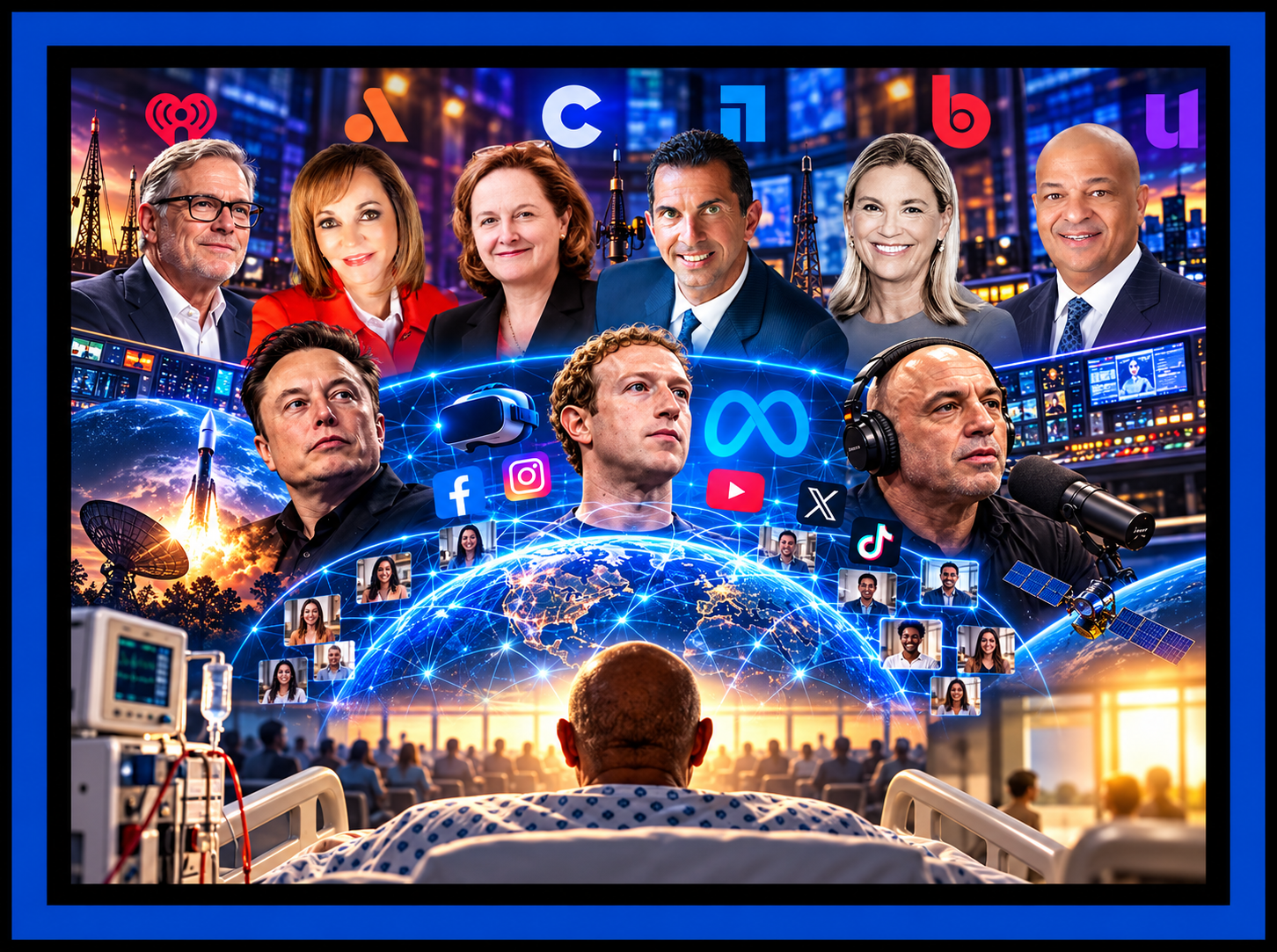
An Urgent Open Letter to Bob Pittman, Kelli Turner, Mary Berner, Bill Wilson, Caroline Beasley, Alfred Liggins III, Ginny Morris, Elon Musk, Mark Zuckerberg, Joe Rogan, TechCrunch, and the Leaders of America’s Communications Industry
By Rev. Dr. Steven Mills | President and Publisher, On The Dial
America has created the most extraordinary communications infrastructure the world has ever known. We can distribute a thirty-second video to millions of people before breakfast, turn an ordinary conversation into an international headline, and use technology to predict what someone might want to watch before they even know they want to watch it. Radio reaches into homes, automobiles, businesses, and communities every day. Social media carries information across continents in seconds. Artificial intelligence is changing industries, while digital publishers and podcasters have built audiences that would have been unimaginable a generation ago. Yet somewhere in America today, a father is preparing for dialysis, a mother is waiting for a transplant-center telephone call, and another family is desperately trying to get a loved one’s medical story in front of someone who might be willing and medically able to help.
There is something deeply troubling about that contradiction.
And I am no longer willing to simply admire the reach of our industries without asking what we intend to accomplish with it.
I have spent more than thirty years in broadcasting. I know how radio companies operate, how audiences are developed, how personalities build relationships with listeners, and how fiercely companies compete for ratings, revenue, and market share. I understand that executives face enormous responsibilities, that technology companies receive countless requests for assistance, and that every media organization has to make difficult decisions about where to devote its resources.
But I also understand something else.
When the communications industry decides that a message matters, it knows how to make America hear it.
That is why I am calling on seven of the most influential leaders in American radio, alongside some of the most recognizable figures in technology, podcasting, and digital journalism, to help begin a national conversation about living organ donation.
Not a conversation six months from now.
Not another panel discussion at an industry conference.
Not another announcement celebrating the theoretical power of technology.
A serious, coordinated, medically responsible conversation that begins now.
Because the people waiting for organ transplants are not waiting for a better news cycle.
They are waiting for medical possibilities that could change the course of their lives.
I Am One of Those Patients
My name is Steven Mills. I am 48 years old, a husband, a father, a pastor, and a broadcaster whose career began in 1995. I have worked in radio markets including Kansas City, Omaha, Tulsa, Wichita, Topeka, Tucson, and others. I’ve programmed stations, developed talent, built audiences, and watched this industry change through consolidation, automation, streaming, and digital transformation.
I am also a two-time cancer survivor.
I survived Hodgkin’s lymphoma and colon cancer. I underwent a bone marrow transplant and endured the treatments that came with fighting those diseases. Those experiences changed my life, my health, and my understanding of what it means to have another opportunity to live.
Today, I am living with end-stage renal disease and depend on peritoneal dialysis at home.
My medical situation is particularly difficult because of the extraordinary degree of immune sensitization I have developed.
My calculated panel reactive antibody level, or cPRA, is 99.9999%.
That figure describes an exceptionally high degree of sensitization to potential donor tissue characteristics. It means finding a medically compatible kidney is extraordinarily difficult. It does not mean that I have a one-in-a-million chance of survival, and it does not mean transplantation is impossible. It means that the search for a compatible donor involves unusually significant medical obstacles.
I am blood type O-positive. My living kidney donor search is being conducted through the HCA Midwest Health Living Donor Program, where qualified professionals determine whether someone can donate safely and whether a potential transplant is medically appropriate.
I perform dialysis to stay alive.
I live with the exhaustion, the treatments, the appointments, the complications, and the uncertainty.
My wife lives through this with me. My daughter is growing up while her father fights another serious medical battle. I continue serving my congregation, writing, broadcasting, and doing everything I can to remain present for the people who depend on me.
But I cannot pretend that time feels unlimited.
And I cannot escape the knowledge that thousands of other patients are experiencing their own versions of this reality.
Some have family members who can organize a donor search. Some have friends who know how to produce videos. Some have community organizations willing to help.
Others have almost nobody.
What happens to the patient who doesn’t know a broadcaster, a journalist, a digital creator, or anyone capable of putting their story before a large audience?
That question should trouble all of us.
This Is About Thousands of Americans, Not One Man in Kansas
Federal organ-donation data showed 95,492 people on the United States kidney transplant waiting list as of July 30, 2026.
Those are people, not statistics designed to fill a presentation.
They are parents who want to watch their children grow up, grandparents who want another holiday with their families, and people whose working lives have been interrupted by a disease they never expected to confront.
Some are waiting for deceased-donor kidneys. Some are seeking living donors. Some have complicated medical histories, rare antibodies, or other barriers that make transplantation especially challenging.
A public-awareness campaign cannot guarantee a compatible donor, and not every patient can receive a living-donor transplant. Medical eligibility, donor safety, informed consent, and clinical evaluation must always come first.
But accurate information can make a difference.
There are people who have never considered living kidney donation because nobody has explained it to them. There are people who assume they must be related to a patient. There are people who don’t know that they can contact a transplant program, ask questions confidentially, and decide whether they want to explore evaluation.
And there are patients whose stories never reach beyond their own communities.
If we have the ability to help more people understand living organ donation, why aren’t we organizing that ability on a national scale?
Bob Pittman, Kelli Turner, Mary Berner, Bill Wilson, Caroline Beasley, Alfred Liggins III, and Ginny Morris, I Am Calling You to the Table
Bob Pittman, Chairman and CEO of iHeartMedia.
Kelli Turner, President and CEO of Audacy.
Mary Berner, President and CEO of Cumulus Media.
Bill Wilson, CEO of Townsquare Media.
Caroline Beasley, CEO of Beasley Media Group.
Alfred Liggins III, President and CEO of Urban One.
Ginny Morris, Chair and CEO of Hubbard.
Seven leaders. Seven organizations with substantial broadcasting experience, established local relationships, and resources spanning radio, digital media, podcasting, and other forms of communication.
I am addressing you publicly because your organizations collectively represent an extraordinary opportunity to demonstrate what American broadcasting can accomplish when the objective extends beyond competition.
Your companies fight for ratings. You compete for advertisers. You compete for talent, digital engagement, and market position.
I understand all of that.
But I want to know whether there is one issue important enough for the competitive walls to come down.
Will you help establish a coordinated national initiative to educate Americans about living organ donation?
Not a promotional campaign designed around one company’s logo.
Not a one-day event that produces impressive photographs and disappears.
Not a project that promises medical outcomes nobody can guarantee.
I am talking about a sustained, medically reviewed effort involving radio companies, independent stations, syndicated personalities, digital publishers, technology platforms, and qualified transplant organizations.
Imagine your companies agreeing to explore a common public-service message.
Imagine morning shows discussing living kidney donation with transplant physicians. Imagine country stations, urban stations, news-talk stations, CHR stations, Christian broadcasters, public radio, and Spanish-language stations making accurate information available to their communities.
Imagine digital teams producing videos that explain the evaluation process and correct common misconceptions.
Imagine nationally syndicated personalities helping listeners understand why finding a compatible donor can be especially difficult for highly sensitized patients.
Imagine people across the country learning how to contact legitimate transplant programs without pressure or obligation.
The transmitters already exist. The studios already exist. The personalities already have relationships with their listeners. The digital platforms are already operating.
What we need is a commitment to coordinate them.
And I am asking each of you directly.
Bob Pittman, with your background in broadcasting and digital media, will you help bring the right people into the same room?
Kelli Turner, will Audacy consider how its radio, podcasting, news, and sports platforms might support a responsible national education effort?
Mary Berner, will Cumulus Media and its network relationships help explore how local and nationally distributed programming could participate?
Bill Wilson, will Townsquare Media consider how its combination of local radio and digital publishing could help bring trustworthy information into communities beyond the largest metropolitan areas?
Caroline Beasley, will Beasley Media Group help demonstrate how the longstanding community-service tradition of broadcasting can be applied to this urgent need?
Alfred Liggins III, will Urban One help ensure that the conversation includes communities whose experiences, medical concerns, and barriers to health information deserve serious attention?
And Ginny Morris, I am asking you to bring Hubbard’s distinctive strengths to this effort.
Hubbard has spent generations building relationships between broadcasters and communities. Its more recent Media That Connects identity recognizes that the company now operates across radio, digital services, and podcasting.
Ginny, if media is about connecting people, could there be a more meaningful demonstration of that mission than helping patients connect with reliable medical information and people willing to explore living donation?
Hubbard’s local stations, established personalities, digital capabilities, and podcasting resources make it a natural participant in this conversation.
Could Hubbard help develop a model that other broadcasters could adopt?
Could your company help demonstrate how trusted local voices and modern digital distribution can work together?
Could you join the other six executives in helping bring this idea from an editorial into an actual working meeting?
I am not suggesting that any of these leaders has personally rejected my request or refused to help. I do not know who has seen my appeals.
But I am making the invitation public because the issue deserves public attention.
Seven major broadcasting organizations. One shared public-health challenge. Who will make the first call?
Radio Has the Human Connection. Social Media Has the Distribution. Technology Has the Tools.
For years, we have debated whether radio is losing ground to digital platforms, whether podcasting is changing listening habits, and whether artificial intelligence will eventually transform the role of the broadcaster.
Those conversations have consumed countless hours.
But perhaps we have overlooked an opportunity sitting directly in front of us.
Radio has something social media cannot simply manufacture.
Trust developed over time.
A broadcaster who has spent fifteen years talking to listeners during their morning commute occupies a different place in their lives than an unfamiliar video appearing in a feed.
When that broadcaster says a medical issue deserves attention, the message can carry the credibility of a longstanding relationship.
Social media has something radio cannot always provide on its own.
The ability to carry that message beyond the reach of a station’s signal and into communities across the country and around the world.
Technology can make information easier to access, translate, organize, and understand. It can help direct interested people toward legitimate medical resources.
Journalism can investigate the scientific and systemic questions surrounding transplantation.
And medical professionals can ensure that public education remains accurate, responsible, and protective of patients and potential donors.
Radio can make people listen. Social media can help them share. Technology can help them find reliable information. Journalism can ask the difficult questions. Medicine can guide the answers.
Why aren’t we doing more of this together?
What if a national radio campaign were supported by digital platforms rather than competing with them?
What if social-media companies worked with transplant organizations to make reliable information easier to discover?
What if technology journalists examined the challenges of transplant compatibility and emerging medical research?
What if the same communications infrastructure used to promote entertainment, products, and political campaigns were also used in a sustained effort to help people understand living organ donation?
We do not need to invent the communications system.
We need to decide whether we are willing to organize it around something that matters.
Elon Musk, Mark Zuckerberg, and Joe Rogan, This Challenge Is Growing
Elon Musk, Mark Zuckerberg, and Joe Rogan, I have publicly asked you to consider helping bring attention to my living kidney donor search.
As of this writing, I have not received a confirmed public response.
I understand that each of you receives an extraordinary number of messages and that I cannot know whether my appeals have reached you personally.
But the questions remain important, and they are no longer limited to my individual circumstances.
Elon Musk, your companies have pursued ambitious technological developments in engineering, artificial intelligence, space exploration, and other fields.
If we can devote extraordinary technological resources to exploring the future of humanity, can we devote greater attention to the medical challenges confronting human beings right now?
Could technology leaders help encourage credible research into transplant compatibility, immune sensitization, regenerative medicine, and emerging treatments?
Could they help bring the public into a better-informed discussion about what science can accomplish today and what remains experimental?
And could the reach of an influential public voice help introduce more people to legitimate living-donor education?
Mark Zuckerberg, Facebook and Instagram have demonstrated how rapidly information can travel when people choose to share it.
If digital platforms can help millions of people discover a video, a product, or a celebrity, can they help more people discover medically accurate information about living organ donation?
Could Meta explore partnerships with qualified transplant organizations?
Could verified educational material become easier to find and share?
Could technology help reach communities that have limited access to information about donation?
And could social platforms support public-health education without pressuring anyone to undergo a medical procedure?
Joe Rogan, your audience has demonstrated a willingness to engage with extended conversations about science, medicine, technology, and human experience.
Will you help bring the realities of organ transplantation, particularly the challenges facing highly sensitized patients, into a larger national conversation?
Invite transplant physicians. Invite researchers. Invite living donors. Invite patients who have waited years.
Ask why some people are extraordinarily difficult to match.
Ask what emerging treatments are showing credible results.
Ask how the transplant system works and where patients encounter barriers.
Ask why people who might be interested in donation sometimes lack the information needed to begin an informed conversation.
This is not about guaranteeing anyone a kidney.
It is about bringing serious attention to a serious medical issue.
And it is about recognizing that influence can be used to do more than generate attention for its own sake.
TechCrunch, There Is a Technology Story Here That Deserves Investigation
To the editors and reporters at TechCrunch, I am asking you to examine the intersection of technology, transplantation, and the human consequences of medical limitations.
Why do some highly sensitized patients face such extraordinary difficulty finding compatible donors?
How are researchers approaching immune compatibility?
What role can artificial intelligence realistically play in transplant research and matching?
Which emerging treatments have demonstrated credible clinical promise, and which remain experimental?
How can digital platforms improve access to reliable living-donor information while protecting medical privacy and informed consent?
And what can the technology industry contribute to a national public-education effort without overstating what its products can accomplish?
These questions deserve independent reporting.
Talk to physicians. Talk to researchers. Examine the medical evidence. Interview patients and living donors.
Do not take my word for it. Investigate it.
Because this is not simply a human-interest story.
It is a story about what modern technology can do, what it cannot yet do, and how we decide which human problems deserve our attention.
Individual Broadcasters Have Already Shown What Is Possible
My own search has been carried forward by people who decided that one man’s medical circumstances deserved a wider audience.
Joshua Liljenquist and his team helped tell my story through video and have continued supporting my search.
KAKE-TV in Wichita, KMBC in Kansas City, and other news organizations have helped explain my situation.
Esther Dillard of the Black Information Network gave me an opportunity to discuss my medical circumstances through national radio.
TJ and his team welcomed me onto The TJ Show. The October 2 interview became available as both a dedicated segment and part of a full-show podcast episode, directing listeners toward FindMyOne.org.
Dave Ramsey gave me an opportunity to speak about my circumstances.
Chris Plante allowed me to explain my medical challenges and share information about my donor search.
And on October 14, Edgar “Shoboy” Sotelo reminded me what the human side of broadcasting can accomplish.
During our recorded conversation, Shoboy repeatedly encouraged listeners to help. He made sure they knew where to learn more. He spoke of us as brothers and extended family. And he prayed with me.
The episode was published under the title Please Help Save Our Friend’s Life: Steven Mills.
He did not promise a transplant.
He gave me his time, his compassion, and his microphone.
That is what makes this next question so important.
If individual broadcasters have already demonstrated what one microphone can accomplish, what could happen if seven major broadcasting organizations decided to work together?
What could happen if that effort were supported by independent stations, syndicated programming companies, podcasters, social platforms, digital publishers, and medical organizations?
How many people might learn about living donation for the first time?
How many patients might discover new opportunities to have their stories heard?
How much confusion could be reduced through accurate, consistent public education?
Those are outcomes worth pursuing.
I Am Asking for a Commitment Within Seven Days
I do not want this editorial to become another article that people read, share, discuss briefly, and forget.
I am proposing a voluntary national living organ donation awareness initiative developed with qualified transplant organizations and medical professionals.
The effort should include medically reviewed public-service announcements, educational interviews, accessible digital materials, multilingual information, and clear directions to legitimate transplant resources.
It should protect the privacy and independence of potential donors.
It should never promise a medical outcome.
It should not be built around my name or any other individual patient.
And it should continue regardless of how my own medical journey unfolds.
Here is my request.
Within seven days of this editorial’s publication, will at least one of the broadcasting or technology leaders named here publicly express a willingness to help convene an initial conversation?
Not a promise of financial support.
Not a commitment to an initiative that has not yet been designed.
Not an announcement intended to generate publicity.
A willingness to bring people together.
Then, within thirty days, could representatives from broadcasting, digital media, technology, and qualified transplant organizations participate in an initial working meeting to determine whether a practical national effort can be developed?
Someone has to make the first call.
Someone has to extend the invitation.
Someone has to decide that this subject deserves a place on the calendar.
Who will it be?
Bob Pittman?
Kelli Turner?
Mary Berner?
Bill Wilson?
Caroline Beasley?
Alfred Liggins III?
Ginny Morris?
Or someone else who recognizes the opportunity and is willing to lead?
The invitation is open to all of you.
The Patients Are Waiting While the Rest of the World Keeps Moving
There are parts of living with kidney failure that no television interview or social-media video can fully communicate.
The exhaustion.
The treatments.
The medical complications.
The uncertainty that follows you into ordinary conversations.
The effort required to continue working, serving, and being present for your family when your body is struggling to keep up.
The moments when you wonder whether you will be able to do the things you have spent your life planning to do.
And the knowledge that somewhere else, another person is confronting the same fears without the support or public platform that I have been fortunate enough to receive.
I cannot tell you how my own story will end.
I cannot promise that someone who hears this appeal will be medically compatible.
But I know that a person cannot consider helping with a situation they have never heard about.
And I know that responsible awareness can help people ask informed questions.
That is why I am asking the leaders of our communications industries to consider what they can accomplish together.
I have spent thirty years watching broadcasters debate their relevance.
I have heard the discussions about consolidation, audience fragmentation, streaming, automation, artificial intelligence, and the future of radio.
Those issues matter.
But relevance is not simply about how many people hear us.
It is also about whether we use our voices to address something that matters in their lives.
Seven Broadcasting Leaders, Three Influential Voices, and One Industry-Wide Question
Bob Pittman, Kelli Turner, Mary Berner, Bill Wilson, Caroline Beasley, Alfred Liggins III, and Ginny Morris, I am asking you to help bring American broadcasting to the table.
Elon Musk, Mark Zuckerberg, and Joe Rogan, I am asking you to consider how your influence, platforms, and expertise could contribute to a medically responsible national conversation.
To the editors of TechCrunch, I am asking you to investigate the scientific and technological questions surrounding transplantation.
To the National Association of Broadcasters, independent station owners, syndicated programming companies, podcast networks, and digital publishers, I am asking you to consider joining the effort.
And to qualified transplant organizations, I am asking you to help guide the medical information so that anything we build is accurate, ethical, and useful.
My own campaign, Find My One, continues through FindMyOne.org. David Krissman invited me onto The Great Social Experiment to share my story and helped make that website possible. Joshua Liljenquist and his team have worked to bring my medical circumstances before audiences across the country.
I am grateful for every person who has helped.
But I am not finished asking.
Because I still need a medically compatible kidney.
And because there are thousands of other people whose needs deserve attention, whether or not they ever become the subject of a national interview.
Radio has the voice. Social media has the reach. Technology has the tools. Journalism has the questions. Medicine has the expertise.
We already possess the means to begin a serious national effort.
What remains is the decision to work together.
Seven days to begin the conversation. Thirty days to bring the right people to the table.
The microphones are on.
The platforms are operating.
The patients are waiting.
Who will lead?
Rev. Dr. Steven Mills
President and Publisher, On The Dial
Senior Pastor, First Baptist Church of Garden City, Kansas
Two-Time Cancer Survivor and Living Kidney Donor Candidate
Find My One: https://findmyone.org
HCA Midwest Health Living Donor Program:
https://www.hcamidwest.com/patient-resources/living-donor-program
The TJ Show Interview:
https://www.spreaker.com/episode/steven-mills–75525039
The Shoboy Show Interview:
https://podcasts.apple.com/us/podcast/shoboy-show/id1533879087?i=1000796354365
#FindMyOne #RadioForLife #LivingKidneyDonation #DontLetItStopWithYou #MediaForGood