


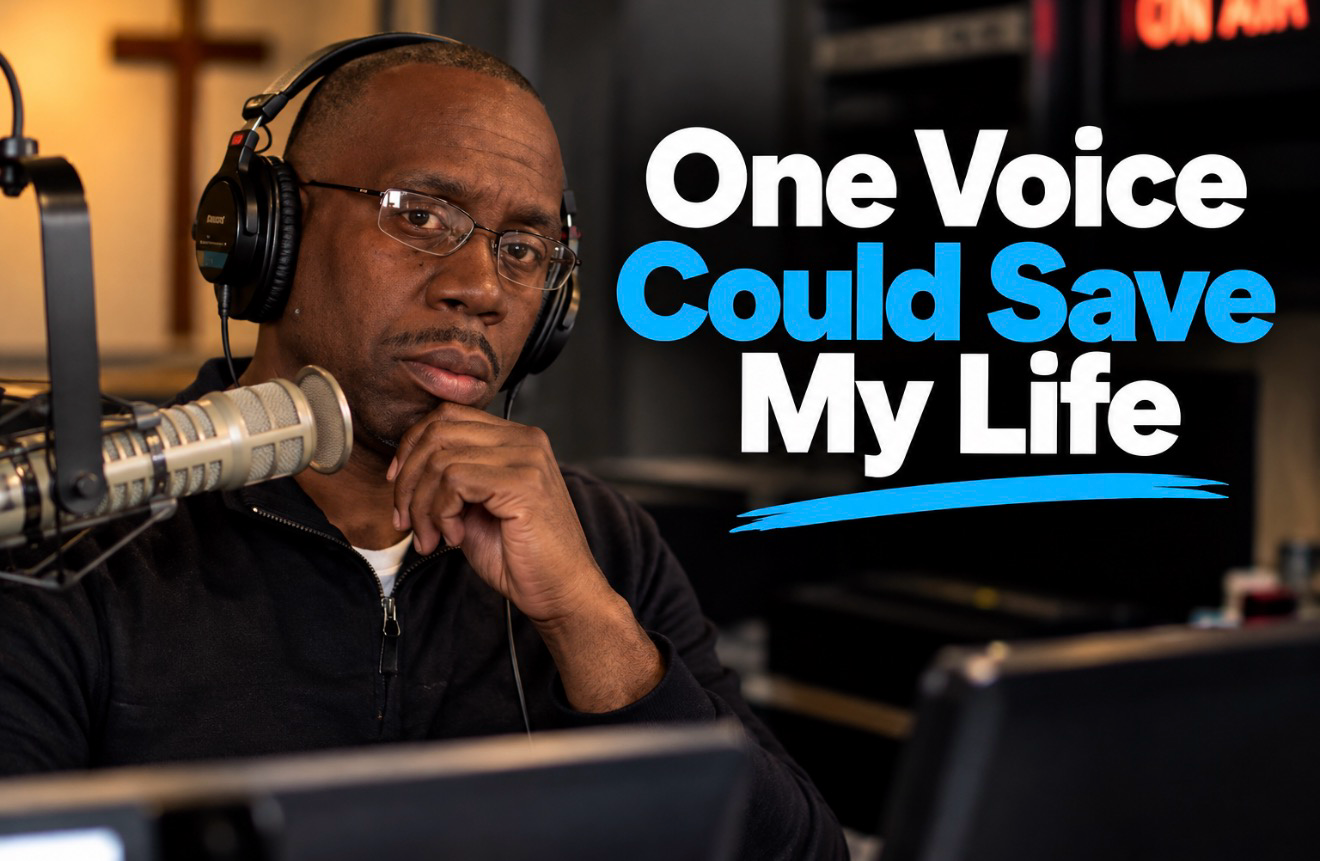
Steven Mills | Publisher, On The Dial
I’ve spent much of my life believing that radio could change lives. I’ve watched microphones bring communities together, seen broadcasters raise money for families they had never met, and witnessed complete strangers respond to a voice coming through their speakers as though it belonged to an old friend. But after surviving cancer twice, undergoing a bone marrow transplant, and now fighting end-stage kidney failure, I find myself depending on the very thing I’ve spent my career believing in. Somewhere in America, there may be a person whose kidney could save my life, and I’m counting on the power of communication to help us find each other.
On Wednesday, October 28, I returned to The TJ Show for my second conversation with TJ and his team. What unfolded was more than another radio interview. It was a reminder of what happens when talented broadcasters understand that sometimes the most important thing they can do with their platform is help another human being.
And before the conversation ended, TJ had helped me explain something I’ve been trying desperately to get the world to understand.
I’m not asking famous people to save my life. I’m asking them to help me find the person who might.
Those words have become the heart of my campaign.
And after Wednesday’s broadcast, I believe it’s time to turn them into something much bigger.
The Interview That Became a Mission
When TJ first welcomed me onto his program earlier this month, I was already in the middle of an extraordinary and frightening journey. I’m a Kansas pastor, husband, father, and longtime broadcaster who has survived Hodgkin’s lymphoma, a bone marrow transplant, and colorectal cancer.
Unfortunately, the treatments that helped save my life also contributed to the destruction of my kidneys.
Today, I undergo dialysis at home every day. My heart has suffered significant damage, and because I’m extremely highly sensitized, finding a medically compatible living kidney donor is extraordinarily difficult.
I don’t have the luxury of assuming that someone who wants to donate will automatically be a match.
The medical odds are complicated.
The waiting is exhausting.
And the clock doesn’t stop because I’m tired.
That’s why I keep telling my story.
When TJ and his team invited me back, they weren’t simply filling airtime. They were giving me another opportunity to reach somebody who might not have heard the first interview.
That is an extraordinary gift when you’re searching for one person among millions.
What impressed me most was that TJ remembered the larger story. He understood the challenge, recognized the strategy behind my unusual public appeals, and approached our conversation with both compassion and curiosity.
He didn’t just ask what had happened since our last conversation.
He helped listeners understand why I was still fighting so hard to be heard.
Yes I’m Asking Billionaires for Help and No I Don’t Want Their Money
During the interview, TJ discussed my public appeals to Elon Musk, Mark Zuckerberg, MrBeast, Joe Rogan, Robin Roberts, MD Motivator, Sarah Hyland, Bob Iger, and Josh D’Amaro.
It’s quite a collection of names.
If I added a few more, I could probably organize the world’s strangest celebrity dinner party.
Imagine Elon discussing artificial intelligence, Zuckerberg checking the engagement numbers, MrBeast announcing that the last person to leave the table wins a million dollars, and Joe Rogan asking whether anybody has considered the possibility that the kidneys are hiding in another dimension.
Meanwhile, I’d just be sitting there wondering whether anyone remembered to bring the transplant specialist.
But behind the humor is something deadly serious.
I am not asking these people for their money.
I am asking for their voices.
Their audiences.
Their influence.
Their ability to reach millions of people with a single post, video, interview, or message.
Because somewhere in those millions could be the person who is medically compatible with me.
And that person may have never heard my name.
They may have no idea that a pastor in Garden City, Kansas, is searching for them.
They may be watching a video, listening to the radio, scrolling through Instagram, or reading something a friend shared.
And then, perhaps, they see my story.
One share could reach one person who could change the rest of my life.
That’s the entire strategy.
It’s not complicated.
But it requires people to care enough to help.
TJ Asked a Question That Deserves a Much Bigger Conversation
At one point, TJ brought up the remarkable technology available to some of the people I’ve been challenging.
Artificial intelligence can process enormous amounts of information. Technology companies can connect billions of people. New discoveries are changing medicine in ways that would have seemed impossible just a generation ago.
So why couldn’t some of that technology help locate a compatible donor?
I loved the question.
Naturally, I suggested that perhaps somebody could simply print me a kidney.
I’m aware that functioning transplant-ready kidneys are not something you can currently order from a 3D printer.
Frankly, my relationship with ordinary printers is already complicated enough.
I have spent more time than I care to admit arguing with machines that insist they are out of paper while sitting directly beside an entire stack of it.
I’m not quite ready to let one manufacture an internal organ.
TJ joined in the humor, imagining what medical technology might accomplish someday.
And we laughed.
For a moment, the heaviness of kidney failure gave way to something every patient needs occasionally.
A reason to smile.
But the question underneath the laughter deserves serious attention.
If technology can connect people across continents in seconds, could those same tools help more transplant patients reach potential living donors?
Could a social-media platform use its enormous reach to spread donor awareness?
Could a technology company help people better understand the living-donor evaluation process?
Could one of the world’s most influential individuals simply say, “This man needs help finding a compatible kidney. Please take a look”?
That alone could be enormously valuable.
I’m not asking artificial intelligence to perform a miracle.
I’m asking the people who control extraordinary communication tools to help make a lifesaving human connection possible.
Something TJ Said Stayed With Me
During the conversation, TJ told me he respected my determination.
I appreciated that more than he probably realized.
When people see the videos, the celebrity appeals, the social-media graphics, and the emails, they see a campaign.
What they don’t always see is the man behind it.
They don’t see the difficult mornings.
They don’t see the nights when sleep doesn’t come easily.
They don’t see the exhaustion that can accompany dialysis or the emotional weight of knowing that your family is living with the same uncertainty you are.
They don’t see the father who wants more years with his daughter.
The husband who wants more anniversaries with his wife.
The pastor who wants to keep serving his congregation.
The broadcaster who still has stories to tell and people to encourage.
There are days when I would love to close the laptop, put down the phone, stop asking strangers for help, and pretend everything is normal.
But I can’t.
Because the need is still there.
And because somewhere out there, I believe my one may still be waiting to hear about me.
TJ understood that my determination wasn’t about publicity.
It was about survival.
And hearing that understanding expressed over the air meant something deeply personal.
The People Behind the Show Deserve Their Flowers
I’ve worked in radio long enough to know that what listeners hear is only part of what makes a great program.
Behind every successful show are people coordinating guests, preparing segments, managing the clock, producing content, and making sure the host doesn’t accidentally spend the entire morning discussing something that was supposed to take ninety seconds.
And let’s be fair.
Some radio personalities can turn a ninety-second break into a documentary series.
I’ve probably been guilty of that myself.
But great radio requires more than a talented person behind a microphone.
It requires a team that understands timing, chemistry, and the importance of the stories being told.
TJ and his team gave me something I didn’t expect to feel quite so strongly.
They made me feel welcome.
They made me feel heard.
And most importantly, they made me feel that my story mattered beyond the few minutes allotted for an interview.
The conversation had humor without trivializing my condition.
It had compassion without becoming a pity party.
It had urgency without turning my medical situation into a spectacle.
That’s not always an easy balance to achieve.
And the fact that the program planned to mention my story again later in the show made the opportunity even more meaningful.
Every mention of FindMyOne.org is another opportunity.
Every listener is another potential connection.
Every share could reach somebody who knows somebody.
To TJ and everyone involved in making these appearances happen, I want to say thank you.
Not the kind of thank-you you send after a routine interview.
The kind you offer when somebody has given you a little more hope.
Because that’s what you’ve done.
There Is a Financial Fight Happening Alongside the Medical One
During Wednesday’s conversation, TJ also asked about the financial reality of living with kidney failure.
I explained that when my associated dialysis expenses and ongoing needs are added together, the costs can approach $2,800 a month.
That figure represents more than a line in a budget.
It represents the ongoing financial pressure that comes with trying to remain healthy enough for a transplant while navigating the expenses of treatment, supplies, travel, and daily life.
I’ve learned that medical bills have an extraordinary ability to arrive on time even when absolutely nothing else in your life is running on schedule.
And apparently, telling a billing department that I’m waiting on a miracle does not qualify as an approved payment arrangement.
I’ve checked.
Well, not literally. But judging from the statements, I’m reasonably confident.
The generosity of people who have donated to my fundraiser has helped pay substantial medical bills and made it possible to keep moving forward.
I am grateful beyond words.
But the financial need continues.
I am also preparing for additional transplant evaluations at Cedars-Sinai and NYU, which bring more travel and related expenses.
Those evaluations are part of my effort to explore every medically appropriate opportunity to find a compatible kidney.
TJ made sure listeners understood that FindMyOne.org isn’t simply a place to read about my story.
It’s a place to learn about living kidney donation, connect with information about my donor search, and find ways to offer financial support.
And for somebody living through this reality, that kind of practical help matters enormously.
October 28 Cannot Be Just Another Interview
This is where I want to change the conversation.
Wednesday’s appearance should not become another entry on a list of media interviews.
It should become a new beginning.
A renewed national push.
A moment when we take a recorded conversation that explains the mission clearly and put it in front of people who can help carry it further.
Because we now have something powerful.
We have TJ asking the questions that ordinary listeners might ask.
We have laughter that makes an otherwise frightening subject approachable.
We have a clear explanation of why finding a compatible donor is so difficult.
And we have a message that can be understood by anyone, regardless of whether they know anything about kidney transplantation.
I’m not asking famous people to save my life. I’m asking them to help me find the person who might.
I want that message to reach the editors and reporters at PEOPLE, including Toria Sheffield, whose recent story about Ocean Peace Silva donating a kidney to his mother, Lisa, demonstrated the extraordinary difference living donation can make.
Their story is about a family that found its lifesaving donor.
Mine is about a family still searching.
Both stories deserve to be heard.
I want Mark Cuban to hear this interview.
Mark has demonstrated that he understands how important access and affordability can be in healthcare. I’m asking him to consider whether his voice and network could help someone facing an extraordinarily difficult donor search.
I want Robin Roberts to hear it.
Robin knows firsthand what it means to confront a serious medical crisis and depend on the generosity of another person. Her experience and compassion could help people understand why this matters.
I want Mark Zuckerberg to hear it.
Not because I expect him to personally solve kidney failure, but because the platforms he helped build connect an astonishing number of people. Imagine what could happen if even a small fraction of that reach were directed toward living kidney donor awareness.
And I want Elon Musk, MrBeast, Joe Rogan, MD Motivator, Sarah Hyland, Bob Iger, Josh D’Amaro, and anyone else with an extraordinary platform to hear it.
Not because they’re obligated to help.
Not because they’re responsible for my condition.
But because they have the ability to place a message in front of people I could never reach on my own.
I’m asking each of them for something simple.
Give my story a moment of your audience’s attention.
That’s all.
No check required.
No elaborate production.
No celebrity appearance necessary.
A share. A short video. A mention. A conversation.
One small act of amplification could make an enormous difference.
And Now I Have Something to Ask the Radio Industry
To every radio broadcaster reading this, I want you to think about what our industry has accomplished over the years.
We’ve raised money for families facing unimaginable hardships.
We’ve helped communities recover from disasters.
We’ve reunited people.
We’ve supported hospitals, food banks, schools, veterans, and countless local causes.
We’ve proven that a voice on the radio can move people to action.
Now I’m asking whether we can use that same power to help find one medically compatible kidney donor.
I’m not asking you to interrupt your programming for an hour.
I’m not asking you to change your format.
And I’m certainly not asking the consultant to approve a new category called Adult Contemporary Kidney Awareness.
Although, knowing radio, somebody would probably try to trademark it by Friday.
I’m asking you to share this interview.
Talk about the story.
Mention FindMyOne.org.
Invite me onto your program if you believe the conversation could help.
And encourage your listeners to learn about living kidney donation through legitimate medical channels.
A morning show in Kansas City might reach somebody in Missouri.
An afternoon personality in Atlanta might reach somebody in Georgia.
A syndicated program could introduce this story to dozens of markets in a single broadcast.
A radio station’s Facebook page could reach somebody who never turns on the radio at all.
We don’t know where the right person is.
That’s why the message has to travel.
This Is Not About Becoming Famous
I want to make one thing unmistakably clear.
I do not want to be known as the man who spent the rest of his life looking for a kidney.
I want to be the man who found one, recovered, and went back to doing the things he loves.
I want to keep preaching.
Keep writing.
Keep broadcasting.
Keep serving people.
Keep watching my daughter grow up.
Keep making memories with my wife.
Keep showing up for the people who count on me.
And maybe, someday, I want to be the person who gets to tell another frightened patient that there is still hope.
But first, I have to get through this.
And I cannot do it alone.
That’s why I’m grateful to TJ and his team.
They understood something that I hope more people will understand after hearing Wednesday’s interview.
The purpose of this campaign isn’t to make me famous.
It’s to help me stay alive.
One Voice Could Save My Life
I don’t know who will ultimately help me find my compatible donor.
It could be somebody who hears this interview on the radio.
It could be somebody who sees a post from Mark Cuban or Robin Roberts.
It could be somebody who follows Mark Zuckerberg, Elon Musk, or MrBeast.
It could be somebody who reads PEOPLE.
It could even be somebody who reads this very article and decides to share it with one more person.
That’s what makes this both terrifying and hopeful.
The person who might help save my life could already be out there.
We simply haven’t found each other.
So I’m asking everyone reading this to do three things.
Share my story. You never know who may see it.
Learn about living kidney donation. A transplant center can explain the evaluation process and determine whether someone might be a suitable donor.
Help financially if you can. The costs of surviving while waiting for a transplant continue, and every contribution makes a difference.
Visit https://FindMyOne.org to learn more and find the appropriate links.
And to TJ and his entire team, I want to say something from the heart.
You didn’t just invite me onto your program.
You helped explain my fight to people who may never have understood it otherwise.
You gave me room to laugh when laughter is sometimes hard to find.
You treated me like a fellow broadcaster, not simply a medical diagnosis.
And you reminded me that the human connection behind a microphone still matters.
I’ve spent much of my life believing in the power of radio.
Today, I’m trusting that power with my own life.
October 28 was not the end of an interview. I hope it was the beginning of the breakthrough I’ve been praying for.
Because millions may hear my story.
But I am still searching for one.
And maybe, just maybe, that one is listening right now.
Rev. Dr. Steven Mills is the Senior Pastor of First Baptist Church in Garden City, Kansas, a longtime radio broadcaster, and founder and publisher of On The Dial. He is a two-time cancer survivor undergoing daily dialysis while searching for a compatible living kidney donor.
Hear the October 28 interview and learn how to help at https://FindMyOne.org.
On The Dial — Because sometimes the most important thing a microphone can do is help someone live long enough to tell another story.
#FindMyOne #DoYouSeeMe #TheTJShow #StevenMills #KidneyDonor #LivingKidneyDonation #KidneyTransplant #RadioCares #RadioFamily #OnTheDial #MarkCuban #RobinRoberts #MarkZuckerberg #ElonMusk #MrBeast #JoeRogan #ShareMyStory #LoveOutLoud