


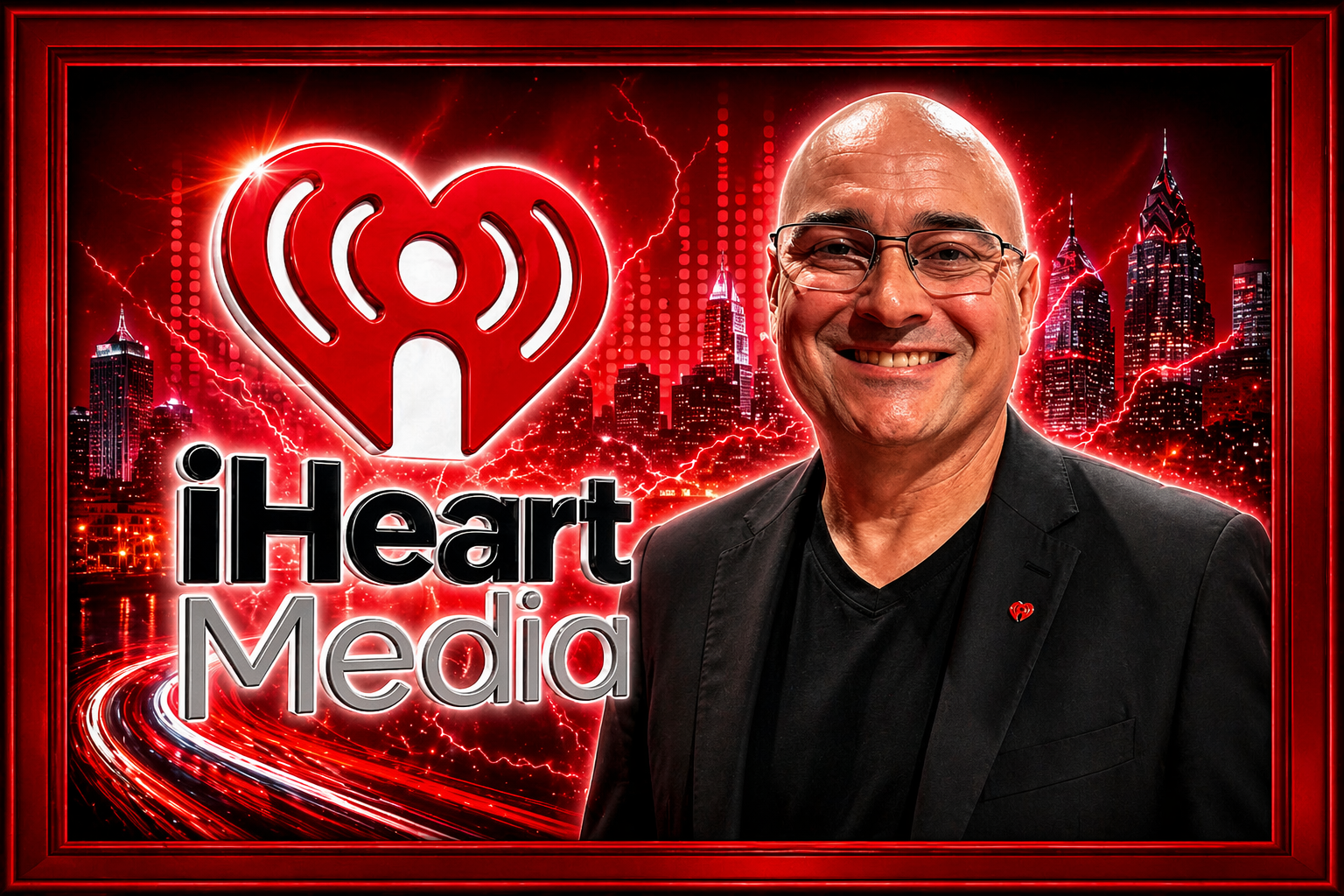
This isn’t a move.
This is a power shift.
Jeff Hurley isn’t leaving anything behind—he’s adding to it.
While many in the industry initially viewed this as a traditional market assignment, let’s set the record straight: Hurley will retain his role as Executive Vice President of Programming for iHeartMedia’s National Programming Group while simultaneously stepping in as Senior Vice President of Programming for iHeart Philadelphia.
That means this isn’t a relocation.
This is an expansion of influence.
This is corporate strategy being embedded directly into a major market.
And that changes everything.
Because now, one of the company’s top programming architects—someone who already helps shape sound, strategy, and structure across multiple markets—is taking direct oversight of one of iHeart’s most important clusters.
Philadelphia just became more than a market.
It became a model.
According to confirmed industry reporting and company-aligned information, Hurley will oversee a powerhouse lineup that includes WDAS-FM, Power 99, Q102, ALT 104.5, Rumba 106.1, and The Gambler. That’s a multi-format ecosystem requiring precision, balance, and vision.
And now it’s sitting in the hands of someone who already operates at the highest level of the company.
Let me make this personal for a moment—because this one hits home.
I’ve worked with Jeff Hurley.
I’ve worked for Jeff Hurley.
Back when I was Program Director at 95.1 WZZO in Allentown—a major Lehigh Valley rock station—Hurley was already demonstrating what separates real leaders from title holders.
Calm.
Focused.
Decisive.
He knows radio—not just how it sounds, but how it works.
Solid programmer.
Solid leader.
And in today’s environment, that combination isn’t just valuable—it’s necessary.
Hurley’s path to this moment has been anything but accidental. He’s been part of the iHeartMedia ecosystem for more than two decades, rising through programming ranks across multiple markets before stepping into the national spotlight as EVP within the company’s programming leadership structure.
That national role doesn’t go away.
It stays.
Which means this Philadelphia move isn’t a step down into market work—it’s a layer added on top of an already influential position.
Think about that.
The same executive helping guide programming philosophy across iHeart’s national footprint is now directly shaping one of its largest and most competitive markets in real time.
That’s not common.
That’s intentional.
And it signals something bigger happening inside the walls of iHeartMedia.
Because when you place a corporate EVP into direct market oversight without removing their national responsibilities, you’re doing more than filling a role—you’re creating alignment between vision and execution.
Top-down meets ground-level.
Strategy meets reality.
And if done right? That’s where the magic happens.
This transition also reflects internal alignment rather than disruption. Existing leadership within the Philadelphia cluster remains part of the structure, ensuring continuity while Hurley operates at a higher strategic level across brands.
That’s not a rebuild.
That’s reinforcement.
From a programming standpoint, this gives iHeart the ability to test, refine, and deploy strategies in a major market with direct input from one of its top decision-makers.
From a business standpoint, it strengthens consistency across the company’s portfolio.
And from an industry standpoint?
It’s another clear sign of where radio is heading.
Fewer silos.
More centralized leadership.
More integration between corporate vision and local execution.
Now let’s talk about what Philadelphia represents.
This is not a plug-and-play market.
This is not a “set it and forget it” situation.
Philadelphia demands authenticity. It demands connection. It demands programming that understands the heartbeat of the city.
And now, that responsibility sits with someone who has built his reputation on understanding both people and product.
Hurley himself has acknowledged the weight of leading heritage brands that carry decades of community connection—and that awareness matters. Because in a market like Philly, legacy isn’t something you inherit.
It’s something you protect.
And if you’re bold enough—something you elevate.
So what does this all mean moving forward?
It means Philadelphia becomes a proving ground for high-level programming integration.
It means iHeart is tightening the loop between corporate strategy and market execution.
And it means Jeff Hurley is now operating on two levels at once—national architect and market leader.
That’s not easy.
But then again… not everyone is built for this level.
Hurley is.
And now the rest of the industry gets to watch what happens when one of the company’s top programming minds puts his hands directly on the wheel of a major market—without ever letting go of the bigger picture.
On The Dial covers breaking radio industry news, including layoffs, programming changes, talent moves, and broadcast trends across the United States.