


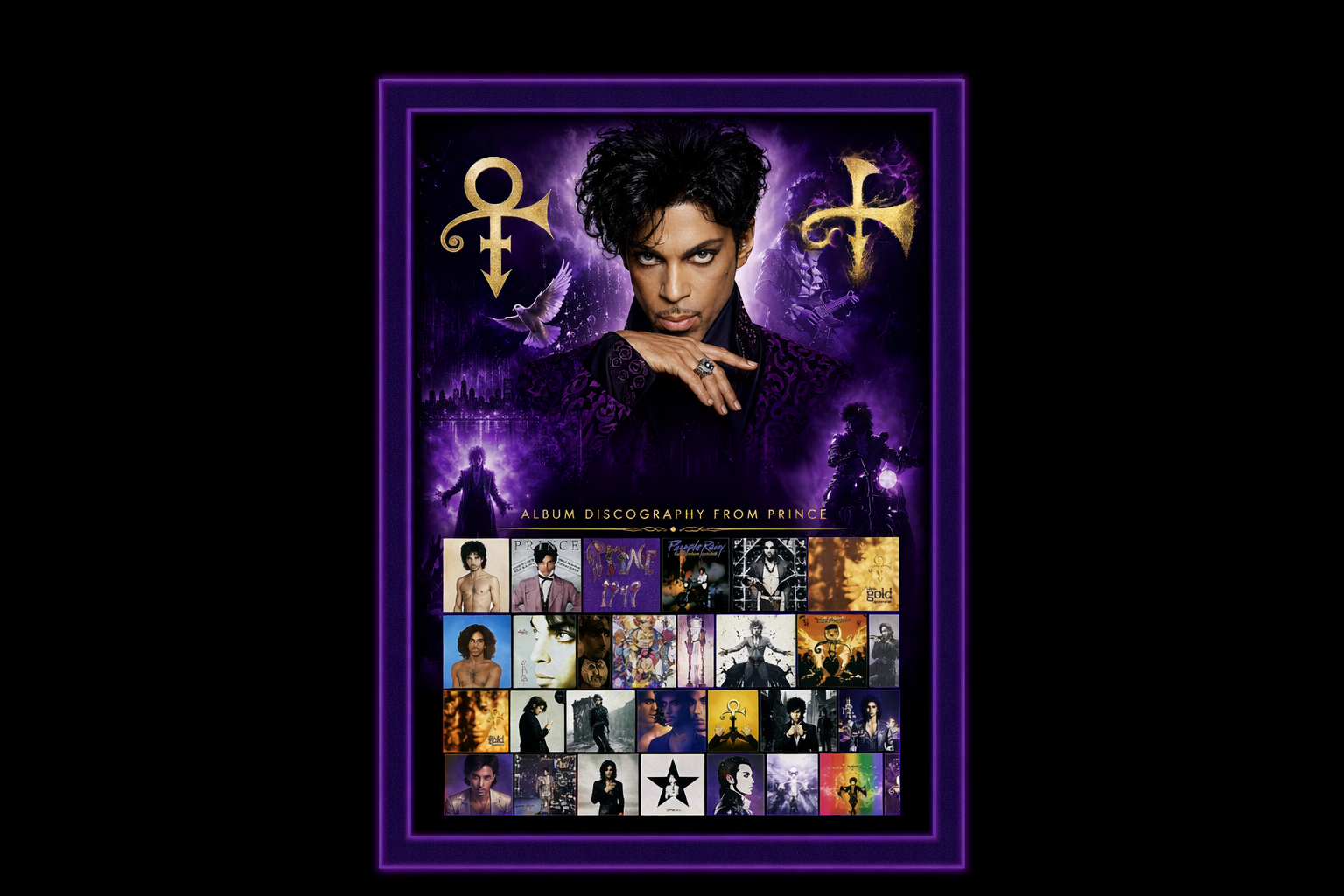
Ten years ago today, the music stopped in the most unnatural way possible.
On April 21, 2016, Prince was found dead at Paisley Park in suburban Minneapolis. He was 57. Authorities later said he died from an accidental fentanyl overdose. A full decade later, that date still lands like a power chord that never really resolves, because Prince was never just another artist on the playlist. He was a format-breaker, a category wrecker, a sonic disruptor before the industry had a polished phrase for disruption.
And maybe that is the only honest place to begin this story.
Because when you talk about Prince and radio, you are not just talking about spins, charts, adds, rotations, or whether a PD thought a song tested well in morning drive. You are talking about a man whose very existence exposed how rigid the music business used to be, how racialized radio lanes were, how frightened the industry could be of anything it could not easily label, and how a true original had to punch through every wall in the building before the building finally claimed it loved him.
Prince did not come along and fit radio.
Prince came along and made radio explain itself.
That mattered then, and it still matters now.
By the numbers alone, Prince eventually became too big to deny. He logged 47 Hot 100 hits, including 19 top 10s and five No. 1 records. “I Wanna Be Your Lover” became his first major pop breakthrough. A few years later, “When Doves Cry” hit No. 1 and helped drive the kind of mass-market explosion that turns an artist into weather.
But before Prince became unavoidable, he had to survive the old machinery.
And that machinery was built on compartments.
Black radio. Pop radio. Rock radio. Urban radio. AOR. Crossover. Specialty. Rhythm. Adult. Young. Safe. Not safe.
The industry loved boxes because boxes are easier to sell than brilliance.
Prince was never going to stay inside one.
Scholarly work on Prince’s relationship with Black audiences and radio notes that he received heavy airplay on Black FM stations in major cities well before the mainstream industry fully caught up. That is important, because the mythology sometimes makes it sound like Prince simply erupted from the sky fully formed and universally embraced. He was not. He was built in part by stations and audiences willing to hear something the larger system had not yet figured out.
That is where the radio story gets real.
Before Prince was the purple giant, he was the artist who could confuse gatekeepers. He sounded Black, but not only Black. He sounded rock, but not only rock. He sounded pop, but not disposable pop. He had funk in his bloodstream, punk in his attitude, church in his phrasing, sex in his records, and enough guitar firepower to melt the assumptions of anybody who thought they already knew what a Black artist was supposed to sound like on the radio.
That was not easy territory in the late 1970s and early 1980s.
This was still an era when radio formats often reflected the industry’s deeper segregation. Black stations were often treated like a proving ground. They would break an artist first, only to watch labels and mainstream outlets shift attention elsewhere once that artist crossed over. Prince’s music had already been a staple on Black-formatted stations for years before his crossover success was fully embraced by Top 40, and that remains one of the clearest windows into how the system worked.
Part of Prince’s radio story is not just triumph. It is tension.
It is Black radio helping build the house and then being told to stand outside once the neighborhood got expensive.
That was not unique to Prince, but Prince’s rise made the contradictions impossible to miss.
And here is what made him even more dangerous to the old system: he was not trying to become acceptable to one lane. He wanted all of it.
So when people talk about Prince crossing over, let us be careful with that phrase.
Because Prince was not crossing over into legitimacy.
He was exposing the illegitimacy of the boundaries.
Radio had to catch up with him.
And not every room welcomed him when he arrived.
The famous 1981 Rolling Stones opening-slot disaster still stands as one of the clearest early snapshots of what Prince was up against. That mostly white stadium crowd met him with hostility. The moment has endured in music history not just because it was ugly, but because it revealed how race, masculinity, performance, and rock gatekeeping all collided when Prince walked onstage as himself.
But here is the miracle in the madness.
He did not retreat into something safer.
He got louder.
He got sharper.
He got more Prince.
And once radio began to feel the full force of records like “Little Red Corvette,” “1999,” “When Doves Cry,” “Let’s Go Crazy,” “Purple Rain,” “Kiss,” and “Raspberry Beret,” the walls started falling in chunks. He did not merely score hits. He moved between radio worlds that were not designed to make that movement comfortable.
That is why Prince remains such an important radio figure.
Not because he gave radio what it wanted.
Because he forced radio to expand its appetite.
And Prince understood radio in ways that were deeper than promotion schedules and label visits. Radio for Prince was not only a delivery system. It was culture. Memory. Local connection. Community. Atmosphere. Identity.
That is what some younger industry people can miss now.
Before algorithms learned your habits, radio was where a city taught you what it loved.
Radio was where taste got baptized in repetition.
Radio was where mystery lived.
Radio was where a kid heard something after dark that did not sound like anything else in the neighborhood and suddenly knew the world was bigger than the block.
Prince belonged to that world, but he also widened it.
And he did it without sanding off the edges that made him frightening to lesser imaginations.
That is what made him so powerful on the air.
A Prince record did not just fill a slot.
It changed the temperature of the room.
When “When Doves Cry” came on, the record did not ask permission. It trusted atmosphere. It trusted tension. It trusted nerve. Radio loves formulas until a genius shows up and reminds everybody that listeners also remember the moments when someone dares to break one.
Prince specialized in those moments.
He also understood event radio before the term became industry jargon. A Prince single felt like something happening. A Prince premiere felt like electricity. A Prince hit was not passive audio wallpaper. It was conversation fuel. It was fashion. It was sexuality. It was risk. It was a statement piece masquerading as a song you could dance to.
And that is why radio needed him as much as he needed radio.
Because great radio has never only been about familiarity.
Great radio is about surprise with enough precision to feel inevitable once it lands.
Prince could do that over and over again.
He could hand a station a song that felt too Black for one format, too rock for another, too sensual for another, too weird for another, and then watch every one of them eventually surrender because the record was undeniable.
That is a broadcaster’s dream and nightmare at the same time.
Dream, because once it hits, you own a moment.
Nightmare, because vision requires courage before consensus shows up.
Prince exposed which programmers had ears and which ones only had categories.
And then there is the larger lesson for radio now, ten years after his death.
If Prince were breaking today, would the industry recognize him faster?
Maybe.
Or maybe it would just build new boxes with better software.
That question should make every programmer, consultant, music director, and market manager just a little uncomfortable.
Because radio still has a habit of loving originality after somebody else has already proven it works.
Prince’s life is a reminder that some of the biggest wins in music come from records that did not neatly fit the existing plan. The same business that now celebrates his genius once had to be dragged toward it.
That is not just Prince history.
That is industry history.
And in the radio business, that means this story is not only about him.
It is also about us.
About who gets believed first.
About which stations take the risk first.
About which communities build the momentum first.
About who gets erased once the money gets bigger.
About whether we can hear innovation before somebody else hands us a research sheet telling us it is safe.
Prince made the airwaves bigger. He made radio more elastic. He made it harder to pretend that Blackness, rock, pop, sensuality, virtuosity, and experimentation had to live in separate neighborhoods. He proved that a song could be musically elite and still hit the masses. He proved that mystery could market. He proved that musicianship could still matter in a hit culture. He proved that the format walls were weaker than the people defending them.
And ten years after his death, that may be the part of the legacy radio should think about the hardest.
Not merely that Prince had hits.
Not merely that Prince was iconic.
It is that Prince was a test.
And radio, over time, either passed that test or got left looking old.
Today, on the tenth anniversary of his death, the records still sound alive because they were never built for one era. They were built to outrun one. That is why Prince still feels current when so many of his contemporaries feel archived. That is why a Prince song still cuts through clutter. That is why his catalog still feels like a dare. And that is why the radio story matters, because radio was one of the battlegrounds where the industry had to decide whether it wanted something safe or something unforgettable.
Prince was unforgettable.
He still is.
And for everybody in radio who has ever fought to get a record heard that did not fit the preset lane, Prince remains the patron saint of beautiful disruption.
Ten years gone.
Still louder than most of what followed.
-JPS