


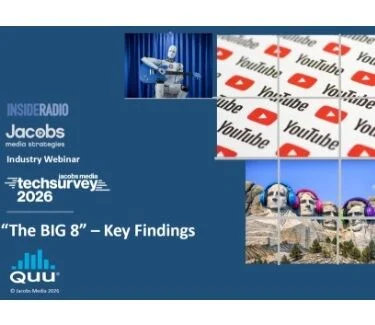
Fred Jacobs’ Techsurvey 2026 is out, and the headline number is impossible to ignore: of all the time core listeners spend with their favorite station, 54% is still on a traditional radio, while 44% is now digital.
That gap used to be 71 points. Now it’s just 10 — and it’s closing fast.
Here’s the part that should make every station manager uncomfortable: radio’s core audience in this survey now averages 58.4 years old. One in three respondents is 65 or older.
We love to pat ourselves on the back about digital growth, but let’s be honest — we’ve had more than a decade to make streaming radio easy, and most stations are still a nightmare to find on smart speakers. The interface is clunky. The skills fail too often. And Nielsen still barely captures much of that listening accurately.
We’re celebrating a narrowing digital gap while our measurement system is stuck in the analog era and our user experience feels like it hasn’t evolved in years.
That’s not a trend.
That’s a warning.
And here’s the part that should really get your attention.
This entire survey — more than 31,000 respondents — is made up of people who already love radio enough to take a 20-minute survey about it. These aren’t casual listeners. These are the believers. The loyalists.
So when we see an average age of 58.4 years old, that’s not necessarily the true age of radio listeners across the country.
It’s the age of the people who still care enough to engage deeply.
Younger audiences aren’t always abandoning radio. Many of them simply aren’t showing up in the data. They’re not being reached effectively, and when they are, they’re not responding in the same ways.
We’re measuring the enthusiasm of our most loyal, aging listeners and treating it like a full-market snapshot.
That’s not a complete picture.
Let’s call it what it is.
We’ve spent years talking about how “radio is thriving digitally,” yet many stations still make it harder than it should be to listen. Ask a smart speaker to play a specific station in another market and see what happens. It’s inconsistent at best. Apps are often bloated. Websites lag. And even when listeners do find the stream, the measurement systems still don’t fully account for it the way they do over-the-air listening.
We’re celebrating that digital listening is approaching half of total usage while relying on systems built for a different era.
The gap isn’t just closing because digital improved.
It’s closing because traditional listening is declining faster than digital is rising.
That’s not a win.
That’s a shift.
And it demands honesty.
This isn’t about declaring radio dead. It’s about recognizing where it actually stands. The Techsurvey is telling us something important: our most engaged listeners are aging, our digital experience still needs serious work, and our measurement systems are struggling to keep up with how people actually listen today.
We don’t have a discovery problem.
We have a clarity problem.
Until we improve the smart speaker experience, demand better digital measurement, and stop assuming that highly engaged older listeners represent the entire future audience, we risk misreading the moment we’re in.
The data is speaking clearly.
The only question left is whether we’re willing to truly hear it.
On The Dial covers breaking radio industry news, including layoffs, programming changes, talent moves, and broadcast trends across the United States.