


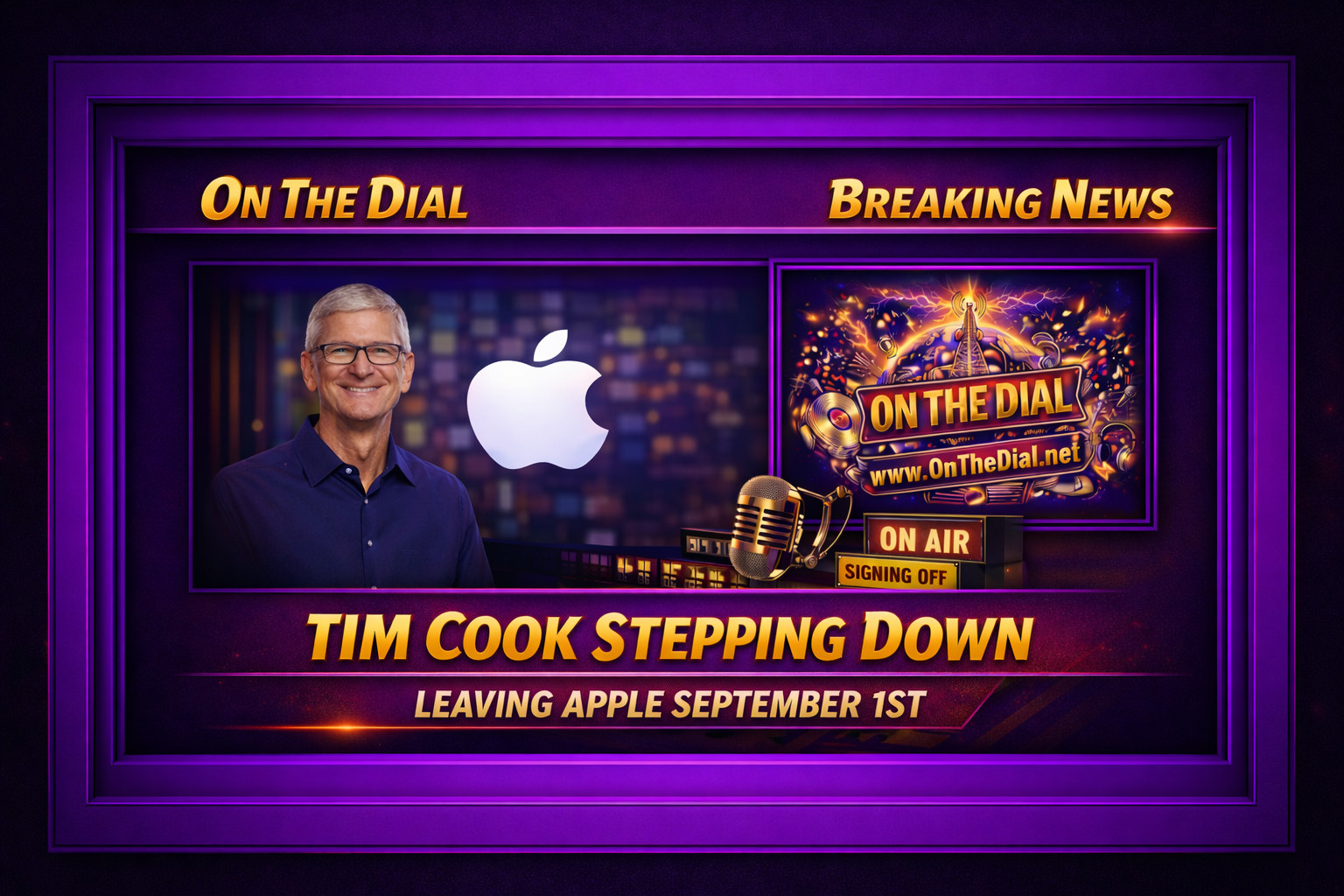
Apple just made one of the biggest corporate moves in modern technology, and this one is not minor, symbolic, or tucked away in some quiet leadership memo. Tim Cook is stepping down as CEO of Apple effective Sept. 1, with longtime hardware chief John Ternus set to take over. Cook will remain with the company as executive chairman, which means this is not a vanishing act, but it is absolutely the end of an era. Apple confirmed the transition Monday, and multiple major outlets quickly matched the reporting.
That matters because Tim Cook did not merely keep Apple alive after Steve Jobs. He stabilized it, expanded it, industrialized it, monetized it, globalized it, and turned it into a machine so massive that the rest of the technology business has spent the better part of the last decade reacting to Apple’s direction, whether they wanted to admit it or not. Under Cook, Apple says its active installed base climbed to more than 2.5 billion devices, its workforce grew by more than 100,000 team members, and its retail footprint stretched to more than 500 stores. In Apple’s most recent quarterly report, the company posted $143.8 billion in revenue for fiscal first quarter 2026, up 16% year over year, with all-time records for total company revenue and earnings per share.
So let’s be clear about what this is.
This is not just a CEO retirement story.
This is a control-room switch at one of the most influential companies on earth.
And when Apple changes hands, the impact does not stop at phones, watches, laptops, and Wall Street. It spills into cars. It spills into streaming. It spills into podcasting. It spills into dashboards. It spills into advertising. It spills into the way people discover audio. And once that starts moving, radio feels it whether radio is prepared or not.
The immediate headline is the succession itself. Apple said John Ternus, currently senior vice president of hardware engineering, will become CEO on Sept. 1, while Johny Srouji is moving into a broader chief hardware role. Reuters described Ternus as the insider chosen to guide Apple into an industry being reshaped by artificial intelligence. That last part is the key. Apple is not simply handing the company to an operations executive to keep the lights on. It is putting a hardware-minded leader in the chair at a moment when devices, chips, software, services, and AI are all being forced back into the same conversation.
That means the next Apple chapter is likely to be more product-forward, more device-centered, and more tightly focused on how Apple’s ecosystem performs in daily life, especially in the car, in the ear, in the home, and across whatever screen or surface the company decides matters next. Cook’s Apple built a fortress. Ternus now inherits the job of making sure that fortress still feels like the future. That is not the same assignment. It is adjacent, but it is different. That is an inference based on Ternus’ background in hardware and on Reuters’ framing of the transition around AI and the industry’s next phase.
And that is where radio enters the picture.
For years, some people in broadcasting treated Apple like it was important but optional. That was a mistake then, and it would be a bigger mistake now. Apple has long had influence over how audio is consumed through Apple Music, Apple Podcasts, Siri, and CarPlay. But that influence is no longer confined to the phone screen. CarPlay became a dashboard factor long ago. CarPlay Ultra pushes even deeper, integrating more of the vehicle experience across screens. Apple says CarPlay Ultra brings together the best of the iPhone and the best of the car in a more deeply integrated environment. iOS 26 also expanded CarPlay features, and Apple Podcasts remains broadly available across Apple devices, CarPlay, and other systems.
That should make every radio executive stop and think for a minute.
Because the dashboard is not just a piece of real estate anymore. It is a battleground of behavior.
Who owns the first tap?
Who owns the voice request?
Who owns the recommendation layer?
Who owns the listener relationship when the car becomes a software environment instead of a simple receiver with presets?
Radio has lived for generations on habit, convenience, locality, companionship, and frictionless access. Those advantages still matter. But Apple keeps inserting itself at the point where friction disappears for everything else too. If a listener can ask Siri for a station, a playlist, a podcast, a news briefing, or a personalized audio stream while driving, then the old assumption that radio automatically wins the car because radio has always won the car starts getting shaky. Apple News added audio features and support in CarPlay years ago. Apple Music Radio has expanded its presence inside Apple’s services ecosystem. Apple Podcasts keeps improving listening features and, this year, rolled out a new video podcast experience that lets users move seamlessly between watching and listening.
That last piece matters more than some folks in radio may want to admit.
Podcasting is no longer just audio.
Streaming is no longer just music.
The dashboard is no longer just AM/FM.
And Apple’s future leadership is stepping in at exactly the moment those boundaries are collapsing.
So when Tim Cook steps down, radio should not read that as merely a Silicon Valley personnel story. Radio should read it as a flashing signal that the platform powers controlling consumer audio behavior are not slowing down. They are reorganizing for the next run.
Cook’s legacy, in part, is that he made Apple enormous without always making it loud. He did not need to scream to dominate. He built the kind of ecosystem that gets stronger when people stop noticing how often they are using it. That is especially relevant to radio because invisibility is power in media distribution. The strongest platform is often the one the audience stops thinking about. It just works. Apple spent years becoming that for millions upon millions of users across music, messaging, payments, wearables, services, and increasingly audio.
Now here comes Ternus.
And with him, the likely pressure increases.
The pressure on devices to matter more.
The pressure on in-car experience to become even more immersive.
The pressure on AI to become more useful, less theoretical, and more embedded.
The pressure on content companies, including broadcasters, to make themselves legible to Apple’s ecosystem instead of assuming audiences will always come find them on old terms.
If you are in radio, that means a few things right now.
First, your stream cannot be sloppy. Not in 2026. Not with this much at stake. If Apple keeps tightening the in-car and cross-device experience, then broken metadata, weak app performance, delayed starts, clunky authentication, and second-rate mobile listening become self-inflicted wounds.
Second, your spoken-word strategy had better be real. Not performative. Real. Apple Podcasts is still a major discovery environment, and Apple is now improving both the listening and video side of that experience. If radio companies still treat podcasting like leftovers or bonus content, they are playing yesterday’s game against a company that is already building tomorrow’s interface.
Third, radio needs to understand that curation is being challenged by recommendation engines, voice interfaces, and platform ecosystems. Radio still has the human edge when it is done right. Personality still matters. Urgency still matters. local still matters. Surprise still matters. A great live break still matters. But if the platform layer gets better at organizing audio around mood, context, and convenience, then radio has to become more intentionally human, more urgently local, and more distinctively alive. Background noise will get crushed.
Fourth, watch what happens in the car. Watch it very closely. CarPlay Ultra is still early, but the direction is unmistakable. The dashboard is becoming software-defined, deeply personalized, and increasingly shaped by the phone ecosystem the driver already trusts. For radio, that does not automatically mean defeat. But it absolutely means competition at a deeper level than button one through six.
Wall Street, meanwhile, is already reading today’s move in real time. Apple shares traded at $273.05 on Monday, with a market capitalization above $4 trillion according to market data returned by the finance tool. Other market coverage reported the stock slipped after the announcement, which is a reminder that even a carefully managed Apple transition still introduces uncertainty. Investors are not only asking whether Ternus can run Apple. They are asking what version of Apple he intends to run.
And that is the larger technology story tonight.
Can Apple remain Apple in the post-Cook phase while also becoming the AI-era company the market expects it to be?
Cook leaves behind an empire that is still huge, still profitable, still culturally influential, and still central to the daily digital life of a staggering number of people. But size alone does not answer the future. The next few years are going to be about who controls the personal computing layer when computing becomes more ambient, more conversational, more automotive, more wearable, and more media-aware. Apple clearly believes Ternus is the man to carry that fight.
For technology broadly, this is the biggest leadership handoff since the kind of transitions that force entire sectors to reassess their assumptions. For radio specifically, it is a wake-up call wrapped in a business story. Because the company helping shape the future of the car, the phone, the earbud, the smart speaker, the podcast app, the paid music environment, and the voice interface just changed captains.
That matters.
It matters to every broadcaster who still thinks platform companies are orbiting radio.
They are not orbiting radio.
They are building the roads listeners travel on.
And if Apple under John Ternus pushes harder into AI, in-car control, seamless device integration, and richer audio-video ecosystems, then radio will have to decide whether it wants to be easy to find, impossible to ignore, and strong enough to compete in a world where the dashboard no longer belongs to tradition.
Tim Cook’s departure closes one of the most remarkable CEO chapters in modern corporate America.
What opens next may hit the technology business first.
But radio is going to feel it too.
-JPS