


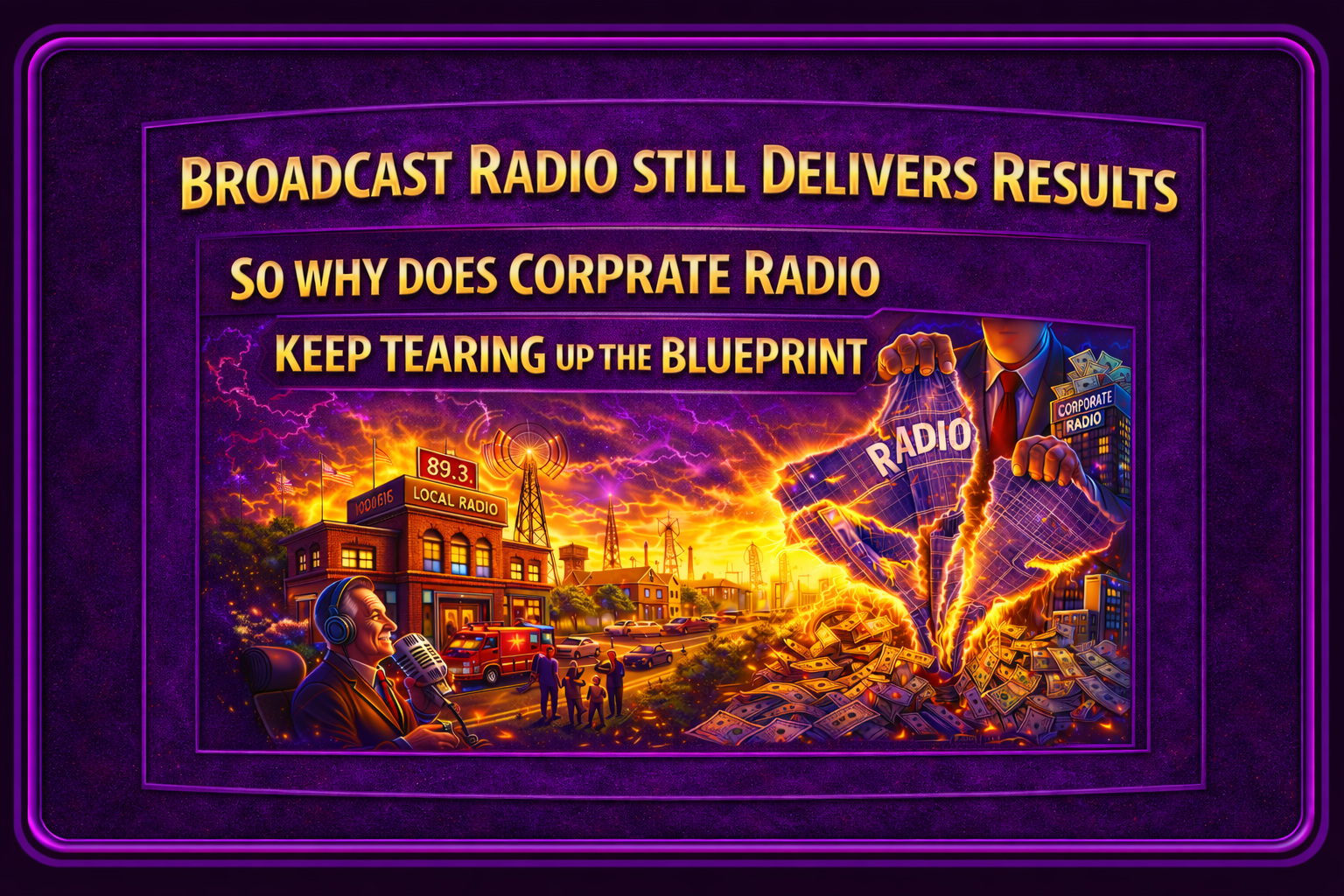
Now here is the question nobody in the big conference room seems to want asked out loud.
If broadcast radio still reaches people in massive numbers, still wins a dominant share of ad-supported audio listening, still owns the dashboard better than a whole lot of flashier platforms, and still moves product for advertisers, then why do some of the biggest radio companies in America keep acting like the answer to every problem is another layoff, another centralization move, another market stripped for parts and another station made to sound less like a hometown voice and more like an audio vending machine?
That is not a small question.
That is the question.
Because the audience story and the corporate behavior are now standing in the same room looking at each other like strangers at a bad family reunion. On one side, the industry’s own research case remains strong. The Radio Advertising Bureau says radio reaches 212 million adults 18 and older weekly and 84% of adults monthly. RAB also points to Nielsen-based findings that advertisers and agencies routinely underestimate radio’s true reach. In plain English, radio is still huge, and a lot of people who buy media still do not fully realize how huge.
On the other side, you have the ownership groups behaving like they are trying to save a ship by sawing off the lifeboats.
That is where the snide part becomes necessary, because at some point the industry deserves a little side-eye. You cannot spend all day telling advertisers that radio’s strength is trust, local connection, companionship and community relevance, then spend the evening gutting the people who create those exact things and expect everybody else not to notice the contradiction. That is not strategy. That is corporate radio trying to eat soup with a fork and then blaming the bowl.
And yes, the financial pressure is real. Audacy emerged from Chapter 11 in September 2024 after cutting debt by about 80% and becoming a private company. Cumulus just won court approval for a restructuring plan that cuts roughly $592 million in debt after reporting a 10.3% revenue decline in 2025 and a net loss of $200.7 million. iHeart reported 2025 full-year revenue that was basically flat, with fourth-quarter revenue up modestly, but also lower adjusted EBITDA and an ongoing emphasis on cost savings. These companies are not making moves in a vacuum. They are carrying debt, margin pressure, shifting ad trends and a digital fight that never clocks out.
Fine.
Say that clearly.
But then say the rest clearly too.
Because financial pressure may explain the behavior, but it does not magically excuse every dumb outcome created by that behavior. A company can be under real economic strain and still make choices that hollow out the very product it needs to protect. Both things can be true at once. That is what makes this so frustrating. Radio is not failing because nobody uses it. In many cases, the medium is still performing. The wounds are often being created higher up the ladder, where debt loads, restructuring demands and investor expectations start calling the plays.
Now let’s get to the part that should make every old-school broadcaster sit up a little straighter.
The Federal Communications Commission still says broadcasters are required by the Communications Act and by the terms of their FCC licenses to operate in the public interest, and the entire historical logic of local licensing was built around service to a specific community of license. The FCC’s own localism materials describe broadcasting as local by nature and tie licensing to serving the needs and interests of the community a station is assigned to serve.
That was the blueprint.
Not “warehouse six stations in one regional hub and pray nobody notices the weather report sounds like it was recorded by someone who thinks the county fair is in another state.”
Not “sell the hometown, move the staff, cut the local management, and call it innovation.”
Not “license the station to one city, operate it from another city an hour and a half away, and then act surprised when the audience starts feeling like the station is less neighbor and more franchise location.”
That is not what this was supposed to be.
And here is where history really matters. For years, the FCC required stations to maintain a main studio in or near their community of license. But in 2017, the FCC eliminated the main studio rule, including the requirement for full-time management and staff at that local studio. The Commission said the old rule was outdated and that broadcasters could serve communities without a physically local studio. Maybe in some cases that is true. But let’s not pretend there were no consequences. Once that local anchor got cut loose, a lot of companies took the flexibility and ran with it like they had just found the office keys to the kingdom.
And boy, did some of them run.
Run to centralized hubs.
Run to voice tracking.
Run to regional programming structures.
Run to fewer local decision-makers.
Run to buildings that save money but know less and less about the streets the station is supposedly serving.
The result, in too many places, is a radio product that still has the call letters, still has the signal, still has the tower, still has the legal city of license, but feels like it has been spiritually outsourced.
And that is where your question really lands: what is that?
It is consolidation without enough localism.
It is efficiency without enough soul.
It is compliance on paper with community service becoming a little too theoretical in practice.
And sometimes it is downright absurd.
Because yes, there are stations today where the audience is told this brand is “for” a certain city, while the programming brain trust is somewhere else, the promotions team is stretched across a region, the local on-air bench is thinner than a gas-station napkin, and the decision-makers are relying on spreadsheets, national templates and consultant language to tell them what the market “needs.” Meanwhile, the people who actually live there are left wondering why their hometown station sounds like it was assembled by a panel in an airport Marriott.
That is not local radio.
That is radio cosplay.
Now, to be fair, not every group is equally guilty in every market, and not every centralized operation is automatically bad. Some regional and hubbed structures are staffed by smart people who work hard and still fight to protect local brands. Some companies really are trying to blend efficiency with service. And technology does allow stations to respond quickly and serve audiences without the old bricks-and-mortar model in every case. But let’s stop pretending that every cut is harmless and every hub is noble. Sometimes a cut is just a cut, and sometimes a “new structure” is just a prettier way to say fewer people are left to care about the market.
The dark comedy in all of this is that the medium itself keeps making the case for its own value while parts of the corporate structure keep undermining that case in real time.
Radio still reaches enormous audiences. Great.
Then why are you weakening local lineups?
Radio still dominates much of ad-supported audio time. Great.
Then why are you reducing the local texture that helps advertisers trust the product?
Radio still matters in emergencies. Great.
Then why are you making it harder in some markets to maintain deep, immediate, lived-in local knowledge when something goes wrong?
You cannot keep bragging that radio is the campfire and then keep tossing the firewood out into the parking lot.
And that is the part that deserves a stern tone, because this is bigger than industry gossip. Broadcast licenses were not handed out so giant companies could simply maximize extraction and minimalize presence. The public-interest idea may sound old-fashioned to some executives, but it is still foundational. The station is supposed to mean something to the community it serves. Not just bill that community. Serve it. Represent it. Sound like it knows it. Be present enough that when something breaks, bleeds, floods, burns, celebrates, grieves or votes, the station is not trying to learn the market by reading yesterday’s social posts.
And let’s go one step further.
If a station is licensed to City A, sold to advertisers in City A, branded around City A, but is physically operated from City B, managed from City C, voice-tracked from City D and measured mostly by how cheaply it can be run rather than how deeply it can serve, then what exactly are we calling local at that point?
A memory?
A slogan?
A legal technicality?
Because it sure is not the older civic idea of localism the FCC used to talk about with a straight face.
Now, none of this means radio is doomed. Quite the opposite. The reason this critique matters is because the medium is still worth defending. Radio still works. Radio still reaches. Radio still influences. Radio still comforts. Radio still sells. Radio still matters in ways people outside the business often underestimate. That is precisely why the corporate behavior feels so maddening. If the product were actually dead, the argument would be over. But the product is not dead. It is wounded, sometimes by the very hands that claim to be preserving it.
So here is the twist in the story.
The scandal is not that radio no longer has value.
The scandal is that radio still has value and too many ownership groups keep behaving in ways that drain the local power out of that value.
That is what should concern people.
Not whether AM/FM still reaches people. It does.
Not whether radio can still deliver results. It can.
The real concern is whether the people running some of these companies still believe deeply enough in the local mission to protect the parts of the business that make those results possible in the first place.
Because if they do not, then what you get is exactly what you described: stations licensed to one place, emotionally absent from that place, structurally tied to another place, and in some cases engineered and operated so far away from the market that the whole “community representation” idea starts to sound like a punchline with FCC stationery on top.
What is that?
It is radio forgetting why it got the license.
And that, more than any streaming app, may be the thing that does the most damage.
-JPS