


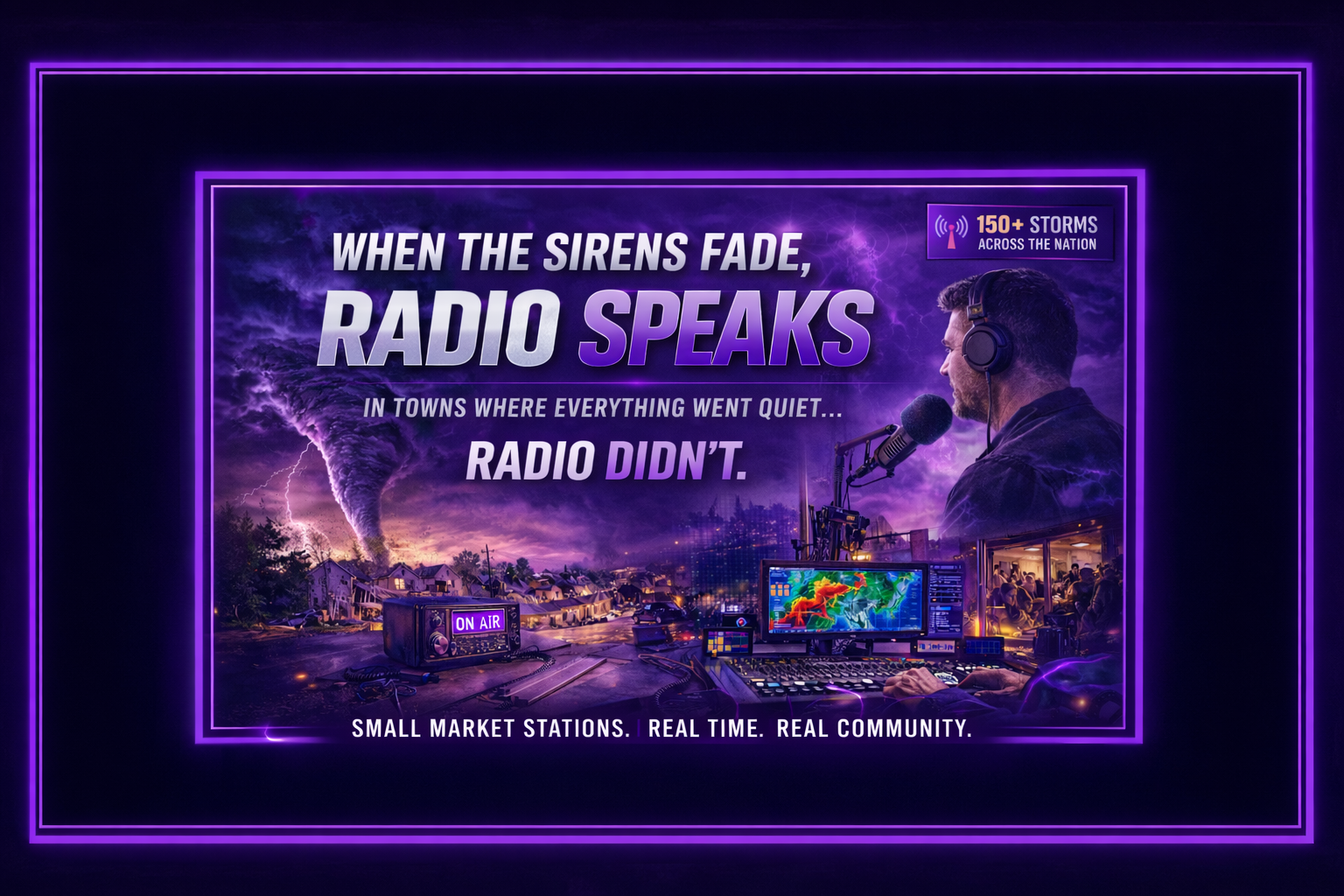
It didn’t begin with a single warning. It built throughout the day, one system feeding another, until more than 150 storms were reported across the country, stretching from the Southern Plains through the Midwest and into parts of the South. What started as watches quickly turned into warnings, and in many communities across Kansas, Oklahoma, and Texas, those warnings became reality. Skies darkened, winds intensified, and in a matter of minutes, normal life gave way to urgency.
The scale of the outbreak told the story from a distance, but the real story was local. In smaller markets, where storms are not a question of if but when, radio stations shifted without hesitation. Formats disappeared. Music stopped. What replaced it was live, continuous coverage built around one mission—keep people informed, keep people safe, and stay with them until it passed.
According to the National Weather Service, severe weather outbreaks like this require immediate access to reliable, real-time information, especially as conditions change rapidly and without much notice. That reality was felt across the Plains, where warnings stacked quickly and movement on the ground often outpaced digital updates. In those moments, the advantage belonged to whoever could speak now, not later.
That’s where local radio proved its value again.
In Kansas, stations tracked storm cells as they moved from county to county, breaking down paths in terms listeners could understand. In Oklahoma, broadcasters described rotation signatures and debris reports in real time, giving people not just alerts but context. In Texas, personalities who were hosting regular programming just hours earlier became steady voices of direction, guiding listeners toward shelter and away from danger.
There is a difference between receiving an alert and understanding what to do with it. Small market broadcasters filled that gap. They translated information into action. They took data and made it usable. They didn’t just report what was happening—they told people what it meant for their street, their neighborhood, their next decision.
Behind those microphones were people who knew their communities. They knew the roads, the landmarks, the counties, and the weak spots where storms tend to hit hardest. That familiarity turned coverage into something more than informational. It made it personal. When a broadcaster said a storm was approaching a certain highway or moving toward a specific part of town, listeners knew exactly what that meant without needing to interpret it.
As the storms intensified, infrastructure began to feel the strain. Power outages were reported in multiple areas. Cellular networks slowed under heavy use. In some places, connectivity became unreliable at the exact moment people needed it most. Radio did not face that same bottleneck. As long as a signal could be maintained, the information kept moving.
Engineers played a critical role in that effort. Backup systems were engaged. Generators were brought online. Equipment was monitored closely as conditions outside deteriorated. The work was not visible to listeners, but it was essential to keeping stations on the air when going off the air was not an option.
This is where small market stations continue to separate themselves in ways that don’t always show up in industry conversations. They are built for immediacy. They are structured for flexibility. When something breaks, they don’t wait for direction—they respond. That responsiveness becomes the difference during moments like these.
Listeners responded as well. Phones lit up with calls and messages. People shared what they were seeing, extending the reach of the broadcast beyond what radar alone could provide. Reports of hail, wind damage, and rotation added layers to the coverage, creating a real-time exchange between station and community. It was not one-way communication. It was a network.
For families taking shelter, that connection mattered. Battery-powered radios became a constant in rooms where everything else felt uncertain. Cars in driveways and garages turned into listening posts. The presence of a live voice—steady, informed, and local—brought a level of reassurance that automated systems cannot replicate.
The broader conversation around media continues to evolve, often centered on technology, distribution, and changing audience habits. Those conversations are valid, but they can sometimes overlook moments like this. Severe weather does not wait for innovation cycles. It does not adapt to new platforms. It demands clarity, speed, and trust in real time.
Radio, particularly in small markets, continues to meet that demand.
There is no delay between the moment something happens and the moment it is shared. There is no filter between the broadcaster and the listener. It is immediate, direct, and rooted in service. That model, which has defined radio for generations, remains intact when everything else is tested.
More than 150 storms moved across the country, leaving damage that will take time to fully understand. Cleanup will follow. Assessments will be made. Communities will begin the process of rebuilding. But in the middle of that disruption, there was consistency.
Stations stayed on the air.
Voices stayed present.
Information kept moving.
In an industry that often looks ahead to define its future, days like this bring the focus back to its foundation. Local connection, live delivery, and community trust are not outdated concepts. They are the reason the medium still matters.
In towns where everything went quiet, where power dropped and signals weakened, one thing remained steady.
Radio did not.
-JC