


Overnight radio may not dominate headlines the way it once did, but don’t tell that to Westwood One.
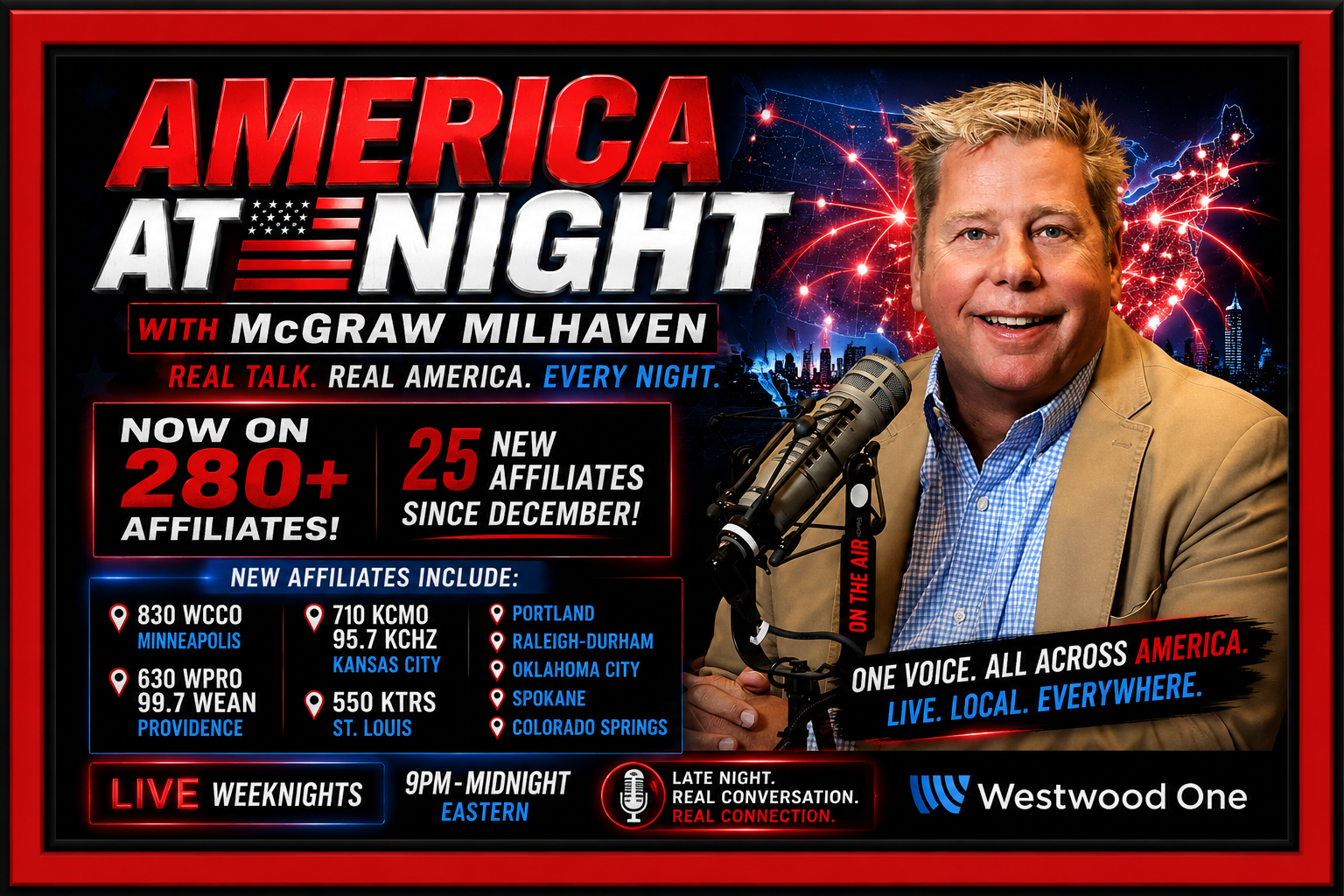
The syndicator’s nationally distributed America at Night with McGraw Milhaven is continuing to build momentum across the country, adding a significant number of new affiliates in recent months as the network strengthens its overnight talk lineup in both major and midsize markets.
Among the newest stations now carrying the program are high-profile signals in Minneapolis, Providence, Kansas City, and St. Louis, giving the show expanded reach in some of America’s most competitive spoken-word radio environments.
Additional affiliate growth has also been reported in markets including Portland, Raleigh-Durham, Oklahoma City, Spokane, and Colorado Springs, pushing the program’s national clearance count beyond 280 stations.
That kind of expansion says a lot about where overnight talk radio still fits inside the modern audio ecosystem.
Because while the industry often focuses heavily on morning drive battles, podcasts, and digital streaming strategies, overnight radio continues serving a highly loyal audience that many programmers quietly acknowledge remains deeply engaged and habit-driven.
Truck drivers.
Third-shift workers.
Insomniacs.
Late-night news consumers.
Political junkies.
Sports fans driving home after games.
Overnight radio still matters to those listeners—and affiliates clearly believe there’s room for personality-driven content in the space.
McGraw Milhaven brings a familiar presence to the format. Long known for his work in St. Louis radio, Milhaven has built a reputation around conversational talk, sharp opinions, and a style that blends politics, culture, current events, and listener interaction without sounding overly scripted or manufactured.
That authenticity may be part of why the program continues gaining traction.
The current version of America at Night launched nationally through Westwood One late last year following changes within the network’s overnight programming lineup. Since then, the show appears to have steadily expanded its footprint as stations continue evaluating syndicated options that balance live content, listener engagement, and cost-effective overnight programming.
And let’s be honest—finding compelling overnight radio has become increasingly difficult in today’s environment.
Many stations have shifted toward automation, delayed content, or low-interaction programming during overnight hours. Others have leaned heavily into syndicated products that prioritize efficiency over personality.
But historically, overnight radio has always been one of the places where strong personalities could still break through.
Some of the medium’s most loyal listener relationships were built long after midnight.
That’s why expansion stories like this still matter.
For Westwood One, the affiliate growth reinforces the continued value of live syndicated talk programming at a time when many radio companies are aggressively reevaluating expenses and staffing models. For stations, the addition of a nationally recognized host with established market credibility offers a potentially attractive balance between local relevance and network consistency.
And for listeners, it means another familiar voice joining the late-night conversation.
At a time when so much media consumption has become isolated and on-demand, overnight talk radio still carries something uniquely old-school: companionship.
A live voice.
A shared conversation.
A sense that somebody else is awake with you.
That connection has always been radio’s secret weapon.
And judging by the continued expansion of America at Night, it still works.
On The Dial covers breaking radio industry news, including layoffs, programming changes, talent moves, and broadcast trends across the United States.