


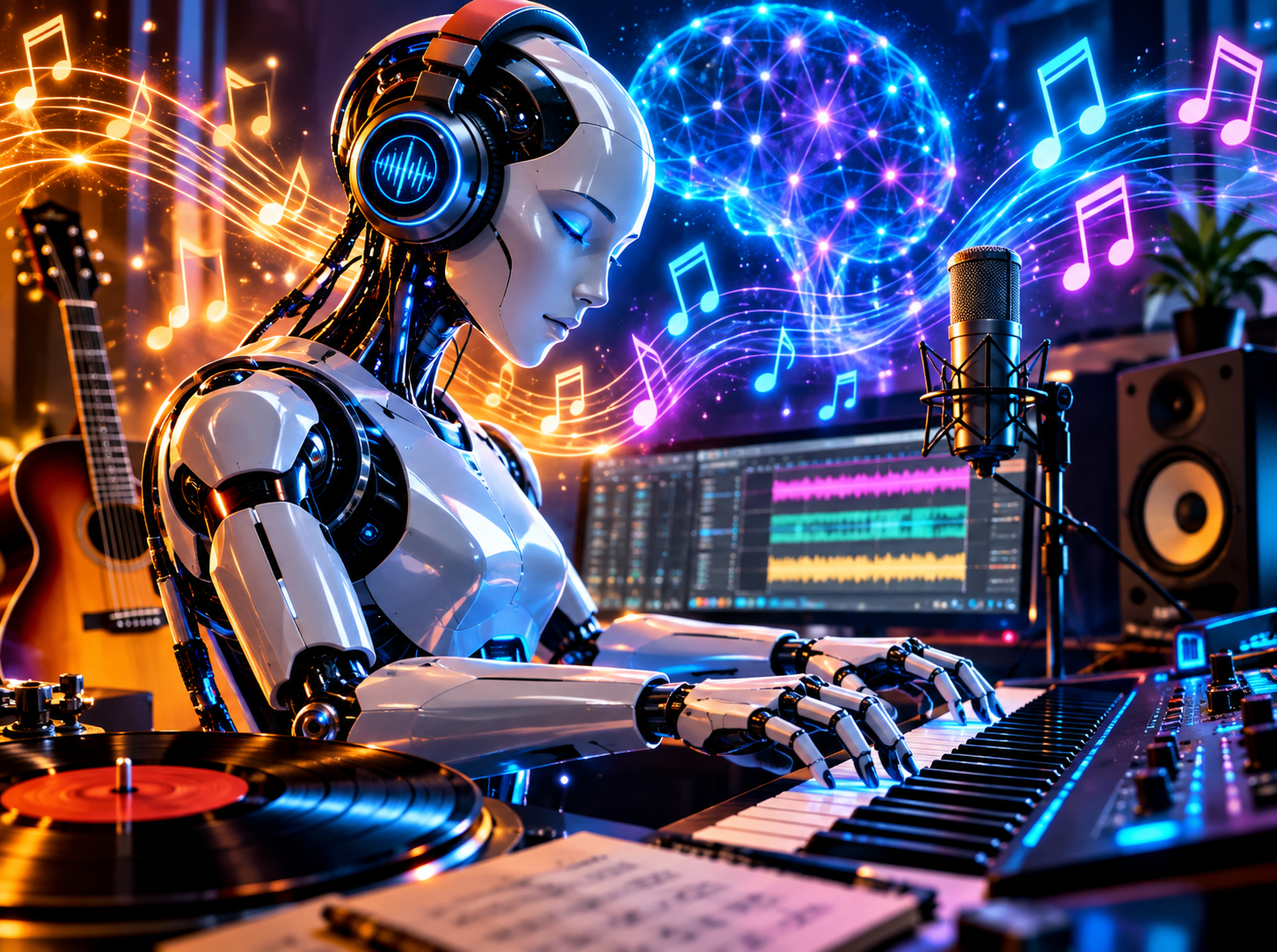
Radio has spent the better part of two years talking about artificial intelligence as though somebody is going to cut a ribbon one Tuesday morning and officially announce that the AI era has begun. That conversation is over. AI isn’t coming to music, radio or broadcasting someday in the future because it is already sitting in the production studio, generating songs, cloning voices, building imaging, assisting programmers, writing copy, creating research tools and forcing virtually every corner of the music business to reconsider what the words artist, recording, performance and creativity actually mean. The question for radio in 2026 isn’t whether we embrace artificial intelligence. We’re already surrounded by it. The question is whether we understand what the hell we’re embracing before we wrap both arms around it.
That’s where I stand.
AI IS THE NOW.
Not the future.
Not next year.
Not something for the kids.
Now.
And radio would be making a monumental mistake if fear convinced us to run from it.
But we’d make an equally monumental mistake if excitement convinced us to stop asking questions.
Because those questions are getting complicated as hell.
Half The New Music Is Already AI
Let’s begin with a number that should make every Music Director in America put down the coffee.
In July, Deezer reported that fully AI-generated recordings had exceeded 50 percent of all new music being delivered to its platform at their June peak.
Approximately 90,000 AI-generated tracks a day.
Not per year.
Not per month.
PER DAY.
The company says AI music still represents a relatively small portion of actual listening and that a substantial amount of activity around it has been connected to streaming fraud. But the supply side has already exploded.
Ninety thousand songs.
Every day.
Remember when Tuesday was add day and your biggest problem was getting 37 records from labels while everybody insisted theirs was a smash?
😂
Congratulations.
The fire hose is now attached to a nuclear reactor.
And AI Has Already Reached Radio
This is the part our industry cannot dismiss.
An AI-created act has already crossed into measurable terrestrial radio airplay.
Xania Monet became the first known AI-powered artist to reach a Billboard radio airplay chart when How Was I Supposed to Know appeared on Adult R&B Airplay.
The person behind Xania Monet, Telisha Nikki Jones, writes the lyrics and uses generative technology to produce the voice and recording around those words. Jones has described AI as another creative tool rather than a substitute for creativity.
That’s not a hypothetical panel discussion at NAB.
RADIO PLAYED IT.
Once that happened, the theoretical debate became a programming decision.
Do you add it?
Do you identify it?
Does the audience deserve to know?
Does it matter if listeners love the song?
Who gets paid?
Who owns the voice?
What material trained the model?
Was everybody whose work helped build that model compensated?
And here’s the question programmers eventually have to confront:
If the research is enormous and the audience wants the record are you willing to play it
Welcome to 2026.
My Answer Is Not Hell No
And it isn’t hell yes either.
My answer is:
KNOW WHAT YOU’RE PLAYING.
That’s going to irritate people on both sides.
Good.
Because I’m increasingly convinced the extremes are useless.
The idea that every use of artificial intelligence somehow destroys human creativity ignores the entire history of technology and music.
Multitrack recording changed music.
Synthesizers changed music.
Sampling changed music.
Auto-Tune changed music.
Pro Tools changed music.
Digital editing changed music.
Laptop production changed music.
Every generation eventually discovers some new piece of technology that causes the previous generation to announce that real music has officially died.
Then somebody creative picks up the new tool and makes something extraordinary.
AI can be another tool.
BUT A TOOL AND A THEFT MACHINE ARE NOT THE SAME THING.
That’s the line radio needs to understand.
The Record Labels Have Already Moved
If anybody still thinks the established music business intends to simply outlaw AI and go home, watch what the companies are actually doing.
The relationship has moved from almost pure warfare toward something considerably more complicated.
Major music companies sued AI developers over the use of copyrighted recordings.
Now licensing arrangements are emerging.
Suno recently released new models developed through agreements involving Warner Music Group and BMG, with participating artists positioned to have opt-in opportunities.
Udio has licensing relationships involving Universal Music Group and Warner.
Sony and Universal still have unresolved litigation involving Suno.
In other words, the industry isn’t simply choosing between:
AI GOOD
and
AI BAD
It’s fighting over the rules of the marketplace.
And that’s exactly where this conversation should be.
Artists Are Asking A Different Question
Creators aren’t necessarily saying technology itself must disappear.
Many are asking:
WHO GAVE YOU PERMISSION
That’s different.
Consent.
Copyright.
Compensation.
Attribution.
Likeness.
Voice.
Those aren’t anti-technology concepts.
They’re ownership concepts.
The Recording Academy says it supports responsible AI innovation while insisting that human creators retain consent, intellectual-property protections and ownership. Grammy rules currently permit works containing AI-generated elements, but the award itself remains reserved for meaningful human authorship or performance.
That’s a pretty reasonable dividing line.
Use technology.
But don’t erase the human being.
Musicians Are Fighting Over The Money Too
The American Federation of Musicians has gone further, filing litigation against major record companies over AI licensing arrangements.
The union argues that catalog licensing to AI platforms triggered contractual obligations involving musicians and that those performers should have been notified and compensated. The labels dispute aspects of the claims, leaving the courts to determine the contractual questions.
Again:
This isn’t merely about whether a computer can make a cool song.
It’s about the entire economic chain underneath that song.
Who played the original music?
Who wrote it?
Who owns it?
Who licensed it?
Who trained on it?
Who generated the new recording?
Who gets paid?
Those questions matter.
Especially when somebody else’s creativity is the raw material.
And There Is A Lot Of Money At Stake
CISAC commissioned research projecting that generative-AI music outputs could represent an annual market worth about €16 billion by 2028, while estimating that under unchanged conditions as much as 24 percent of music creators’ revenue could be at risk by then.
That’s a projection, not destiny.
But it’s a hell of a warning.
AI doesn’t have to destroy music to radically change the economics of making music.
That’s what radio should understand.
We have lived this movie before.
Technology arrives.
Everybody celebrates efficiency.
The economics change.
Then ten years later everybody looks around and asks where all the jobs went.
LEARN FROM OUR OWN DAMN HISTORY.
Listeners Are More Skeptical Than The Industry
And here’s where programmers really need to pay attention.
Radio audiences aren’t necessarily as enthusiastic about this as technology companies are.
Jacobs Media’s Techsurvey asked core commercial-radio listeners how they felt about AI-generated music appearing on their favorite stations.
Nearly three out of four reportedly considered it a deal-breaker.
That’s huge.
It doesn’t necessarily mean those listeners will always feel that way.
Attitudes toward technology change.
It also doesn’t tell us whether listeners could actually identify an AI record without being told.
But it tells us something extremely important:
TRUST MATTERS.
And there’s another fascinating wrinkle.
In a Deezer and Ipsos survey across eight countries, 97 percent of listeners couldn’t reliably distinguish fully AI-generated music from human-made music in a blind test, while 80 percent believed AI music should be clearly labeled.
Read those two numbers together.
People often can’t hear the difference.
But they still want to know.
That’s the issue.
Transparency May Be The Whole Ballgame
I think radio should get ahead of this.
If we’re playing fully AI-generated music, why hide it?
Tell people.
Make it interesting.
Turn it into content.
Here’s this new record.
Here’s how it was created.
Here’s who wrote it.
Here’s what AI did.
Here’s what the human did.
Here’s why we’re playing it.
Then ask the audience what they think.
That’s radio.
The global music business is already moving toward that distinction. A broad coalition including the RIAA, IFPI, A2IM, independent-music organizations, SAG-AFTRA, the Recording Academy and the Human Artistry Campaign introduced a voluntary labeling framework this summer distinguishing AI Generated recordings from AI Assisted ones.
That distinction is enormously important.
Because Almost Everything Is Going To Become AI Assisted
This is where absolutism becomes ridiculous.
If AI touches a recording, is the recording suddenly fake?
What if AI removes background noise?
What if it separates stems?
What if it helps master the record?
What if it suggests a chord?
What if it generates a percussion sound?
What if a songwriter uses it to brainstorm rhymes?
What if a producer uses AI to audition an arrangement before human musicians record it?
What if a disabled artist uses generative technology to perform something physically impossible otherwise?
Are all of those equivalent to typing:
MAKE ME A TAYLOR SWIFT SONG
and uploading whatever comes out?
Of course not.
That’s why radio needs vocabulary more sophisticated than real and fake.
AI-assisted creation and fully AI-generated content are different things.
Treat them differently.
And Then There Is The Slop Problem
This is the part AI advocates need to acknowledge.
Technology that makes creativity easier also makes garbage easier.
Universal Music Group just sued DistroKid, alleging the service has enabled large volumes of AI-generated material and infringing versions of copyrighted recordings to flood digital platforms. DistroKid rejects those allegations and says it will defend its practices.
The court can settle the legal dispute.
But the broader problem is obvious.
When the cost of creating 10,000 songs approaches the cost of creating one song, somebody will create 10,000 songs.
Not because they have 10,000 artistic ideas.
Because they can.
That’s where curation becomes more valuable, not less.
And guess who spent the last hundred years learning how to curate music?
HELLO RADIO.
THIS COULD ACTUALLY BE OUR MOMENT
Think about it.
Streaming services are drowning in supply.
Ninety thousand AI tracks arriving on Deezer daily at peak.
Human releases.
Catalog.
Remixes.
AI-assisted tracks.
Fully synthetic tracks.
Fraud.
Great records.
Terrible records.
Everything everywhere all at once.
The consumer doesn’t need access anymore.
The consumer needs someone to make sense of the access.
That’s radio’s original job!
We were curators before anybody used the word curator.
The Music Director listened to 40 records so the audience didn’t have to.
The programmer built a sound.
The personality provided context.
The station put records beside one another and created meaning.
AI doesn’t necessarily make that job obsolete.
AI MAY MAKE THAT JOB MORE IMPORTANT THAN IT HAS BEEN IN YEARS.
But Please Don’t Replace Everybody With Robots
Here comes the other side.
Radio management is going to look at AI and see efficiency.
Of course it will.
Write this.
Voice that.
Schedule this.
Produce that.
Automate those.
Great.
Use it.
I do.
You probably do.
Most of us increasingly will.
But if the final strategy is:
WE DISCOVERED TECHNOLOGY THAT ALLOWS US TO REMOVE EVERY INTERESTING HUMAN BEING FROM THE RADIO STATION
then congratulations.
We’ve learned absolutely nothing.
😂
Radio’s competitive advantage isn’t that we can become more robotic than Spotify.
Spotify already has computers.
Lots of them.
Radio’s advantage is humanity.
Personality.
Locality.
Immediacy.
Community.
Surprise.
Emotion.
AI should help the humans make better radio.
It should not become an excuse to eliminate the humans and then wonder why nobody feels anything about the station.
The Same Rule Applies To AI Personalities
Could an AI host technically do a radio show?
Absolutely.
We’re beyond debating whether the technology is capable.
But should the audience know?
HELL YES.
Australia has already moved in that direction. Its 2026 commercial-radio code requires disclosure when a synthetic voice hosts a regularly scheduled program or news broadcast.
That concept deserves serious consideration everywhere.
Don’t fool the listener.
If it’s AI, say it’s AI.
Then make the product so damn good that the listener chooses whether it has value.
Trust your audience enough to tell them what they’re hearing.
On The Dial Perspective
Here’s where I land.
AI IS THE NOW.
I’m not afraid of it.
I’m excited about it.
I think the creative possibilities are enormous.
I think programmers who refuse to learn it are eventually going to find themselves standing in the same place as the people who once insisted streaming wasn’t radio’s problem.
But embracing AI cannot mean surrendering our judgment to it.
Use it.
Experiment with it.
Learn it.
Play with it.
Build with it.
Let artists create things we’ve never heard before.
Let broadcasters create things we couldn’t afford to create before.
Let small-market stations suddenly have production capabilities that once required major-market budgets.
Let disabled creators overcome barriers.
Let young artists experiment.
Let weird people make weird shit.
THAT’S HOW ART MOVES FORWARD.
But ask questions.
Who created this?
Who trained this?
Who consented?
Who owns it?
Who gets paid?
Whose voice is that?
Whose work made this possible?
Is the listener being told the truth?
And perhaps most importantly:
IS IT ANY GOOD
Because after all the technology, lawsuits, licensing agreements, ethical debates and existential panic…
Radio still has one wonderfully primitive responsibility.
Play great stuff.
Don’t Fear The Machine And Don’t Worship It Either
That’s the headline inside the headline.
AI isn’t Satan.
AI isn’t God.
AI is technology.
What humans decide to do with it determines what comes next.
The record companies know it.
The artists know it.
The unions know it.
The streaming services know it.
And whether radio is ready to admit it or not…
WE’RE NEXT.
Actually, scratch that.
We’re not next.
We’re already here.
AI music has reached radio airplay charts.
AI-generated recordings are arriving by the tens of thousands every day.
Labels are licensing technology they were suing.
Creators are demanding consent and compensation.
Listeners are demanding transparency.
The rulebook is being written while the record is playing.
So radio has two choices.
We can sit in the back of the room complaining that everything was better in 1997.
Or we can walk directly into the biggest technological disruption in modern music and help decide what responsible adoption looks like.
I know which room I want to be in.
EMBRACE IT.
But know what you’re embracing.
Protect the humans.
Protect the listener’s trust.
Protect creativity.
Demand transparency.
Pay people when their work creates value.
And then turn the damn speakers up and see what somebody invents.
Because AI isn’t the future of music.
AI IS PART OF MUSIC RIGHT NOW.
The only question left for radio is whether we’re going to understand it well enough to use it wisely.
#OnTheDial #AIMusic #ArtificialIntelligence #Radio #RadioIndustry #MusicRadio #RadioProgramming #MusicIndustry #GenerativeAI #Suno #Udio #HumanCreativity #RadioInnovation #FutureOfRadio #Broadcasting