


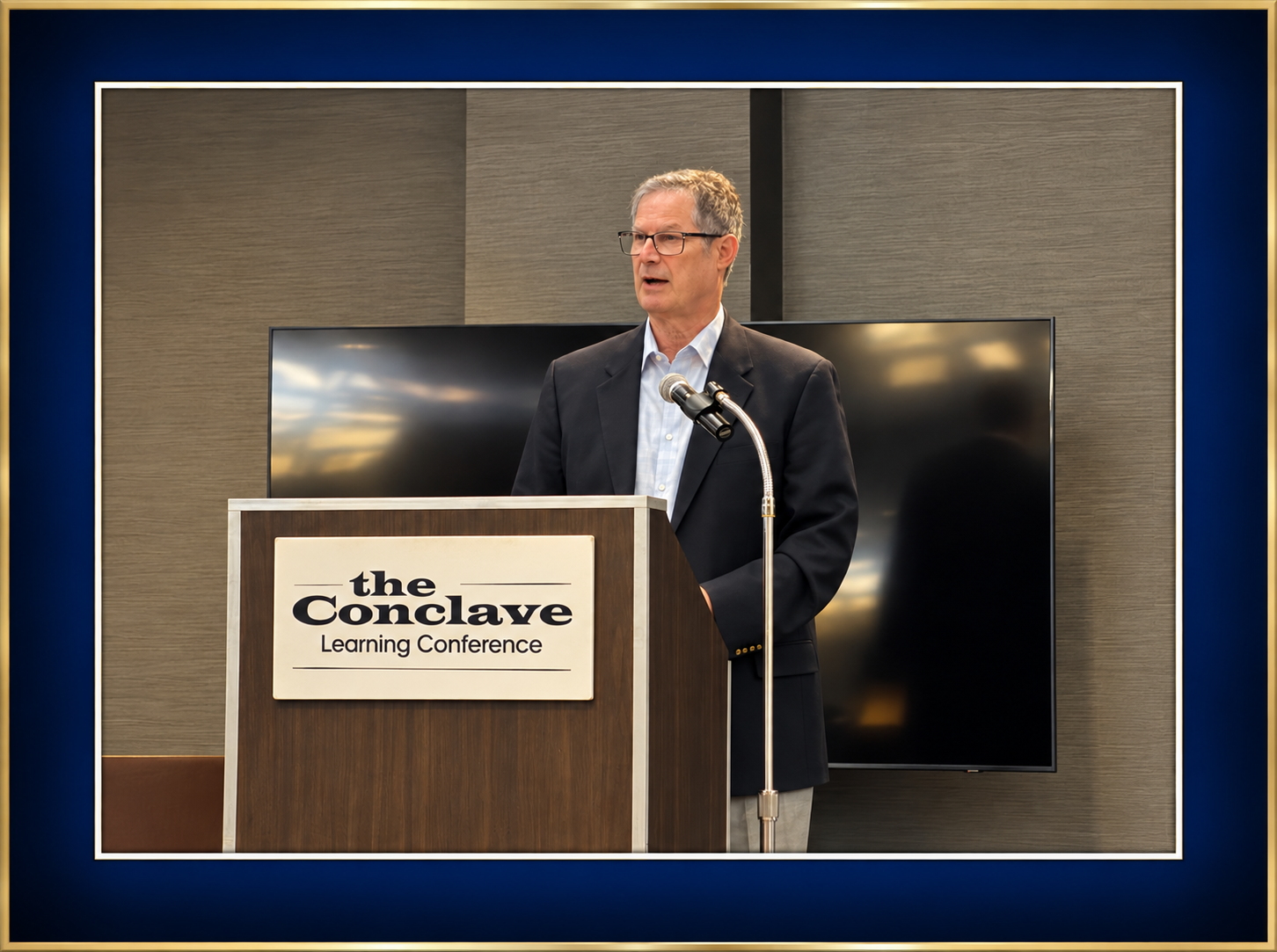
If you wanted one person to explain what a lifetime in radio can unexpectedly become, Ken Levine may have been the perfect choice to stand before The Last Conclave Thursday morning. His journey began as a young sports intern at legendary KMPC Los Angeles in 1969, carried him behind the microphone at stations including KERN Bakersfield, transformed him into the gloriously named Top 40 personality Beaver Cleaver, and eventually deposited him in writers’ rooms responsible for some of the greatest television comedy America has ever seen. Then, because apparently that wasn’t enough of a career, Levine found his way into Major League Baseball broadcast booths. Anyone who wasn’t in the room for this keynote missed something special.
This wasn’t another conference presentation about the future of media.
It was storytelling from somebody who has spent a lifetime doing exactly that.
Radio.
Television.
Comedy.
Producing.
Directing.
Baseball.
Yet beneath every one of those chapters, Levine remains unmistakably a radio guy.
And you knew you were surrounded by radio people when, at one point, Levine invoked Art Vuolo — Radio’s Best Friend — and somebody essentially wanted to know the only thing any self-respecting radio nerd would want to know in that moment:
CAN WE HEAR A JINGLE
😂😂😂
Of course.
Because apparently you can take radio people out of the production room, but sooner or later somebody is still going to ask for the damn jingle.
WELCOME TO THE CONCLAVE.
Before Television There Was KMPC
Go back to 1969 and imagine walking into KMPC Los Angeles for your first commercial-radio opportunity.
Then consider the people wandering those halls.
Gary Owens.
Wink Martindale.
Jim Lange.
Geoff Edwards.
Roger Carroll.
Dick Whittinghill.
And occasionally Bob Crane.
For an aspiring broadcaster, that wasn’t merely an internship.
THAT WAS AN EDUCATION.
KMPC was one of Los Angeles’ great full-service radio institutions, blending major personalities, music, news and sports. The station carried the Rams, Angels and UCLA, with voices including Dick Enberg and Dave Niehaus working games.
Somewhere inside that operation was Ken Levine.
Sports intern.
Making about $1.25 an hour.
There was no possible way for that young man to know that more than half a century later he would be standing in Minnesota, telling a ballroom full of broadcasters how far that first opportunity ultimately carried him.
Bakersfield Helped Turn The Dream Into The Craft
The road didn’t jump directly from KMPC to television stardom.
Radio careers rarely worked that way.
You went where somebody was willing to hand you a microphone.
For Levine, one of those important early stops was KERN Bakersfield.
And that piece of his history says something important about an ecosystem radio once understood exceptionally well.
Smaller and medium markets gave young talent room to become good.
You could grow up listening to Los Angeles legends and dream about joining them, but eventually somebody had to let you open the microphone yourself.
That’s where you discovered that thirty seconds can feel like six minutes when your brain suddenly goes completely empty.
😂
You learned timing.
You learned the clock.
You learned to hit the post.
You learned how to recover when something failed.
You learned how to enter a stopset and, perhaps more importantly, how to get back out of one.
You discovered that the hilarious bit you planned all morning could become astonishingly unfunny approximately three seconds after the microphone opened.
And eventually you learned the most important part:
How to talk to one listener.
KERN was part of that education for Levine.
He wasn’t simply dreaming about becoming a broadcaster anymore.
HE WAS BECOMING ONE.
And Somehow Ken Levine Became Beaver Cleaver
Then came one of the great traditions of Top 40 radio.
The ridiculous air name.
😂
Ken Levine became:
BEAVER CLEAVER.
The future writer of Hawkeye Pierce was now cracking microphones under the name of a fictional television kid.
That’s about as beautifully radio as it gets.
Levine carried that identity through stations and markets including San Francisco, Detroit, San Diego and Los Angeles.
KYA.
WDRQ.
B100.
K100.
TenQ.
These were stations from an era when personality wasn’t something squeezed between two songs.
Personality was part of why listeners came.
And while Levine was entertaining those audiences, he was unknowingly developing skills that would become enormously valuable in another medium.
He was learning to write for the ear.
Establish the premise quickly.
Find the joke.
Remove what doesn’t matter.
Understand timing.
Know where the payoff belongs.
Recognize when you’ve said enough.
Those principles work beautifully in a radio break.
They also work beautifully in comedy.
Ken Levine eventually got to prove both.
The Radio Name Even Followed Him To Tom Hanks
Years later, Levine met Tom Hanks.
Consider the résumé Levine had accumulated by then.
MASH.
Cheers.
Frasier.
A television career most writers could only imagine.
And what did Tom Hanks remember?
BEAVER CLEAVER.
😂
Hanks had heard Levine on KYA while growing up in the Bay Area and still remembered the air name years later.
That may be one of the greatest demonstrations of radio’s strange staying power.
You can create television watched by millions.
You can work on legendary shows.
You can meet one of the world’s most recognizable actors.
And somehow the connection becomes the crazy name you used while talking between records decades earlier.
Radio gets into people’s memories in peculiar ways.
Then Radio Followed Levine Into Hollywood
Levine and writing partner David Isaacs eventually began writing television together and sold a script to The Jeffersons.
Then came the opportunity that changed everything.
MASH.
Levine and Isaacs joined the writing staff and eventually became head writers on one of television’s most celebrated series. Their work included the groundbreaking Point of View, which presented its story through the perspective of a wounded soldier.
Think about that transition.
The guy who learned clocks, timing and brevity behind a radio microphone was suddenly helping shape the rhythm of MASH.
Yet the two disciplines weren’t as distant as they might appear.
Radio had already taught him to create on demand.
Be concise.
Understand format.
Know the audience.
Find the joke.
Recognize when the emotion matters more than the joke.
And above everything else:
DON’T BORE PEOPLE.
There are worse rules for a radio station to remember in 2026.
Then The Television Résumé Became Ridiculous
MASH.
Cheers.
Frasier.
The Simpsons.
Wings.
Everybody Loves Raymond.
Becker.
Dharma and Greg.
Eventually you’re no longer reading a résumé.
You’re walking through decades of American television culture.
Levine wrote.
He produced.
He directed.
His directing work included Wings, Frasier, Everybody Loves Raymond and other major network comedies.
He earned Emmy recognition and worked alongside some of television’s most accomplished writers, actors, producers and directors.
But the foundation underneath those different jobs remained remarkably familiar.
STORYTELLING.
It was something Levine had been practicing since he was a young man obsessed with Los Angeles radio and learning the craft behind microphones in places such as Bakersfield.
And Then There Was Art Vuolo
This may have been one of my favorite little moments of the morning because you couldn’t have gotten it from an agenda.
At one point, the conversation reached Art Vuolo, known across the industry as Radio’s Best Friend.
And suddenly we were talking about hearing a jingle.
😂
Of course we were.
Mention an old set of call letters around enough veteran radio people and somebody remembers the jingle package.
Play three notes and there will inevitably be somebody in the room who can identify the station, year and probably the jingle company.
Perfectly normal behavior.
😂
Here stood Ken Levine — Emmy-recognized television writer, producer, director, Major League Baseball broadcaster and veteran air personality — addressing decades of collective broadcasting experience.
And we still managed to get back to jingles.
THAT MAY BE THE CONCLAVE IN ONE MOMENT.
No matter how much the technology changes or how impressive the titles become, radio people remain radio people.
Then The Sports Intern Became A Major League Broadcaster
The young sports intern from KMPC never completely disappeared either.
Levine eventually pursued another dream and became a professional baseball broadcaster, calling games involving the Baltimore Orioles, Seattle Mariners and San Diego Padres and later returning to Los Angeles radio with Dodgers-related programming.
Not fantasy camp.
Not sitting behind home plate explaining to everyone nearby how the professional announcer should be doing his job.
😂
Actual Major League Baseball.
And baseball requires another form of storytelling entirely.
A television writer knows what’s coming because somebody wrote the script.
A director knows where the scene is supposed to go.
A baseball announcer?
The pitcher releases the ball.
Good luck.
Home run.
Double play.
Wild pitch.
Rain delay.
Nothing for four innings.
Then one pitch changes everything.
The broadcaster has to recognize the story while it is happening and know when to talk, when to explain and when the moment is better left alone.
Once again, those are pretty useful skills for somebody who learned how to work a radio microphone.
Why Levine Fit The Last Conclave So Perfectly
The longer Thursday morning went, the more appropriate the keynote choice felt.
For nearly half a century, The Conclave brought broadcasters together to discuss programming, talent, creativity, mentorship, careers and whatever strange new direction the industry was taking.
For its final keynote, it chose somebody whose entire career answers a question generations of young broadcasters have asked:
WHERE CAN RADIO TAKE ME
Anywhere.
KMPC can lead to KERN.
Bakersfield can lead to bigger markets.
Being a jock can sharpen comedy instincts.
Comedy can lead to television.
Television can lead to an Emmy.
The sports obsession you carried as a kid can eventually put you inside a Major League broadcast booth.
And more than half a century after the first radio job, all of those roads can bring you back before a room full of broadcasters at The Last Conclave.
That’s an extraordinary career.
But more than anything else, it’s an extraordinary radio story.
If You Weren’t Here You Missed It
That has become one of the recurring truths of The Last Conclave.
Some of this simply cannot be recreated afterward.
You had to hear the laughter.
You had to see longtime friends recognizing each other across hallways.
You had to experience the Rockwell Awards.
You had to hear conversations continue long after the panel officially ended.
You had to watch generations of broadcasters trade stories that may never appear in any industry history book.
Thursday morning, you needed to be there for Ken Levine.
A recap can provide the credits.
It can explain the career.
It can tell you what happened.
It cannot fully recreate what it felt like to sit among people who have spent their lives in broadcasting while one of America’s great storytellers traced the bizarre route from radio obsession to a lifetime of storytelling.
And it certainly can’t reproduce the exact feeling of Art Vuolo coming up in conversation and radio people immediately wanting a jingle.
😂
YOU MISSED SOMETHING SPECIAL.
What The Last Conclave Has Really Been About
This week may have been scheduled as a conference.
It has felt like something else.
Memory.
Perspective.
Reunions.
Debate.
Mentorship.
History.
And a hell of a lot of laughter.
It has also been a reminder that the real infrastructure of radio isn’t the transmitter, the automation system, the ratings report or the corporate organizational chart.
It’s people.
The people who taught us.
The people who hired us.
The people who fired us.
😂
The people who let us try again.
The competitors who made us better.
The air personalities we studied.
The people sitting beside us in studios at hours when normal human beings were sleeping.
And the voices we heard as kids that caused something inside us to say:
I WANT TO DO THAT.
Ken Levine was one of those kids.
KMPC gave him an opening.
Somebody eventually handed him a microphone.
KERN gave him another place to learn.
And one opportunity kept creating another.
On The Dial Perspective
Perhaps the most important lesson from Levine’s keynote has nothing to do with television or baseball.
Your next job may not exist yet.
The weekend jock may become a programmer.
The producer may eventually host mornings.
The engineer may create technology that changes the business.
The salesperson may become the owner.
The radio personality may become a television writer.
The sports intern may eventually call Major League Baseball.
And somebody making about $1.25 an hour at KMPC in 1969 may eventually help write MASH, Cheers and Frasier.
Nobody knows where the first opportunity leads.
That’s exactly why radio needs to keep giving people one.
Open the door.
Give somebody weekends.
Give them overnights if you’ve still got them.
Give them Bakersfield.
Hand them a microphone.
Let them watch.
Let them fail.
Let them learn.
Let them meet people who know more than they do.
Let them become obsessed with this business.
Somewhere in a station today may be another Ken Levine.
The tragedy wouldn’t be that the person eventually takes everything radio taught them and succeeds somewhere else.
The tragedy would be never giving them a place to start.
One More Morning At The Last Conclave
The end of The Last Conclave is getting close now.
That becomes a little harder to acknowledge each time.
There are still conversations underway.
Still stories being traded.
Still phone numbers being exchanged.
Still people making promises that this time they really won’t wait another decade before seeing each other again.
And there is still some radio left to talk about before everyone heads home.
Thursday morning gave this final gathering exactly the kind of keynote it deserved.
A man whose career represents just how unpredictable a life in broadcasting can become.
From KMPC in 1969…
to KERN Bakersfield…
to Beaver Cleaver…
to MASH…
to Cheers…
to Frasier…
to Major League Baseball…
to The Last Conclave.
Ken Levine’s career proves that the first radio job doesn’t necessarily tell you where you’re headed.
Sometimes all it does is unlock the first door.
If you weren’t in that room Thursday morning?
You missed something special.
Those of us who were there received one more story to carry home from The Last Conclave, delivered by somebody who has spent a lifetime understanding exactly how stories are supposed to be told.
And Art?
Somewhere along the way, we still need that jingle.
😂
— Steven Mills
President and Publisher
On The Dial
#OnTheDial #KenLevine #ArtVuolo #TheLastConclave #Conclave45 #Radio #RadioHistory #RadioLegends #Broadcasting #KERN #KMPC #MASH #Cheers #Frasier #RadioPeople #Storytelling #RadioIndustry