


FROM THE PUBLISHER | STEVEN D. MILLS | ON THE DIAL
Hollywood has given us some extraordinary political storylines, but Georgia may have just delivered one that deserves a prime-time special, a national radio conversation and perhaps a very nervous meeting among people who thought they understood the boundaries between entertainment and government. Tyler Perry, the billionaire entertainment entrepreneur who built a media empire from Atlanta, has been named a co-chair of Governor-elect Keisha Lance Bottoms’ transition team. And while the official announcement concerns preparations for a new administration, the bigger question is impossible to ignore: Has one of America’s most influential entertainment figures just taken a meaningful step toward a future in public office?
Now, before somebody starts printing PERRY FOR PRESIDENT bumper stickers, let’s establish what we actually know.
Perry has not announced a campaign for president, governor, senator or any other elected office. There is no verified indication that he has decided to run, and his transition appointment does not establish that he wants a political career.
But something significant has happened.
Tyler Perry is no longer simply a prominent entertainer commenting on politics from the outside. He has accepted a formal role helping an incoming governor prepare to lead one of America’s most consequential states.
And that is worth examining.
From Madea to the Governor’s Inner Circle
On November 6, Bottoms unveiled the leadership of her transition effort, called Georgia’s Promise, following her historic election as the nation’s first Black woman elected governor.
Among the co-chairs are Atlanta Falcons owner and Home Depot co-founder Arthur Blank, former corporate executive Rosalind Brewer, former Georgia state Sen. Jason Carter, civic leader Michelle Nunn and Perry, the founder of Tyler Perry Studios.
This isn’t a celebrity photograph at a campaign fundraiser.
This isn’t somebody standing in the audience waving a sign.
This is a place at the table where an incoming administration begins organizing its priorities, evaluating personnel and preparing for the responsibilities of government.
Perry is bringing something different to that table: experience building a major entertainment business, overseeing large productions, creating jobs and navigating the relationship between media, commerce and culture.
He also brings an extraordinary public platform.
And let’s be clear about something else.
Perry and Bottoms aren’t political strangers suddenly discovering one another because somebody needed another famous name on a press release.
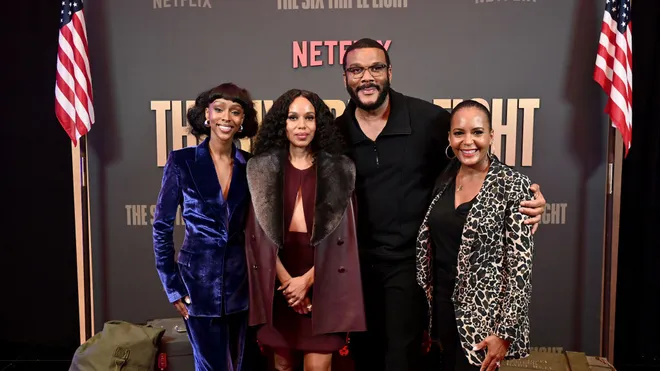
Bottoms previously served as an executive producer on Perry’s Netflix political comedy She the People, later titled Miss Governor.
The relationship between these two influential Georgians already extends into the entertainment business.
Now it extends into the transition to state government.
That makes this appointment more interesting than an ordinary celebrity endorsement.
Could Tyler Perry Actually Enter Politics?
Absolutely, in the sense that a transition assignment can introduce someone to the machinery of government and create opportunities for further public service.
But possibility is not probability.
There is no evidence that Perry is preparing a campaign.
Still, the appointment creates questions worth asking.
Could he eventually accept an appointment to a state advisory commission? Could Bottoms ask him to help lead an initiative involving film production, workforce development, economic opportunity or the creative industries?
Those would be logical areas to explore given Perry’s professional background, although none of those appointments has been announced.
And a transition co-chair is not automatically a member of the governor’s cabinet. It is a temporary leadership role in preparing an incoming administration.
But if Perry discovers that he enjoys shaping policy as much as producing entertainment, what happens next?
That’s where the story gets fascinating.
President Tyler Perry?
Now we’ve arrived at the question guaranteed to make social media stop scrolling.
Could Tyler Perry someday run for president of the United States?
Constitutionally, the presidency is not reserved for career politicians. An eligible American citizen can pursue the office without first serving in Congress, a governor’s mansion or a state legislature.
Donald Trump’s election in 2016 demonstrated that celebrity and business prominence can translate into a successful presidential campaign, although that precedent says nothing about Perry’s intentions or prospects.
Perry has national recognition, extensive business experience and relationships across entertainment, philanthropy and public life.
But recognition is not a campaign organization. Business success is not a governing record. And public admiration does not eliminate the scrutiny that comes with running for office.
As of this writing, I have found no credible announcement or substantiated campaign effort indicating Perry intends to seek the presidency.
So let’s not manufacture one.
The real story is not that Tyler Perry is running for president. The real story is that a man who built an entertainment empire is now participating directly in the preparation of a state government.
What he chooses to do with that experience remains entirely his decision.
And if he never seeks office, this appointment can still be consequential.
Here’s Where Radio Enters the Conversation
This is where On The Dial sees a story that extends well beyond the political pages.
Tyler Perry understands something that broadcasters have known for generations.
The person who controls the microphone can help shape the national conversation.
Perry’s influence wasn’t built in the Georgia Capitol.
It was built through storytelling.
He understood audiences that much of the entertainment establishment had underestimated. He created characters, films, television programs and a business that spoke to viewers who wanted to see their experiences represented.
And long before streaming platforms became dominant, radio played a central role in the entertainment ecosystem that helped audiences discover movies, television programs, performers and cultural movements.
Think about the importance of Atlanta radio.
From influential urban contemporary and R&B stations to news and talk outlets, Atlanta broadcasters have helped shape conversations about music, entertainment, business and civic life for decades.
Stations such as WVEE V-103, WAMJ Majic 107.5/97.5, WHTA Hot 107.9 and WSB Radio are part of a media landscape where entertainment, community affairs and public policy regularly intersect.
And that raises a question for broadcasters everywhere.
If one of America’s most influential entertainment entrepreneurs is helping prepare a new state administration, shouldn’t radio be examining what that administration might mean for Georgia’s creative economy?
We’re talking about film and television production.
Entertainment employment.
Advertising.
Small businesses.
Local media.
Digital content.
Workforce training.
The industries are connected, even when their business models are different.
Georgia’s film and television sector has attracted major productions and investment. Perry’s studio operations represent a highly visible part of that ecosystem.
If the new administration pursues policies affecting the creative industries, radio companies, advertising agencies, production businesses and independent content creators will have reason to pay attention.
This is not merely a Hollywood story. It is a business, media and public-policy story with implications for the people who create and distribute content.
And radio should be part of that discussion.
There Is Also a Question About Accountability
With a more public governmental role comes greater scrutiny.
Perry is already a high-profile and sometimes controversial figure. He faces civil allegations of sexual misconduct in lawsuits filed by former actors; Perry has denied wrongdoing. Those allegations remain allegations, not findings of guilt.
His involvement in a gubernatorial transition is therefore likely to generate questions not only about his accomplishments but also about transparency, public confidence and the standards applied to influential advisers.
Those questions are legitimate.
The same standards should apply to every powerful person participating in government, whether that individual comes from Hollywood, Wall Street, corporate America or a political family.
A celebrity’s influence should not exempt that person from accountability.
And public controversy should not automatically be treated as proof of misconduct.
The Bigger Question Is What Perry Wants His Next Chapter to Be
Tyler Perry has already achieved something that most entertainers never will.
He built a major studio operation. He created an enduring entertainment brand. He became one of the most recognizable figures in American media.
Now he has an opportunity to contribute to the transition of a state government.
That doesn’t mean he’s preparing to trade the director’s chair for a seat in Congress.
It doesn’t mean Bottoms is preparing to appoint him to a permanent government position.
And it certainly doesn’t mean the White House is next.
But it does mean the lines between entertainment leadership, economic influence and public service are becoming increasingly interesting.
From my perspective as a broadcaster and publisher, this is exactly the kind of development the media industry should be examining.
Not because we need another celebrity politician.
Not because we should assume every successful entertainer secretly wants to be president.
But because influential media figures increasingly have opportunities to participate in decisions that reach far beyond the entertainment business.
And when someone who has spent decades telling America’s stories begins helping shape the direction of government, the public has every reason to ask what story comes next.
Governor-elect Bottoms has given Perry a seat at the transition table.
What he does with that seat will be worth watching.
And Tyler, should you ever decide to trade the movie premiere for a political debate, there is one thing I can promise.
Radio will have plenty of questions.
We’ll bring the microphones.
You bring the answers.
Because this time, Mr. Perry, nobody gets to yell CUT when the questions become difficult.
— Steven D. Mills
President and Publisher, On The Dial
On The Dial covers breaking radio industry news, including layoffs, programming changes, talent moves, and broadcast trends across the United States.
Hashtags
#OnTheDial #TylerPerry #KeishaLanceBottoms #GeorgiaPolitics #GeorgiaGovernor #AtlantaRadio #BlackMedia #EntertainmentIndustry #TylerPerryStudios #RadioIndustry #GeorgiaPromise #MediaAndPolitics