

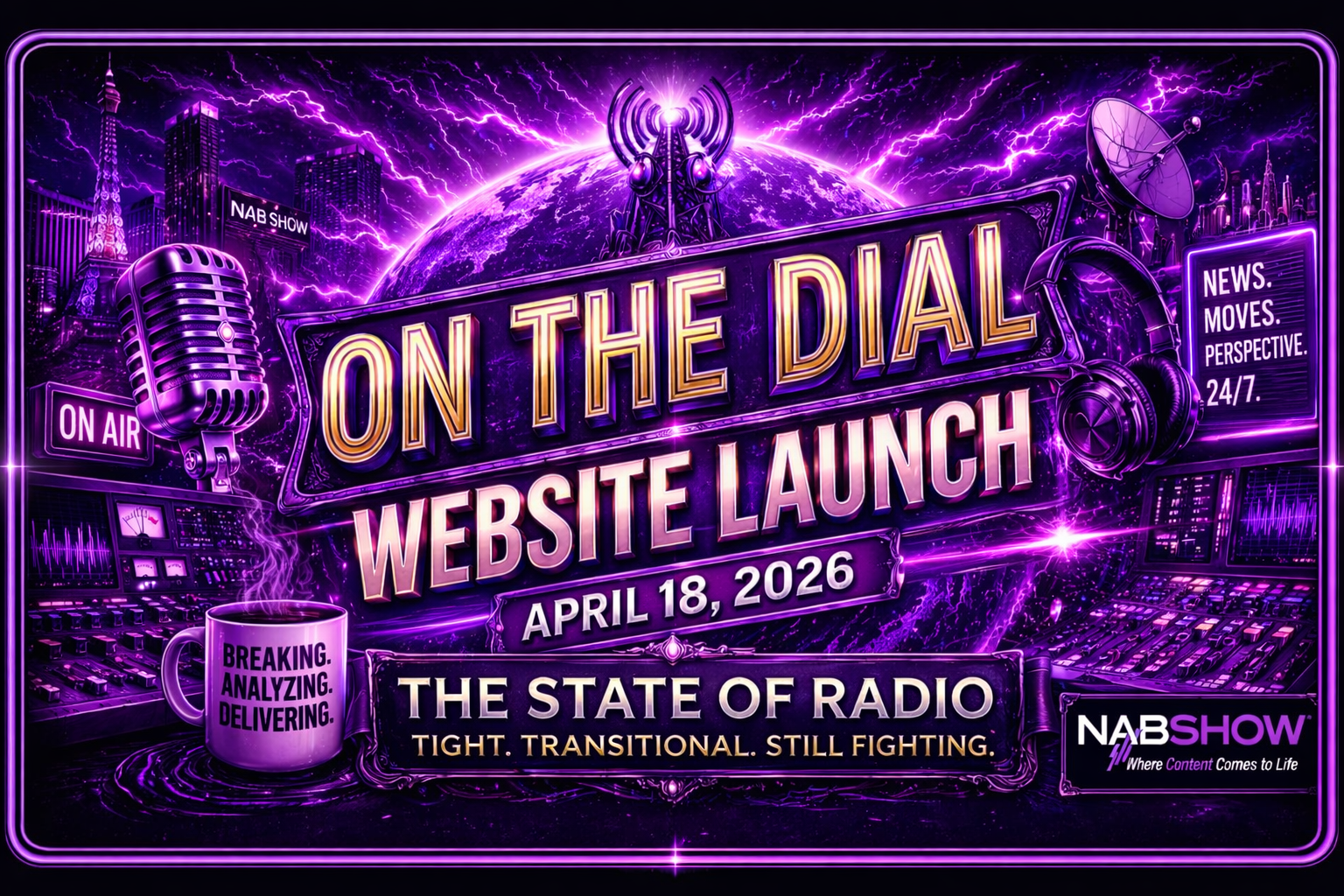
The doors have opened again at the NAB Show, and the energy inside the building tells you everything you need to know about where broadcast radio stands right now. The crowds are moving, the demos are polished, the conversations are layered, but underneath all of it there is a shared understanding that this industry is no longer operating the way it once did. This is not a look back moment. This is a recalibration moment.
Broadcast radio in 2026 is not collapsing, but it is tightening. The margins are thinner, the expectations are higher, and the room for error has almost disappeared. Operators are making faster decisions with fewer resources, and the structure that once supported the day-to-day execution of radio—those middle layers that connected corporate strategy to local programming—continues to shrink. What remains is a leaner version of the business that is being forced to operate with precision instead of padding.
That tightening is not just financial—it is structural. Across markets, responsibilities are expanding while headcounts are contracting. Program directors are overseeing multiple signals, sometimes across different cities. Market managers are balancing broader territories. Talent is being stretched across platforms, expected to deliver on-air, online, and on-demand without missing a beat. And yet, through all of that compression, the product continues to move. The signal is still live. The content is still flowing. The audience is still there.
Inside the halls of the NAB Show, the shift is visible in a different way. The physical backbone of radio—the racks, the hardware, the infrastructure that once defined the engineering side of the business—is giving way to something far less visible but far more powerful. Conversations are no longer centered on equipment as much as they are on ecosystems. Cloud-based workflows, automation pipelines, and remote production capabilities are no longer experimental ideas; they are active solutions being deployed in real time. The way radio is built is changing, even if the way it sounds remains familiar.
This quiet technological transition is one of the most important stories in the industry right now because it is redefining how stations operate behind the scenes. Content is being produced in one place, processed somewhere else, and delivered everywhere at once. The need for physical infrastructure is being reduced, replaced by systems that can scale across markets without being tied to a single location. For ownership groups, that means efficiency. For engineers, it means evolution. For the industry as a whole, it means the operating model is being rewritten while the audience continues to listen uninterrupted.
At the same time, the role of talent is being reshaped. Radio has always been built on personalities, and that foundation is not going anywhere, but the expectations surrounding those personalities are expanding. Being great on the air is no longer enough. Talent is now expected to connect across multiple platforms, maintain a digital presence, and engage audiences in ways that extend far beyond a traditional airshift. The microphone is still the centerpiece, but it is no longer the only stage.
That shift creates both opportunity and pressure. For those who can adapt, the reach is greater than ever. For those who cannot, the margin for survival continues to narrow. The industry is no longer structured to carry passengers. It is built for contributors who can move with it, evolve with it, and deliver value across multiple touchpoints. That is the new reality being felt not just in major markets, but across the entire radio landscape.
The economic pressure driving these changes is not unique to radio, but it is hitting radio in a very specific way. Advertising models are evolving, competition for attention is intensifying, and ownership groups are being forced to rethink how they allocate resources. Cost reduction is no longer a short-term strategy; it is an ongoing discipline. That reality is reflected in staffing decisions, in technology investments, and in the way stations are being positioned within their communities.
And yet, even with all of that pressure, radio continues to hold onto something that no other platform has fully replicated: immediacy and locality. In an era where content can come from anywhere, radio still has the ability to speak directly to a specific place in real time. That connection—local news, weather, sports, community presence—remains one of its strongest advantages. It is also one of the reasons why, even as the industry tightens, it does not disappear.
The conversations happening at the NAB Show reinforce that point. This is not a gathering of an industry preparing to exit. It is a gathering of an industry trying to figure out how to move forward more efficiently, more effectively, and more intentionally. The focus is not on whether radio survives. The focus is on how radio evolves.
And that evolution is already underway. New workflows are replacing old ones. New expectations are redefining roles. New strategies are emerging in response to changing audience behavior. The industry is not standing still long enough to debate the future—it is actively building it, one adjustment at a time.
On The Dial Publisher Steven Mills sees the moment clearly, framing it not as a decline but as a transition that is forcing the business to rediscover its core. “Broadcast radio is being refined in real time,” Mills said. “The excess is being stripped away, the expectations are rising, and what’s left is the true heartbeat of the medium. The companies and the people who understand how to move in this environment are not just going to survive—they’re going to redefine what radio looks like moving forward.”
That perspective captures what is unfolding across the industry right now. This is not the end of something. It is the reshaping of something that has already proven its ability to adapt. Radio has faced disruption before, and each time it has found a way to reposition itself within a changing media landscape.
What feels different now is the speed. The adjustments are happening faster. The expectations are higher. The tolerance for inefficiency is lower. And the competition is not just other stations—it is every platform fighting for the same audience attention.
Still, as the NAB Show continues and the conversations spill out of meeting rooms and onto the show floor, one thing remains consistent. Radio is still part of the conversation. It is still evolving. It is still fighting.
And in 2026, that fight is not a weakness.
It is the strategy.
-JPS