


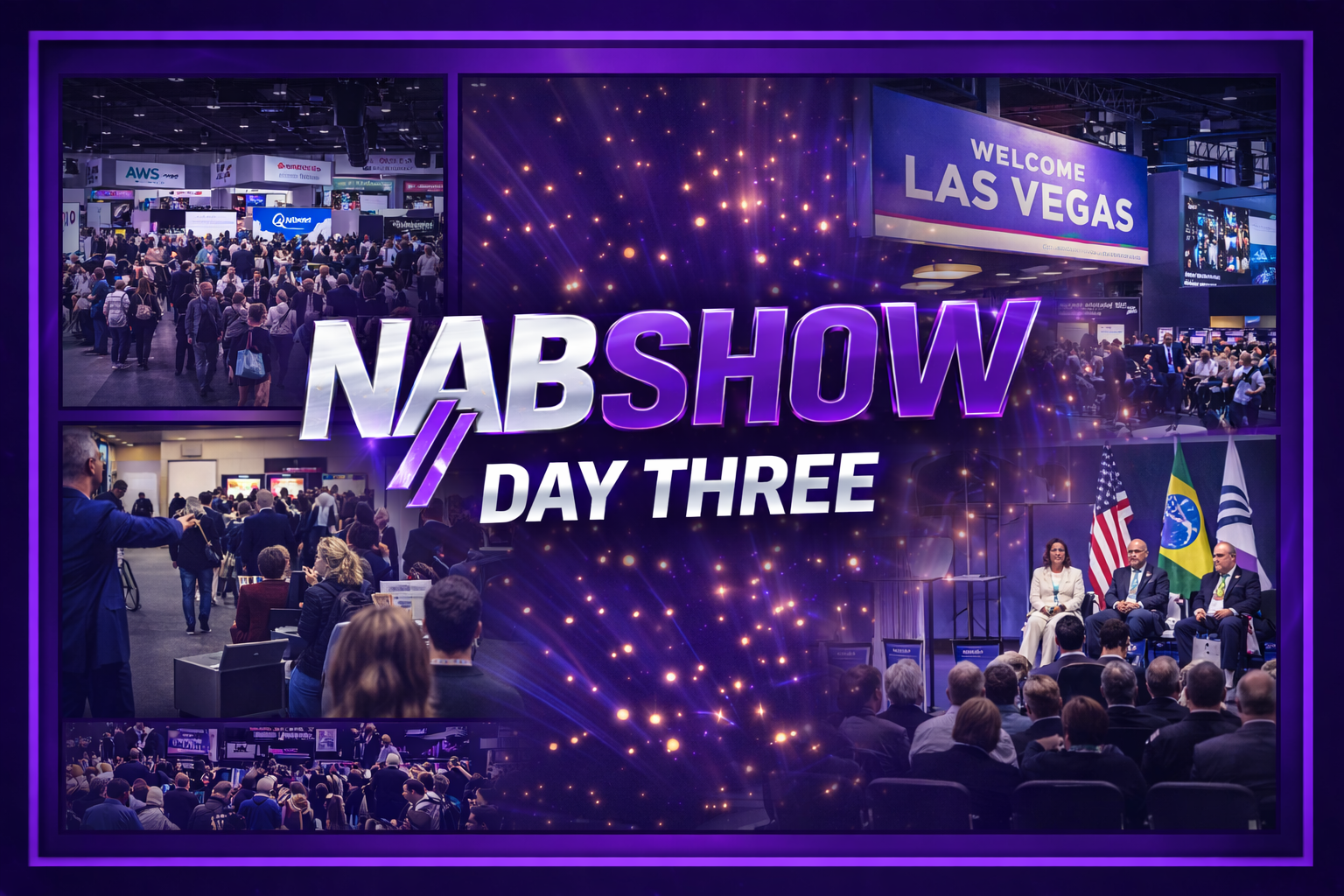


By the time Monday hits at the NAB Show, the smiles are still there, the handshakes are still happening and the cameras are still rolling, but the mood changes.
Day one is discovery. Day two is adrenaline. Day three is where people stop wandering and start hunting.
That is what Monday was shaping up to be in Las Vegas.
Officially, NAB Show’s exhibit floor was set to run from 9 a.m. to 6 p.m. Monday at the Las Vegas Convention Center, with conferences and workshops continuing alongside the floor as the show settled into its most productive stretch. NAB’s own positioning for this year’s event has been centered on next-generation workflows, AI, monetization and global reach, and by the time attendees hit day three, those themes were no longer just talking points on banners and websites. They were becoming the actual agenda.
And that is the thing about Monday at NAB.
It is not usually the day for people to simply stand around looking impressed.
It is the day when the questions get sharper. It is the day when engineers start asking what actually works in the field. It is the day when operators want to know what integrates, what scales, what cuts labor, what saves time and what brings in money. It is the day when broadcasters, streamers, manufacturers, platform people and content executives start separating the hype from the hardware and the buzz from the business. That practical bend matched the way NAB itself framed the 2026 show, describing it as the flagship marketplace for breakthrough technology, major deals and worldwide visibility across media and entertainment.
That means if you are walking into day three expecting a sleepy middle day, think again.
Monday looked like one of the most consequential days of the entire run.
For broadcasters, one of the clearest indicators of that came from the engineering side of the program. NAB scheduled “Broadcast-Ready Innovation: Practical AI, Secure IP Links and NextGen Emergency Wake-Up” for 11 a.m. Monday, and the title alone told you where the conversation is headed. This was not AI in the abstract. This was AI being measured against real newsroom and promo tasks, paired with secure internet-based contribution and distribution discussions and an inside look at ATSC 3.0 wake-up signaling for emergency alerting. That is the kind of session that screams one thing: show me what works, not what just sounds futuristic on a slide deck.
That matters, especially for radio and television operators who have been hearing AI talk non-stop for what feels like forever.
The conversation has moved past fascination.
Now it is about deployment.
Now it is about whether these tools can actually live inside day-to-day operations without wrecking trust, workflow, staffing or output. NAB’s own description of the Broadcast Engineering and IT Conference reinforces that exact direction. The conference was built around real-world technical challenges, emerging standards and the technologies reshaping radio, television, digital platforms and the broader media IT landscape, including AI-driven automation, virtualization, cloud-native systems and NextGen TV. In other words, Monday was not about dreaming. Monday was about implementation.
And then there is the global side of the equation.
One of the most significant Monday sessions on the schedule was “NextGen TV and TV 3.0: A Global Conversation on the Future of Broadcasting,” set for 1 to 2:45 p.m. with participation from Brazil’s minister of communications and FCC Commissioner Olivia Trusty. NAB said the program would focus on the international advancement of ATSC 3.0, policy alignment and how broadcasters are pushing the standard into a platform for innovation and new services. NAB President and CEO Curtis LeGeyt said, “NextGen TV is opening a new chapter for free, over-the-air broadcasting,” and that quote really gets to the heart of what Monday represented. This was not just a gear show flex. It was a policy, standards and future-of-broadcasting conversation happening at a very high level.
That is important because a lot of people still talk about NAB as if it is simply a giant room full of equipment, lights, switchers, cameras and logos.
It is that.
But it is also something else.
It is a place where the business is trying to decide, in real time, what kind of media future it is actually building. And Monday’s lineup made that impossible to miss. NAB’s homepage highlighted the Monday program around not just AI and engineering, but also policy, creator economy conversations, streaming and higher-level strategic sessions. The official site was pushing day-three programming as a mix of technology, insight, connections and what it called can’t-miss sessions and networking events.
That broader mix matters because the NAB Show in 2026 is not pretending the walls between sectors still look the way they used to.
Broadcast is talking to streaming. Streaming is talking to creators. Creators are talking to platforms. Platforms are talking to policymakers. And everybody, whether they admit it out loud or not, is trying to figure out how AI, monetization pressure and audience fragmentation fit into the same increasingly complicated machine. NAB’s own description of the show says it is where media, entertainment and storytelling converge, and for once that is not just event-copy language. On Monday, it looked very real.
Streaming, in particular, looked like it would have serious gravity on day three.
The Streaming Summit ran April 20 and 21 in West Hall, with roughly 85 speakers across two tracks focused on business and technology issues around OTT, FAST, SVOD and AVOD. Monday’s summit schedule included discussions around distribution, reliability, bundling growth and video monetization, and it wrapped with the official Streaming Summit Happy Hour from 5 to 6:30 p.m. on the Level 3 Terrace. That is not a side-show detail. That is where the hallway conversations keep going after the panels end, and anybody who knows trade shows knows plenty of the real business gets done right there, between the last session and the first drink.
And that is really what makes Monday so powerful.
It is the point in the week where the event stops being just a showcase and starts acting like a market.
People have seen enough by then to know what questions to ask. They have met enough people to know who matters. They have heard enough trend language to know who is selling smoke and who is showing substance. So the tone changes. Monday becomes more targeted, more intentional and, frankly, more valuable.
That is especially true for broadcasters.
The TV and Radio Broadcasters’ Guide to NAB Show made clear that TV and Radio HQ was open Monday from 9 a.m. to 6 p.m. inside Central Hall, giving broadcasters a home base for meetings, refreshment stops and on-the-floor regrouping. That kind of detail may sound small, but it speaks to how NAB still understands one core truth: even in a show increasingly filled with cross-platform language, traditional broadcasters are still a major part of the heartbeat.
And if you are looking at Monday through a radio lens, the relevance is still there, even when the headlines look TV-heavy.
The engineering pieces matter to radio. AI workflow questions matter to radio. Secure contribution and distribution matter to radio. Monetization discussions matter to radio. Policy discussions matter to radio. The Career Fair and Graduate School Showcase, scheduled Monday from 11 a.m. to 3 p.m. in West Hall, also underscored the workforce side of where the industry is heading, with NAB, RAB, SMPTE and other partners involved. That is part of the same larger question hanging over this business right now: who is coming next, what skills will matter and what kind of operation are they walking into?
That is why day three is such a telling day.
It reveals priorities.
If day one is about showing up and day two is about taking it all in, day three is about deciding where you stand. Are you here to watch the future roll by, or are you here to get your hands on it? Are you here to collect tote bags and booth candy, or are you here to understand where the business is really moving? Monday at NAB usually answers that question fast.
And this year, the answers appeared to be landing in a few very loud categories.
AI was still everywhere.
NextGen TV was still pushing toward center stage.
Streaming was still commanding serious oxygen.
And the bigger fight underneath all of it remained the same: how do media companies modernize fast enough to stay relevant without losing the trust, identity and operational stability that got them here in the first place? That tension sits inside almost every meaningful NAB conversation right now, whether it is being discussed through technology, policy, audience growth or revenue models. NAB’s own descriptions of the show and its featured sessions point directly to that mix of modernization, monetization and transformation.
So what should people expect from NAB Show day three?
Expect crowds that know where they are going.
Expect booths that are less about curiosity traffic and more about qualified conversations.
Expect more serious questions about AI use cases, cloud and IP infrastructure, platform strategy, emergency communications, automation and whether all this beautiful technology actually helps operators do more than just spend money faster. Expect the global conversation to get louder. Expect the streaming crowd to keep pressing the business case. Expect the engineers to keep demanding proof. Expect the broadcasters to keep looking for what translates to the real world back home.
And expect the energy to hold.
Because Monday was not the comedown.
It was the lock-in.
At this stage of NAB, the show floor is still open wide, the sessions are still loaded, the networking is still hot and the people who came to Las Vegas to get actual work done are now fully in motion. The official schedule backed that up from top to bottom: a full exhibit day, continuing workshops, engineering sessions, global broadcasting discussions, streaming programming and multiple end-of-day mixers designed to keep the conversation moving long after the floor quiets down.
That is day three.
Not a filler day. Not a cruise-control day. Not a “we’ll see what happens” day.
This is the day where the NAB Show starts showing you what really matters to the people who came here to shape what comes next.
And if the first part of the weekend was about spectacle, Monday looked like it was going to be about substance.
-WW