


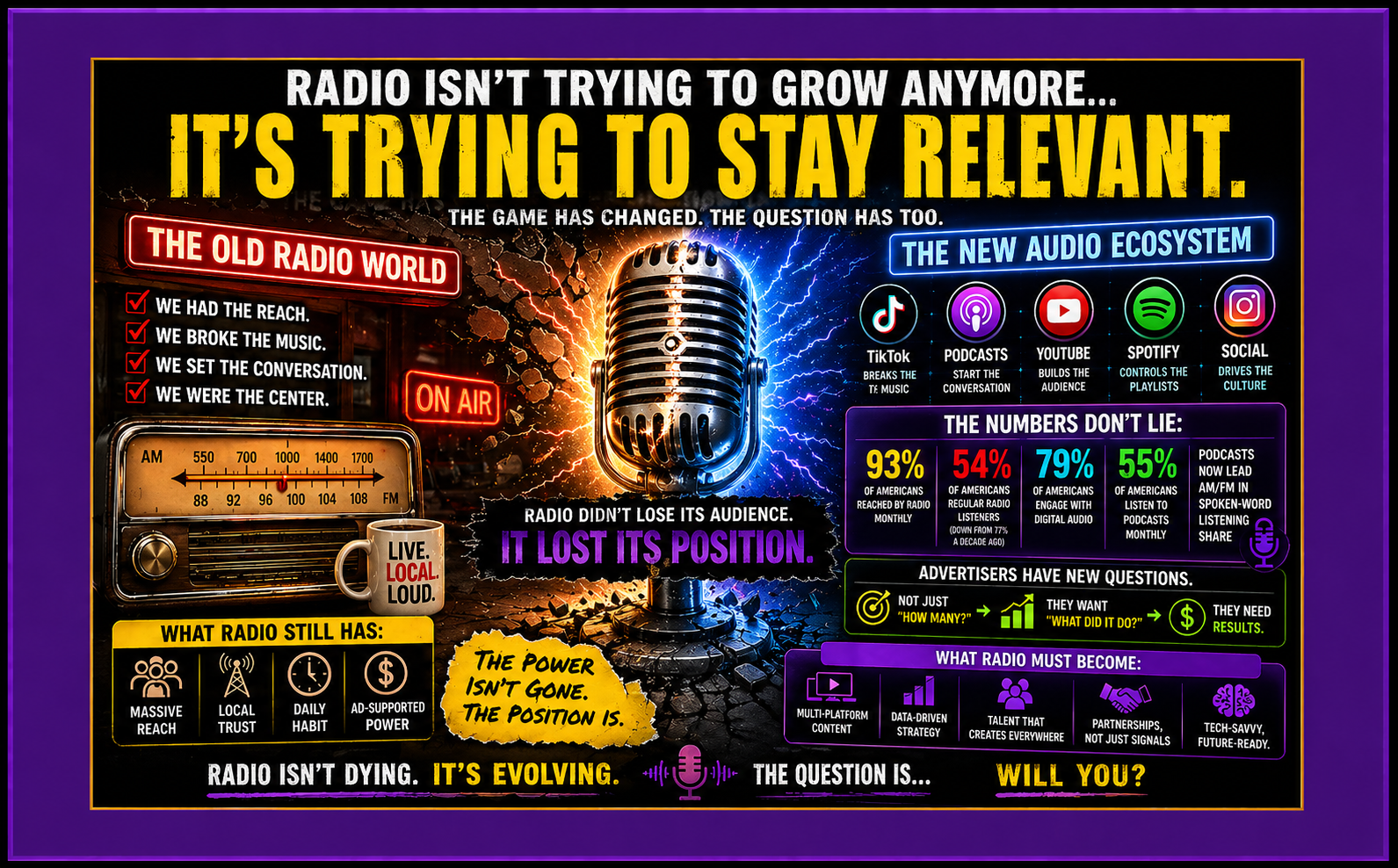
Somewhere along the way, radio stopped asking how to get bigger and started asking something a whole lot more uncomfortable: how do we make sure we’re still in the room when the music starts?
Yeah… I said it.
Because if you think this is still about adding signals, stacking formats, and squeezing another tenth out of a ratings book, you’re reading yesterday’s playbook. The real conversation now — the one happening behind closed doors and polite smiles — is this: how does radio stay relevant in an audio world that doesn’t need it to survive?
And before somebody clutches their pearls… let’s talk facts.
Radio still reaches about 93% of Americans every month. That’s not just strong — that’s dominant. If reach alone decided winners, radio would still be the undisputed heavyweight champion of the world.
But reach doesn’t run the table anymore.
Behavior does.
And behavior has shifted like a tectonic plate.
Today, nearly 80% of Americans engage with digital audio, and more than half listen to podcasts every month. Even more telling — podcasts have now overtaken AM/FM in spoken-word listening share. Let that sit for a second.
Radio still talks.
But people are choosing where they listen to the talking.
And increasingly, it’s not us.
Let me go a step further — and this is where some folks are going to say, “Did Steve Mills just really say that?”
Radio didn’t lose its audience.
It lost its authority.
There was a time when radio told you what mattered.
Now it confirms what already blew up somewhere else.
Music breaks on TikTok.
Conversations ignite on podcasts.
Personalities are built on YouTube before they ever touch a mic.
And radio?
Radio walks in like the uncle who shows up to the cookout late with a plate and says, “What’d I miss?”
That’s not shade. That’s the shift.
So what do you do when you’re no longer the center of the universe?
You adapt… or you get real comfortable being background noise.
That’s why radio companies aren’t building “radio strategies” anymore. They’re building audio ecosystem strategies.
You see it everywhere if you’re honest about it:
- Partnerships with social platforms
- Podcast networks expanding faster than FM footprints
- Sales teams suddenly talking about data like they’ve been hanging out in Silicon Valley
- Talent being told, “Hey, can you also shoot video, run socials, and host a podcast before lunch?”
Because the advertiser doesn’t care how pretty your signal is anymore.
They want results.
They want attribution.
They want to know that what they spent actually did something.
And radio — bless its heart — is learning to speak that language in real time.
Now here’s where it gets even more uncomfortable.
Radio still owns over 60% of ad-supported audio listening time. That’s massive. That’s power. That’s leverage.
But influence?
That’s been sliced up, packaged, and handed out to platforms that don’t even own a transmitter.
Spotify influences playlists.
YouTube influences personalities.
TikTok influences hits.
Radio influences… well… we’re working on it.
Let’s talk about the thing nobody wants to say out loud.
Localism.
We love it. We preach it. We put it on bumper stickers.
But behind the scenes?
We’re redefining it.
National shows with local liners.
Regional content dressed up as hometown flavor.
Fewer boots on the ground, more voices in the cloud.
We didn’t kill local.
We just… repackaged it to fit the budget.
Yeah, I said that too.
And here’s the part that should make everybody sit up straight.
Radio companies are no longer asking:
“How do we grow radio?”
They’re asking:
“How do we stay relevant in a world where audio is everywhere and attention is nowhere?”
That’s a completely different question.
Because growth assumes control.
Relevance assumes competition.
So what happens next?
You’re going to see:
- More syndication
- More consolidation
- More data-driven everything
- Fewer people doing more jobs
- More content built for platforms first… radio second
And the people who win?
Not the loudest.
Not the oldest.
Not even the most experienced.
The ones who win are the ones who understand this simple truth:
Radio is no longer the destination.
It’s part of the journey.
Let me land this plane.
Radio isn’t dying. I’m not giving you that lazy headline.
Radio is being compressed, stretched, re-engineered, and dropped into a bigger ecosystem that doesn’t revolve around it anymore.
That’s not the end.
That’s the test.
Because if radio can combine what it’s always had — reach, connection, trust — with what it now needs — data, speed, and platform awareness — it won’t just survive.
It’ll matter again.
But if it keeps pretending it’s still 1998 with a better app?
Well…
We might still be in the room.
Just not at the head of the table.
On The Dial covers breaking radio industry news, including layoffs, programming changes, talent moves, and broadcast trends across the United States.