


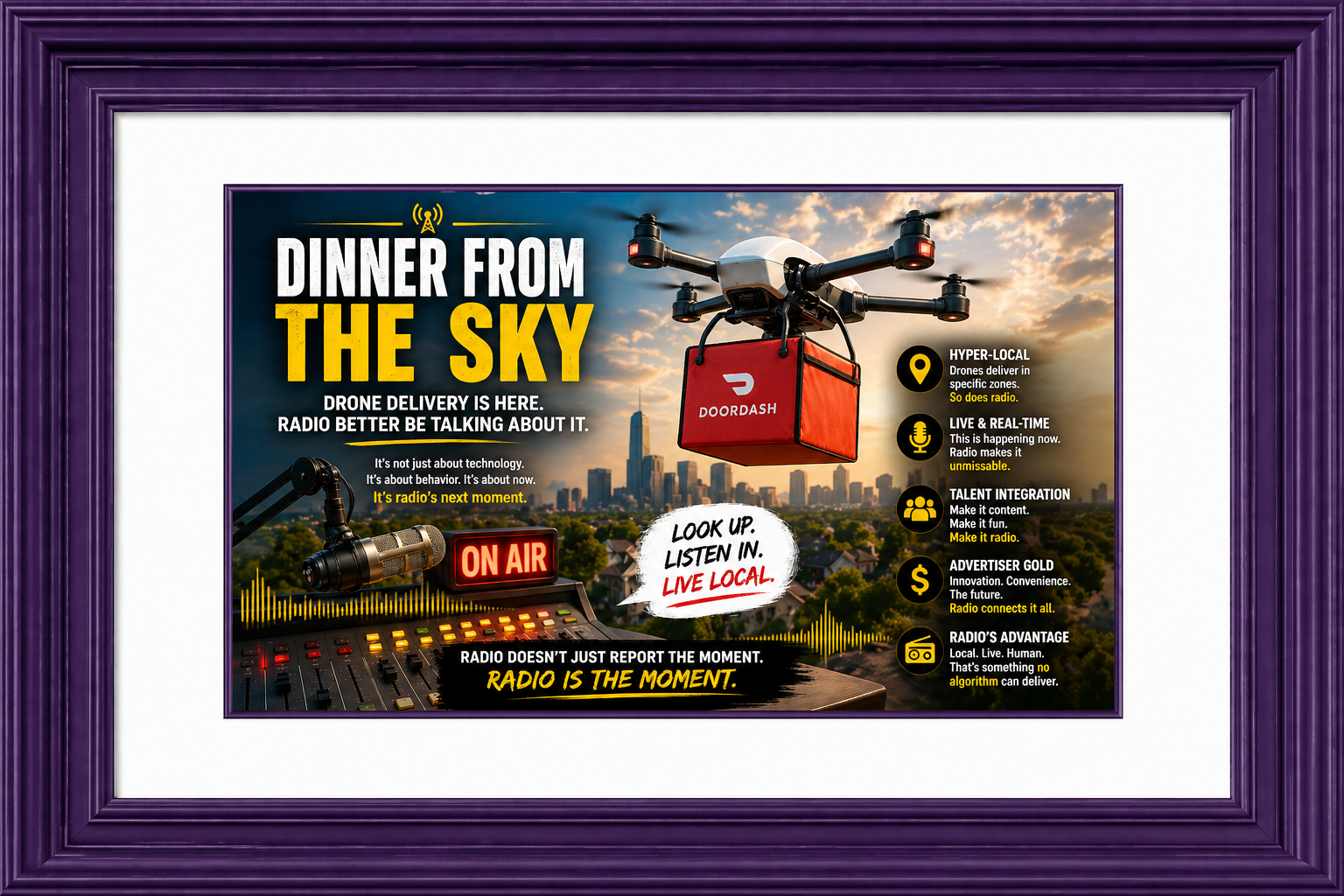
There’s a moment coming — or already here in some markets — when someone looks up, sees a small aircraft hovering overhead, and realizes their lunch is about to descend from the sky. No driver. No car. No knock at the door. Just a quiet drop from above and a phone notification that says, essentially, “your order has landed.”
That’s not science fiction anymore. That’s behavior.
And the question for radio isn’t, “Is this cool?”
The question is: why aren’t we all over this?
Because if you think this is just about drone delivery, you’re missing the point. This is about how fast culture is moving — and whether radio is moving with it or watching it pass by like traffic on the interstate.
Let’s call it what it is.
Food delivery has already rewired consumer behavior. Apps trained people to expect immediacy. Streaming trained them to expect control. Now drone delivery is training them to expect something even more dangerous for legacy media:
effortless convenience without interruption.
No friction. No waiting. No interaction.
And that right there? That’s radio’s challenge.
Because radio was built on interruption.
Now before somebody gets defensive — don’t.
This is where the opportunity lives.
Drone delivery is hyper-local. It only works in specific zones. It launches in targeted neighborhoods. It creates curiosity every single time it happens.
You know what that sounds like?
Radio’s backyard.
This is where radio still wins — when it shows up in the moment, in the market, in real time.
Imagine this:
A morning show in Dallas orders breakfast live on-air using a drone delivery service. Listeners are told exactly where it’s coming from, how long it’ll take, and when to look up. The countdown starts. The audience is locked in.
Ten minutes later, someone on the show steps outside. Phones are out. Listeners are posting. The drone appears.
And suddenly radio isn’t talking about the moment.
Radio is the moment.
That’s the difference.
Because here’s the uncomfortable truth — and yes, I’m going to say it:
Radio has spent years reacting to innovation instead of attaching itself to it.
Streaming took off — radio reacted.
Podcasting exploded — radio reacted.
Social media reshaped discovery — radio reacted.
At some point, reaction turns into irrelevance.
Drone delivery is not just a tech story.
It’s a behavior shift in real time.
And radio has a choice:
Talk about it after it happens…
or put itself right in the middle of it.
Now let’s talk money, because that’s where this gets real.
Advertisers don’t just want reach anymore. They want association with what’s next.
Drone delivery screams:
- innovation
- convenience
- future-forward thinking
So why isn’t radio building around that?
“Sky Drop of the Day” sponsored by a local restaurant.
Live drone delivery integrations with talent.
Promotions tied to real delivery zones.
This isn’t complicated.
It’s just different.
And different is where radio has been hesitant.
Let’s go one level deeper.
This isn’t really about drones, is it?
It’s about whether radio still knows how to insert itself into the conversation when something new captures attention.
Because attention is the currency now.
And attention doesn’t wait.
It moves to whatever is:
- interesting
- immediate
- shareable
A drone dropping lunch from the sky checks all three.
Here’s the part that should hit.
If radio doesn’t talk about this…
someone else will.
And not just talk about it.
They’ll build content around it.
They’ll capture the moment.
They’ll own the narrative.
Meanwhile, radio will be in the studio running a liner about “10 in a row.”
And yes — I said that too.
This is the moment where radio decides what it wants to be moving forward.
Not what it was.
Not what it used to dominate.
Not what it hopes people remember.
What it chooses to be right now.
Because relevance doesn’t come from legacy.
It comes from participation.
Drone delivery isn’t the future.
It’s the signal.
A signal that behavior is shifting again.
A signal that convenience is accelerating.
A signal that attention is being pulled in new directions.
And radio?
Radio still has something nobody else has:
A live, local, human connection that can turn moments into experiences.
But only if it shows up.
Because the next time someone looks up and sees their order descending from the sky…
The question won’t be whether it’s impressive.
The question will be:
Did radio see it coming — or did it miss it again?
On The Dial covers breaking radio industry news, including layoffs, programming changes, talent moves, and broadcast trends across the United States.