


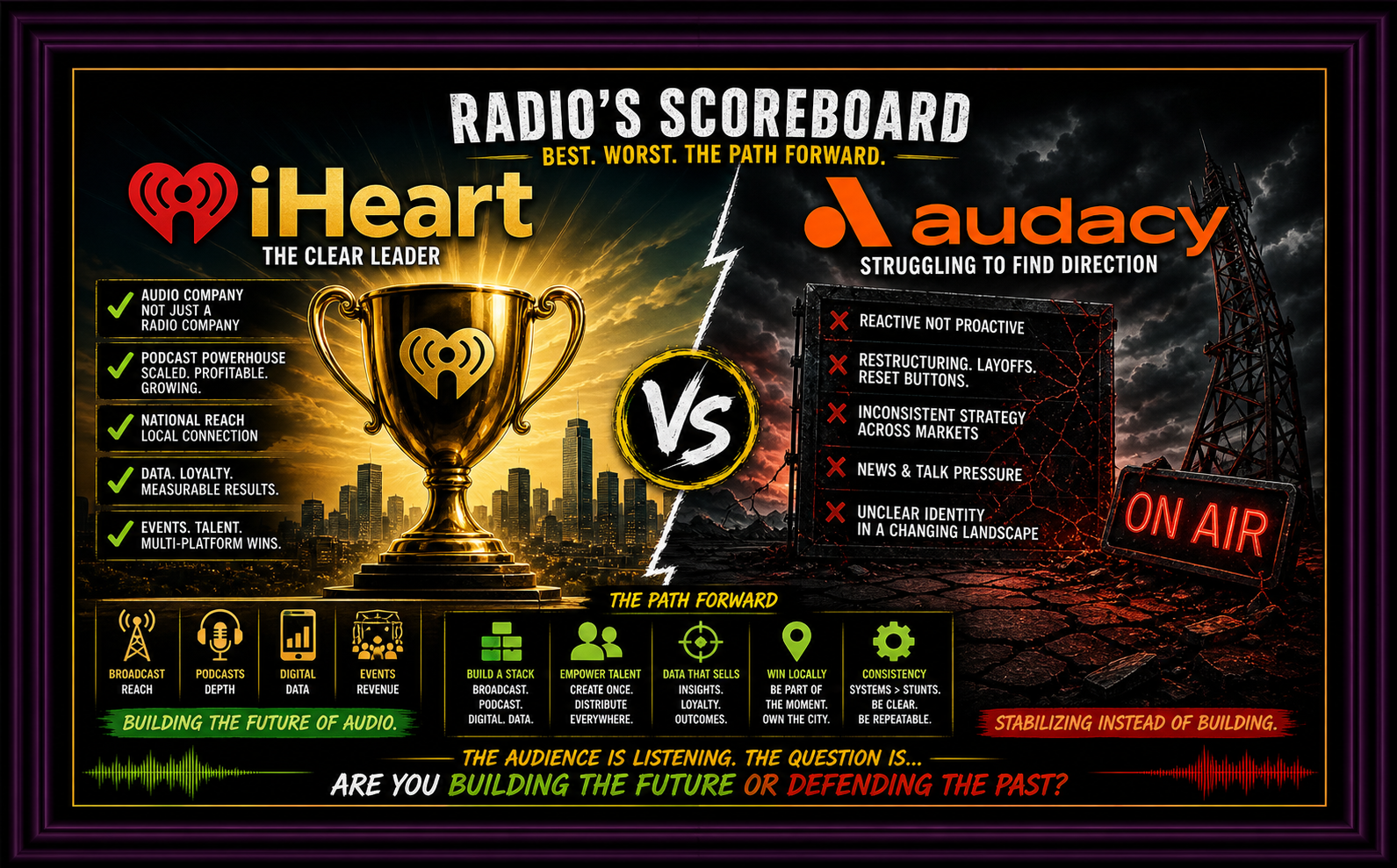
Every industry has a moment when the scoreboard stops being polite and starts being honest. Radio is there. Not the quarterly-earnings version of honest, but the kind you feel in momentum, product, and whether a company looks built for what’s next.
So let’s deal in trajectories.
Who is building for the future of audio — not just defending the past — and who is still trying to find stable ground?
Start with the company that, right now, is playing the long game better than anyone else:
iHeartMedia.
Yes, the same company people love to reduce to a balance-sheet debate. That’s lazy analysis. The real story is positioning — and on that front, iHeart deserves real credit.
They didn’t just “add podcasts.” They industrialized them. A scaled network, a repeatable launch model, cross-promotion that actually moves audience, and a sales engine that can package audio, digital, and events in one buy. That’s not dabbling — that’s architecture.
They didn’t just keep radio. They reframed it as a funnel:
- Broadcast for reach
- Podcasting for depth
- Digital for data
- Events for revenue diversification
They didn’t wait for proof. They built ahead of proof.
Are there misses? Of course. Show me a company moving this fast without a few. But when you zoom out, iHeart looks like a company asking the right question: How do we win in audio, full stop?
And that’s why they’re ahead.
Now the harder part.
Audacy.
This isn’t about taking shots. It’s about reading signals.
Audacy has talent. Brands. Big-market sticks. They’ve made meaningful moves into podcasting and sports. But the overall picture still feels like a company stabilizing in real time.
You see it in the cadence:
- Reset here
- Reorg there
- Format flips that feel more reactive than directional
It’s not that there isn’t a plan. It’s that the plan hasn’t yet translated into a consistent, unmistakable identity across markets and platforms.
And in 2026, inconsistency is expensive.
Because attention doesn’t wait for clarity. It goes where clarity already exists.
Zoom out again, because the middle matters.
Cumulus Media is doing the unglamorous but necessary work — tightening costs while pushing hard into data-led selling. That’s not flashy, but it’s essential. If radio can’t prove outcomes, it can’t defend budgets.
Townsquare Media keeps executing a quietly effective hybrid: local radio plus owned-and-operated digital that actually monetizes. Less noise, more results.
Sirius XM Holdings sits slightly outside the traditional lane, but the lesson is obvious: layered monetization wins — subscription, ads, podcasts, talent — all feeding each other.
Different paths. Same destination: don’t be one-dimensional.
So what’s the fix for anyone trying to close the gap?
Not a slogan. A system.
1)
Pick a lane — then build a stack
Stop being a radio company with side projects. Be an audio company with a stack:
- Broadcast (reach)
- Podcast (depth)
- Video/social (discovery)
- Data (retention and attribution)
iHeart didn’t win by dabbling. They won by stacking.
2)
Make talent multi-platform by design, not by memo
Don’t tell hosts to “do more.” Equip them to do it well:
- Clip workflows that turn segments into social
- Studio setups that produce video natively
- Producers who think distribution, not just airtime
If your best content dies at :00 and :30, you’re leaving half the value on the table.
3)
Turn data into a product, not a report
First-party data isn’t a slide deck. It’s a sales weapon:
- Loyalty programs that capture behavior
- CRM that tracks response
- Campaign reporting that shows lift
If advertisers can’t see outcomes, they’ll buy where they can.
4)
Local isn’t dead — it’s underproduced
Win the one thing platforms can’t: the moment.
- Hyper-local stunts that people talk about
- Real-time coverage that lives on-air and online
- Partnerships that make the station part of the event
Be where the city is, not just where the tower reaches.
5)
Consistency beats cleverness
One-off brilliance doesn’t scale. Systems do.
- Clear brand voice across markets
- Repeatable show formats that travel
- Sales packages that are easy to buy
Make it obvious what you are — every time.
Let’s be blunt.
This isn’t about crowning a permanent winner or writing anyone off. It’s about trajectories.
Right now, iHeart looks like it’s building outward with intent. Others are still tightening inward to find it.
That gap can close. But it won’t close with hope. It closes with alignment — product, talent, data, and sales all pulling the same direction.
One more thing, because this matters.
Radio doesn’t need a pep talk. It needs execution at scale.
The audience is still there. The brands are still strong. The megaphone is still loud.
But the game has changed from:
“Who can reach the most people?”
to:
“Who can turn attention into action across platforms?”
iHeart is closer to that answer today.
The rest of the field?
Plenty of talent. Plenty of opportunity.
Now it’s about building a system that can actually deliver.
On The Dial covers breaking radio industry news, including layoffs, programming changes, talent moves, and broadcast trends across the United States.