


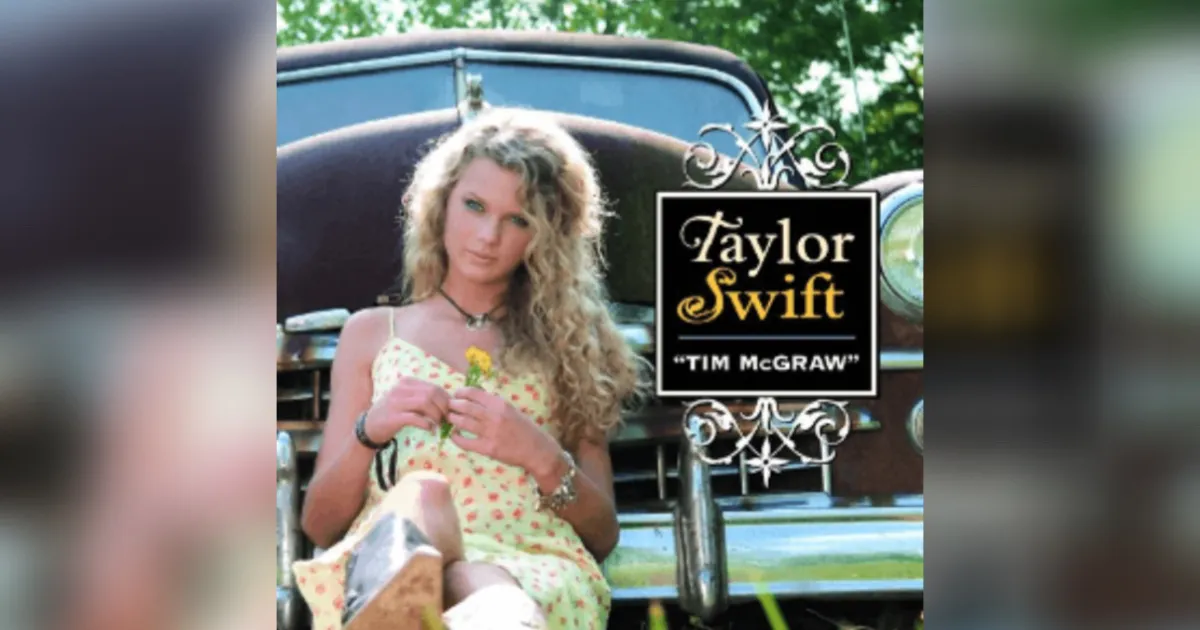
Twenty years ago this week, a 16-year-old girl released an album that would eventually change the course of popular music. There were no sold-out stadiums stretching across continents, no worldwide phenomenon called the Eras Tour, and no armies of devoted fans dissecting every lyric for clues about what might come next. There was simply a young songwriter named Taylor Swift, a guitar, an extraordinary ability to turn ordinary emotions into unforgettable stories, and a debut single bearing the name of a country superstar she had not yet met.
The song was called “Tim McGraw.” The album was called Taylor Swift. And although nobody could have predicted just how enormous her world would become, I remember thinking there was something different about this young lady.
I was working in country radio at KZSN-FM in Wichita, Kansas, serving as interim music director under a terrific program director named Cody. Country radio was an interesting place in 2006. The format had its established superstars, its familiar voices, and its own ideas about what a hit record should sound like. New artists arrived with dreams and promotional teams every week. Some were talented. Some were memorable. Very few possessed that difficult-to-explain quality that makes you stop thinking about the record and start paying attention to the person singing it.
Taylor had that quality.
What fascinated me about “Tim McGraw” was that it wasn’t really about Tim McGraw at all. It was about the way music becomes attached to people, places, relationships, and memories. A song on the radio could take somebody back to a summer, a first love, or a moment they wished had lasted forever. She understood something at 16 that some broadcasters spend their entire careers trying to master.
The most powerful thing music can do is make a stranger feel like somebody finally understands them.
And somehow, this teenager already knew how to do that.
The Girl I Remember Before the World Knew Her Name
I had the opportunity to meet Taylor shortly after “Tim McGraw” introduced her to country radio. I also remember seeing her perform in 2006 at the Peanut in Shawnee, Kansas. It is one of those memories that becomes more remarkable with the passing years, not because anybody could have known the full extent of what was coming, but because the contrast between then and now is almost impossible to comprehend.
There is something special about witnessing an artist before fame becomes an industry surrounding them. Before every public appearance becomes an international event. Before a simple walk into a football stadium can generate headlines around the world.
What stays with me from that period is the young woman and the music. She was at the beginning of a journey, telling stories that felt personal, sincere, and refreshingly uncomplicated.
I knew she had something. I certainly didn’t know that someday she would redefine what it meant to be a global recording artist.
There is a difference between recognizing talent and predicting history.
Taylor went on to make history.
An April Fools Day That Was No Joke
Four years later, on April 1, 2010, I saw Taylor again, this time at INTRUST Bank Arena in Wichita. By then, the intimate world of those early country performances had given way to a massive production built around an artist whose popularity was accelerating almost beyond comprehension.
She was touring behind Fearless, and the arena was filled with fans who knew the songs, understood the stories, and sang as though the words belonged to them personally.
What a difference four years can make.
The young singer who had once asked listeners to remember her through a Tim McGraw song was now giving thousands of people memories they would associate with her own music for the rest of their lives.
I remember having a wonderful time that night. It was a celebration of how far she had come, but looking back, it was also a reminder of how much farther she still had to go.
Because 2010 Taylor Swift, enormous as she already seemed, was nowhere near the ceiling.
She was still building the house.
The Woman Who Refused to Stay in One Musical Room
Country music introduced Taylor Swift to the world, but it could never contain the full range of her imagination. With each new chapter, she expanded the possibilities of what her career could become.
Speak Now demonstrated her confidence as a songwriter. Red stretched the boundaries between country and pop. 1989 announced a transformation that would have been unthinkable to some of the people who first encountered her on country radio. Reputation confronted public scrutiny. Lover embraced another emotional palette. Folklore and Evermore reminded listeners that beneath the spectacle was an artist who could still sit down with a story and make the entire world lean closer.
And then came the Eras Tour.
The scale of that undertaking was extraordinary, but the achievement wasn’t simply selling tickets. Taylor persuaded generations of listeners to revisit different periods of their own lives through hers. Every album represented a season. Every song reopened a memory.
In a world where attention is increasingly measured in seconds, she created an experience that asked people to spend hours celebrating the stories they had carried for years.
Her work also extended into film, including Cats, Amsterdam, the concert film Taylor Swift: The Eras Tour, and her work directing All Too Well: The Short Film. Not every project met the same reception, but the range reflected an artist willing to explore new creative territory rather than remain permanently attached to one successful formula.
She also made ownership of recorded music a mainstream conversation through her rerecording efforts and the fight to control her masters. Whatever one’s perspective on the business decisions involved, she forced an industry and its audience to think more carefully about the relationship between artists, their work, and the people who profit from it.
That is an extraordinary evolution for someone who first reached country radio singing about a boy, a summer, and Tim McGraw.
From Country Radio to Kansas City
There is another chapter in Taylor’s life that makes this story especially interesting to those of us with Kansas roots.
Travis Kelce.
For years, Taylor’s connection to Kansas was part of the early story of her career. Now, through her relationship and marriage to the Kansas City Chiefs star, the region has become part of a completely different chapter.
The pairing of a globally recognized songwriter and one of professional football’s most recognizable personalities brought together two audiences that might otherwise have had little reason to follow each other’s worlds. Football fans learned about album releases and concert tours. Swifties learned about tight ends, playoff scenarios, and the peculiar emotional roller coaster of Chiefs football.
And Kansas City found itself in the middle of a cultural conversation that stretched far beyond Arrowhead Stadium.
There is something rather wonderful about that. The young artist I remember from country radio in Kansas eventually became part of one of the biggest entertainment and sports stories in the world, with Kansas City playing a starring role.
But what interests me most isn’t the celebrity of it all. It’s that life continues to unfold in ways nobody could have scripted when she first stepped into a recording studio.
Twenty years ago, she was writing about a famous country singer.
Today, her own name carries a significance that reaches well beyond music.
What Taylor Swift Understood Before the Rest of Us
After spending much of my professional life in broadcasting, I have seen artists come and go. I’ve watched songs become hits, careers reach incredible heights, and records that once seemed unstoppable disappear from public memory.
What separates the enduring artists from the temporary sensations isn’t simply the quality of their voices or the size of their promotional budgets.
It’s connection.
Taylor Swift built a career by making people believe their experiences mattered. She wrote about heartbreak without pretending it was trivial. She wrote about growing up without pretending it was easy. She allowed her audience to change alongside her, and she gave them permission to see their own lives reflected in the music.
That is why the first record still matters.
Not because “Tim McGraw” was the biggest song she would ever record. It wasn’t.
It matters because the essential ingredient was already there.
A young woman understood that a song could become a bridge between two people who might never meet.
Twenty years later, that bridge stretches around the world.
I think about that young lady I met in 2006, the performance I remember in Shawnee, and the April Fools’ Day concert in Wichita four years later. I think about the distance between those memories and the extraordinary life she has built.
And I am reminded that the greatest stories often begin in places where nobody is expecting history to happen.
Sometimes they begin with a teenager, a guitar, and a song named after somebody else.
Sometimes they begin at a little performance in Kansas.
And sometimes, twenty years later, the world is still listening.
Happy 20th anniversary, Taylor. I was fortunate enough to witness a small piece of the beginning. What a remarkable journey it has been.
A Personal Note From the Author
There is something I would like to share that is separate from this celebration of Taylor Swift.
My name is Steven Mills. I am a broadcaster, publisher, pastor, two-time cancer survivor, and a man fighting to stay alive while searching for an exceptionally rare compatible kidney donor.
Years of cancer treatment helped save my life, but the damage to my kidneys has left me dependent on dialysis. I am extremely highly sensitized, making the search for a compatible living donor extraordinarily difficult.
I have spent years believing in the power of radio to connect people who otherwise might never meet. Today, I am depending on that same power of connection for something much more personal.
I need to find one person.
One compatible kidney donor.
Not a million people. Not a stadium full of people. Just the right person somewhere in this world who might be willing to explore whether they can help save my life.
If this story reaches Taylor, Travis, someone in their circles, or simply someone who loves their music, I have one request: Please help this message travel farther than I can carry it alone.
Visit FindMyOne.org to learn about my search and how to help.
You can also support the medical, travel, and living expenses associated with my fight through my GoFundMe organized by Joshua Liljenquist.
My story has already reached millions of people. Yet the one person who could potentially save my life may still have no idea I exist.
Twenty years ago, I watched a young artist demonstrate how one song could connect strangers through a shared feeling.
Today, I am hoping one shared story can connect me with someone who can help give me more tomorrows.
Don’t Let It Stop With You.
With gratitude,
Rev. Dr. Steven Mills
President and Publisher, On The Dial
FindMyOne.org
#TaylorSwift #TimMcGraw #TaylorSwift20 #Swifties #TravisKelce #KansasCityChiefs #CountryRadio #OnTheDial #FindMyOne #DontLetItStopWithYou #KidneyDonor #StevenMills