

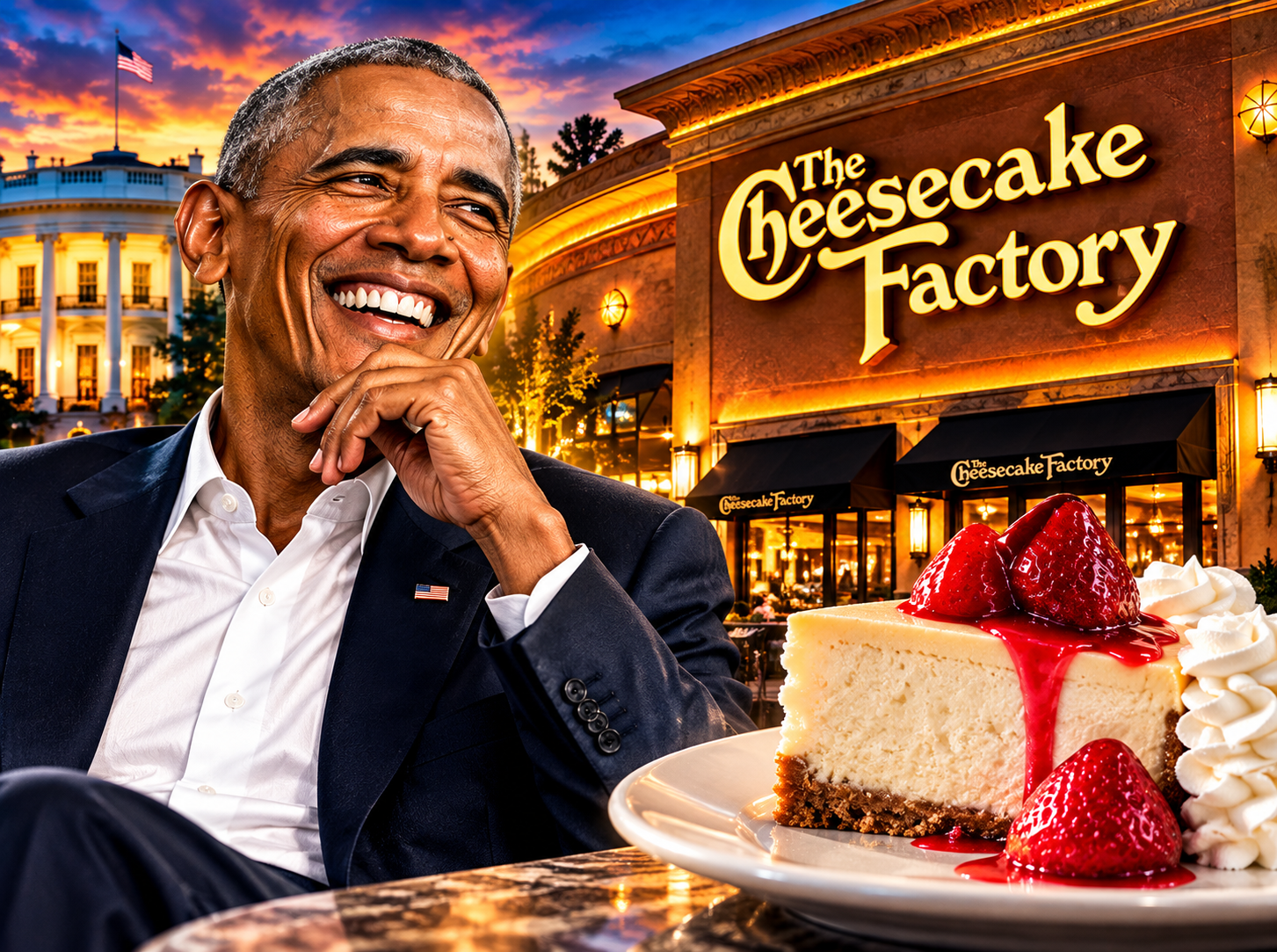
Former President Barack Obama probably never imagined that a reference to The Cheesecake Factory would become one of the most talked-about moments of a political appearance. Yet there he was in Cleveland, delivering a punchline about President Donald Trump’s White House renovations that quickly found its way into headlines, social media feeds, and conversations across America. Whether people laughed, rolled their eyes, or immediately took political sides, the moment demonstrated something broadcasters have understood for generations: sometimes a single sentence can accomplish what an hour of carefully prepared programming cannot.
Obama compared the White House’s elaborate decorating style to what might happen if Saddam Hussein opened a Cheesecake Factory. It was an unusual combination of politics, restaurant humor, and presidential criticism, but it worked as a memorable media moment. Within hours, the remark had become a conversation of its own, illustrating just how quickly an unexpected comment can move through today’s interconnected media landscape.
And somewhere in all that chatter was a lesson worth remembering for anyone who has ever sat behind a microphone.
Radio Was Built for Moments Like This
Long before social media influencers discovered viral clips, radio personalities were creating them without the benefit of cameras, hashtags, or algorithms. A spontaneous joke during morning drive, an unexpected caller, or an unforgettable observation could become the conversation around office watercoolers, dinner tables, and school hallways.
Rick Dees, Tom Joyner, Howard Stern, and countless other broadcasters understood that audiences don’t always remember everything someone says during a program. They remember how a particular moment made them feel.
That’s what makes Obama’s Cheesecake Factory comment interesting beyond the political argument.
The former president didn’t need a lengthy explanation to generate attention. He created a mental picture that people could immediately understand, repeat, debate, and share.
For radio, that’s practically a master class in memorable communication.
But it also raises an interesting question about what we’ve become as an industry.
Have We Become Better at Creating Attention Than Creating Impact?
Today’s broadcasters and digital creators have access to distribution tools that earlier generations could barely imagine. A conversation that once reached a few thousand listeners in a local market can now reach millions through podcasts, streaming platforms, social media, and syndicated programming.
Yet with all that extraordinary reach comes an uncomfortable question.
What are we doing with it?
There’s nothing wrong with entertainment. Political satire has always had a place in American culture, and laughter can bring relief to an otherwise exhausting news cycle. But when a restaurant joke can command national attention while stories about people facing life-threatening circumstances struggle to break through, perhaps there’s an opportunity for the media industry to reconsider how it uses its influence.
Not every story needs to be serious. Not every broadcast needs to change the world.
But every once in a while, shouldn’t we try?
The Difference Between Going Viral and Making a Difference
The greatest broadcasters have always understood that the microphone carries responsibilities beyond ratings, revenue, and recognition. Radio has helped communities recover from disasters, reunited families, raised money for children, supported veterans, and rallied listeners around neighbors facing unimaginable circumstances.
Some of the industry’s proudest moments never appeared on a ratings report.
They appeared in hospital rooms, family homes, community shelters, and the lives of people who received help because somebody on the radio cared enough to speak up.
And that brings this conversation a little closer to home.
I’m Rev. Dr. Steven Mills, a broadcaster and pastor who has spent much of his life watching the extraordinary things happen when people use their platforms to help others.
Today, I also happen to be someone who needs that kind of help.
After surviving Hodgkin’s lymphoma, a bone marrow transplant, and colon cancer, I now live with end-stage kidney disease. I’m undergoing dialysis at home while searching for an exceptionally rare compatible living kidney donor. Because I’m extremely highly sensitized, finding that match is extraordinarily difficult. My heart has also suffered significant damage.
My story has traveled through television, radio, podcasts, and social media, reaching millions of people.
But despite that exposure, I still haven’t found a compatible donor.
I’m grateful to broadcasters who have already shared my story, including The TJ Show, Dave Ramsey, Chris Plante, and Shoboy. Their willingness to open their microphones has meant more than they may ever realize.
Still, the search continues.
What If We Made Compassion Go Viral?
Imagine if the same creative energy that sends a political punchline around the world could be directed toward helping someone facing a medical crisis.
Imagine if radio stations, television networks, podcasters, social media creators, and public figures occasionally joined forces around a single human-interest story, not because it promised enormous ratings, but because it offered an opportunity to make a meaningful difference.
That kind of cooperation doesn’t require political agreement. It doesn’t require everyone to share the same faith, background, or worldview.
It simply requires recognizing that some things matter more than our differences.
President Obama has an extraordinary platform. So does President Trump. So do the executives who lead America’s broadcasting companies, the personalities who entertain millions every morning, and the creators whose videos reach audiences larger than some television networks.
Every one of those platforms has the potential to change someone’s circumstances.
And sometimes, that change begins with nothing more complicated than a share, an introduction, or a few seconds behind a microphone.
The Next Great Media Moment Could Be Someone’s Second Chance
Perhaps the greatest opportunity facing today’s media industry isn’t figuring out how to make the next joke, controversy, or celebrity moment go viral.
Perhaps it’s remembering that the same tools can connect people who desperately need one another.
For those willing to help with my own kidney search, the information is available at https://FindMyOne.org. Potential living donors can learn more about the process and how to contact my transplant team for evaluation.
I’m not asking anyone to stop laughing, stop debating politics, or stop enjoying the lighter moments that make life interesting.
I’m simply asking whether we can occasionally turn that attention toward something with the potential to change a life.
Because the next truly unforgettable broadcast moment might not come from a former president, a celebrity, or a perfectly timed punchline.
It might come from an ordinary person hearing a story, deciding to help, and discovering that they have the ability to make an extraordinary difference.
And if that happens, perhaps we’ll all have something worth celebrating.
Even if we have to order the cheesecake ourselves.
Rev. Dr. Steven Mills
Founder & Publisher, On The Dial
Pastor | Broadcaster | Two-Time Cancer Survivor
#BarackObama #CheesecakeFactory #RadioIndustry #Broadcasting #MediaInfluence #FindMyOne #DoYouSeeMe #LivingKidneyDonor #OnTheDial