


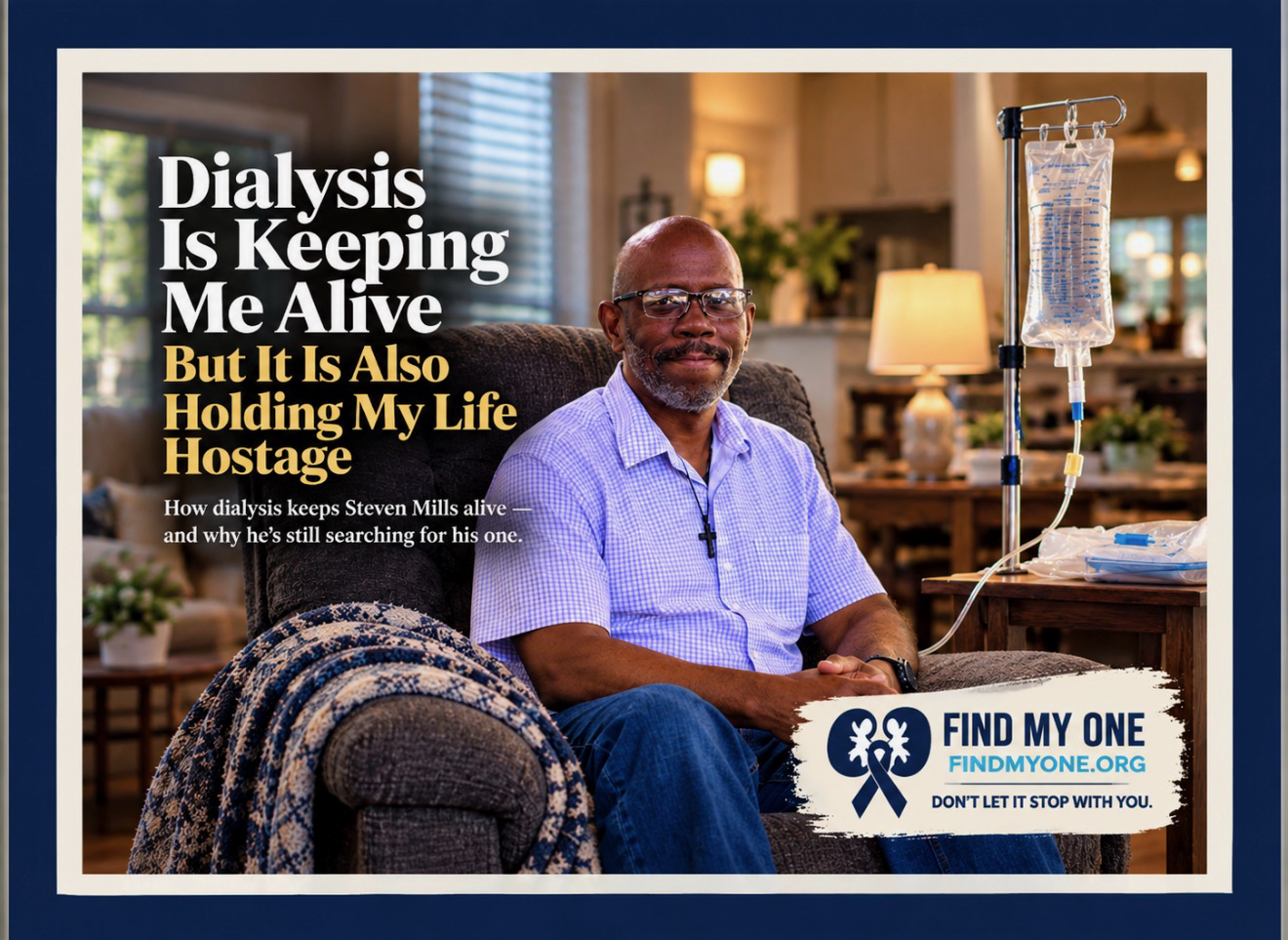
Steven D. Mills | On The Dial
There is a rather remarkable business arrangement happening inside my home these days. I have a machine-free medical routine that helps keep me alive, a collection of dialysis supplies that could make a small medical warehouse jealous, and a calendar that no longer revolves around meetings, family outings, church services, or the occasional opportunity to do absolutely nothing. Instead, my days are scheduled around the very serious business of convincing my body to keep functioning. And unlike most subscriptions, this one does not come with a free trial, a cancellation button, or a cheerful customer-service representative offering me three months at half price.
Welcome to the world of dialysis. The admission is expensive, the hours are terrible, and the only thing worse than having to show up is what happens if you don’t.
I am a two-time cancer survivor. Hodgkin’s lymphoma introduced me to chemotherapy, radiation, and eventually a bone marrow transplant. Colorectal cancer came along years later, apparently unaware that I had already fulfilled my lifetime membership requirements for the Cancer Survivors Club. I fought both diseases, survived both, and believed that perhaps the worst medical chapters of my life were behind me.
Unfortunately, the treatments that helped save me also damaged my kidneys. Today, I live with end-stage renal disease, and my survival depends on peritoneal dialysis performed at home.
For anyone unfamiliar with peritoneal dialysis, it involves introducing a special dialysis solution into the abdominal cavity through a catheter. The lining of the abdomen helps filter waste and excess fluid from the blood. After the solution has remained inside for a prescribed period, it is drained and replaced. The process is repeated according to an individualized treatment schedule.
That is the medical explanation.
The human explanation is that my life has become a continuing negotiation with bags, tubing, sterile connections, fluid exchanges, supplies, fatigue, discomfort, and a clock that never seems particularly interested in my plans.
And there are no vacation days from kidney failure.
The Disease Doesn’t Punch a Time Clock
People sometimes imagine home dialysis as a convenient alternative to spending hours in a dialysis center. In certain respects, it can offer flexibility, and I am grateful that the treatment exists. But convenience is a relative term when the alternative is dying.
My dialysis schedule requires multiple exchanges throughout the day. Each exchange means preparation, careful attention to cleanliness, the actual treatment, and the work of making sure everything has been done properly. There are mornings when nausea is waiting for me before I have even had the chance to decide whether I want breakfast. There are nights when pain, discomfort, or worry interfere with sleep.
Then morning arrives, whether I am ready for it or not.
And the world expects you to function.
I still have responsibilities as a pastor. I still publish On The Dial. I still have a family that deserves my attention, and I still want to participate in the ordinary moments that make life worth living.
But kidney failure doesn’t care whether I have a sermon to prepare, a daughter who wants time with her dad, or a wife who would simply like an evening with her husband without another medical interruption.
It doesn’t care whether I am exhausted.
It doesn’t care whether the bills have been paid.
And it certainly doesn’t care whether I’ve had enough.
When Staying Alive Becomes a Financial Obligation
One of the most misunderstood parts of serious illness is the assumption that having health insurance means the financial crisis has been solved. Insurance is important, and I am thankful for the coverage I have. But coverage does not necessarily eliminate deductibles, coinsurance, transportation, supplies, medications, or the many other costs that surround treatment.
When I account for the various expenses associated with dialysis and accessing care, the burden on my household is approximately $2,800 a month.
That is not a luxury expense. It isn’t a vacation fund. It isn’t a payment on a fancy new car.
It is part of the price of staying alive.
And the bills don’t become more understanding because the patient is tired.
Doctors, medical suppliers, transportation providers, and the other parts of this system have their own obligations and expenses. I understand that. But patients are left trying to hold everything together while managing illnesses that have already taken so much from them.
A person can be grateful for lifesaving treatment and still question why the financial burden of receiving it can be so punishing.
Those two thoughts are not mutually exclusive.
People have donated generously to help my family. Their kindness allowed us to address an enormous hospital bill that might otherwise have overwhelmed us. I am profoundly grateful. But paying one major bill does not make kidney failure disappear, and the next month does not arrive with a note saying, “You’ve been through enough. This one’s on us.”
I wish it did.
Frankly, if dialysis expenses came with reward points, I should have enough by now for a complimentary trip around the world. Instead, I am trying to find the resources to travel for additional transplant evaluations.
Millions Have Seen Me but I Still Need One
Here is where my situation becomes even more complicated.
I need a kidney transplant, but I am extremely highly sensitized because of my previous medical treatments and transfusions. That means my immune system has antibodies that can make finding a compatible donor exceptionally difficult.
Having the right blood type is important, but it is not the entire answer. A potential living donor must undergo a careful medical evaluation, including compatibility testing, to determine whether donation is medically appropriate.
I am blood type O-positive, and I am searching for someone willing to explore the possibility of living kidney donation.
A remarkable young man named Joshua Liljenquist helped tell my story to millions of people. Broadcasters including Dave Ramsey and The TJ Show have opened their microphones. People across the country have prayed, donated, and shared my story with others.
I am grateful for every one of them.
But millions of views do not automatically produce one compatible kidney.
That is why I have been reaching out to people with enormous audiences, including Mark Zuckerberg, Elon Musk, MrBeast, Joe Rogan, Robin Roberts, and others. Some people have asked why I would contact celebrities or powerful business leaders when what I need is a transplant.
The answer is simple.
I am not asking them to perform surgery.
I am asking them to help my story reach someone who might be able to help.
If someone has the ability to reach millions of people with a single post, and somewhere among those millions is a person who could be a compatible donor, then that post could accomplish something extraordinary.
I don’t need everyone to say yes.
I need the right person to have the opportunity to consider it.
There Is a Family on the Other Side of the Tubing
My daughter is 13 years old. She is bright, talented, and growing up faster than I ever imagined possible. I want to be there for her graduation, for the important decisions, for the heartbreaks and triumphs, and for all the ordinary conversations that don’t seem important until you realize how much you would miss them.
My wife has walked beside me through two cancers and now kidney failure. She has watched me survive treatments that were supposed to help me live, only to see me face another medical crisis because of the damage left behind.
I know what it is to preach about faith.
I also know what it is to lie awake wondering whether I will live long enough to see the things I have spent years praying for.
Those experiences exist in the same human heart.
I have faith in God. I believe in the power of prayer. But faith has never meant pretending that suffering doesn’t hurt, or that fear doesn’t occasionally knock on the door.
Sometimes faith is getting up, completing another dialysis exchange, preparing another sermon, writing another story, and refusing to surrender the belief that tomorrow might bring good news.
And sometimes it is laughing at something ridiculous because the alternative is crying.
I do both.
Occasionally on the same day.
A Transplant Is Not a Luxury
I am pursuing additional transplant evaluations at Cedars-Sinai in Los Angeles and NYU Langone in New York. Those appointments mean travel, lodging, meals, transportation, and time away from home, all while continuing to manage the realities of dialysis.
These are not sightseeing trips.
If I wanted a vacation, I can assure you that carrying dialysis supplies through an airport would not be my first choice of entertainment.
I am pursuing these opportunities because expanding my transplant options may improve the chances of finding a medically appropriate pathway forward.
I am not looking for special treatment. I am looking for a chance.
And I am asking people to help make that chance possible.
What I Need From You
There are three ways you can make a meaningful difference.
First, share my story. Visit https://FindMyOne.org and share it with your family, friends, coworkers, church, and social networks. You never know who might see it or who might pass it along to the right person.
Second, consider learning about living kidney donation. If you are interested, FindMyOne.org provides information to help you connect with the appropriate transplant professionals. Donation must always be voluntary, informed, and medically evaluated. No one should ever feel pressured to make such a decision.
Third, help financially if you can. The costs of dialysis, transportation, and additional transplant evaluations are real and ongoing. Contributions through my GoFundMe help my family navigate those expenses while I continue this search.
https://www.gofundme.com/f/help-pastor-steven-fight-for-his-life-p74hx
If you cannot donate financially, please do not underestimate the power of sharing the story. One share can reach someone I have never met, and that person may be the one I have been praying to find.
I Am Not Finished Living
I don’t want to become a cautionary tale about what happens when someone survives cancer but cannot find a compatible kidney in time. I want to be the man who comes back to tell the story of the person who stepped forward, the community that refused to give up, and the extraordinary good that can happen when people decide that someone else’s life matters.
I want to be there when my daughter graduates. I want more years with my wife. I want to keep preaching, writing, laughing, serving, and occasionally complaining about things that are nowhere near as serious as kidney failure.
I want the luxury of having ordinary problems again.
And I want to stop measuring my days in dialysis exchanges.
Dialysis is keeping me alive. But I am fighting for the chance to truly live.
Somewhere, there may be one person who could help make that possible.
Millions have seen my story. I’m still looking for one.
Don’t Let It Stop With You.
Steven Mills is the publisher of On The Dial and Senior Pastor of First Baptist Church in Garden City, Kansas. His living kidney donor search and ways to help are available at https://FindMyOne.org.