


The future of radio didn’t arrive with a countdown.
It slipped in through the back door—quietly, efficiently, and now, undeniably.
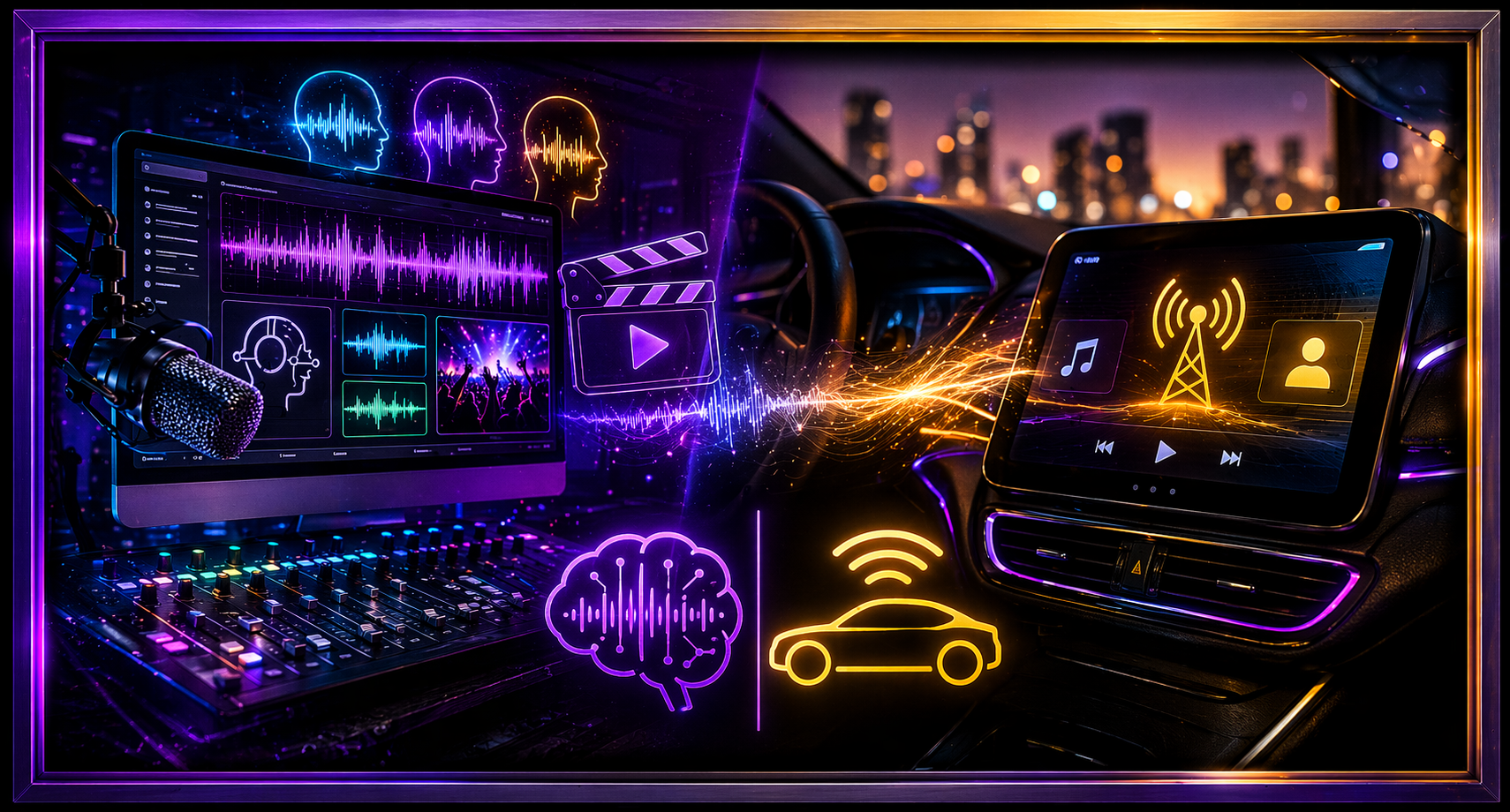
Two technology developments that surfaced on the same day are beginning to tell a much larger story about where the broadcast industry is heading. On the surface, they look like vendor updates. Underneath, they signal something far more important: radio is being reshaped in real time by artificial intelligence and the evolving battle for the car dashboard.
ENCO, a longtime player in broadcast workflow technology, has expanded its SPECai platform with new capabilities that go beyond basic automation. The updated system now supports multiple AI-generated voices and adds video functionality, pushing the platform into territory that blends audio production with visual content creation. That combination matters, because it reflects a shift in how content is being created, packaged, and distributed across platforms.
This is no longer just about what goes over the air.
It’s about how fast content can be produced, how flexible it can be, and how easily it can move between audio, digital, and visual environments.
At the same time, Xperi is advancing its position inside the vehicle, rolling out a premium tier of its DTS AutoStage platform. That move is designed to enhance the in-car listening experience, offering expanded features that go beyond traditional radio playback and into a more interactive, data-driven environment.
Taken together, these developments point to two fronts that are beginning to define radio’s next chapter.
The first is inside the building.
Artificial intelligence is no longer experimental. It is becoming embedded in the workflow. Systems like SPECai are not replacing talent, but they are changing the pace of production. What once took hours can now be done in minutes. What once required multiple people can now be handled by fewer. And what once existed only as audio can now be extended into video without a separate production cycle.
That changes expectations.
Stations are now being pushed to produce more content, more quickly, and in more formats than ever before. The traditional boundaries between radio, digital, and social content are dissolving, replaced by a continuous flow of material that must be ready to move wherever the audience is.
The second front is inside the car.
For decades, radio owned that space. The dashboard was its home field advantage, a place where presets mattered and familiarity drove loyalty. But that environment is changing. Platforms like DTS AutoStage are redefining what the in-car experience looks like, integrating streaming, metadata, personalization, and interactive features into a single interface.
The competition is no longer just the station across town.
It is every audio option available on demand.
By introducing a premium tier, Xperi is signaling that the dashboard is evolving into a layered experience—one where differentiation will come not just from content, but from how that content is presented, discovered, and engaged with.
That raises the stakes.
Because as the car becomes more connected, the margin for error becomes smaller. Stations that fail to adapt risk becoming just another option in a crowded menu. Those that embrace the shift have an opportunity to extend their reach in ways that were not possible even a few years ago.
What makes these two stories significant is not their size individually.
It is their timing.
They arrived on the same day, from different corners of the industry, pointing in the same direction.
Faster workflows.
Expanded formats.
A more competitive dashboard.
This is what the next phase looks like.
And it is happening now.
The conversation around artificial intelligence in radio has often focused on fear—what it might replace, what it might take away. But the more immediate reality is how it is being used to enhance speed and scale. The tools are becoming more sophisticated, but their purpose is clear: to help stations keep up with an environment that demands constant output.
At the same time, the dashboard conversation has shifted from access to experience. Getting into the car is no longer enough. The question now is what happens once you are there. How does a station stand out? How does it hold attention? How does it compete when the listener has more control than ever before?
Those are the questions being answered in real time.
And they are no longer theoretical.
The industry has reached a point where technology is not just supporting radio—it is shaping it. Decisions being made today around AI integration and in-car platforms will determine how stations operate, how content is delivered, and how audiences engage moving forward.
This is not a distant future.
It is already in motion.
And while these developments may not carry the headline weight of a major hire or a high-profile exit, their impact will likely be felt far longer. Because they are not about who is on the air.
They are about how the air itself is being redefined.
Radio has always adapted.
From analog to digital. From local to syndicated. From towers to streams.
Now, it is adapting again.
Only this time, the changes are happening faster—and in more places—than ever before.
And if today is any indication, the next evolution of radio will not be driven by a single moment.
It will be built through moves like these.
Quiet. Precise. And impossible to ignore once you see where they lead.
-WW