


There was no breaking alert.
No industry-wide pause. No defining headline that forced everyone to stop and take notice.
April 17, 2025 moved through the broadcast radio business like any other day—quietly, steadily, without urgency.
But the deeper you look, the more it becomes clear that the industry wasn’t standing still that day.
It was repositioning.
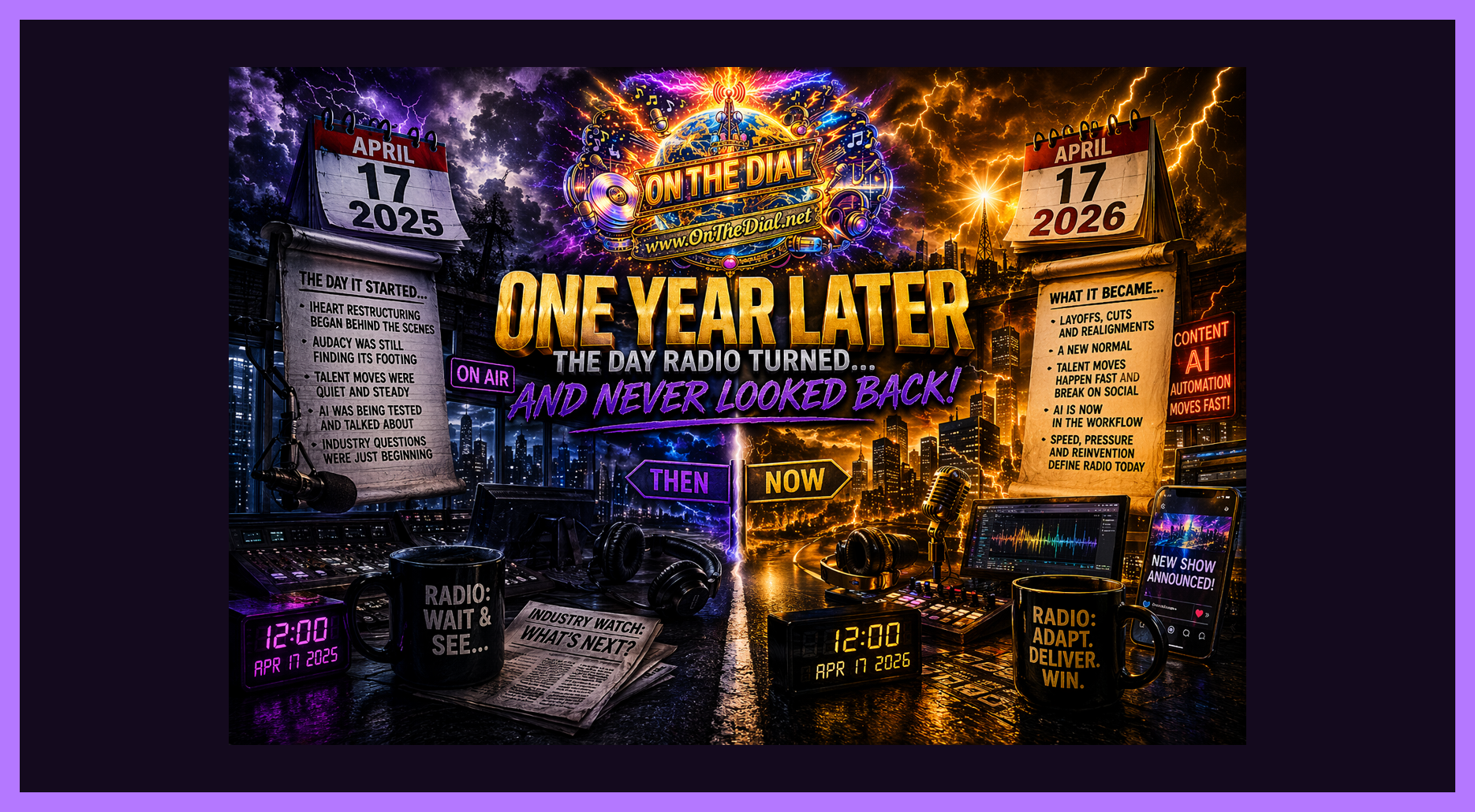
Exactly one year ago, iHeartMedia was already in the early stages of what would become a sweeping cost-reduction strategy. While the largest rounds of cuts had not yet hit the headlines, internal restructuring had begun to take shape. Regional leadership layers were being evaluated, clusters were being asked to do more with less, and the language of efficiency was replacing the language of expansion.
At the time, it didn’t feel urgent.
Today, it defines the landscape.
What was conversation in April 2025 has become action in April 2026. The layoffs that would follow, the consolidation of roles, and the reduction of management layers have shifted how stations operate on a daily basis. The difference between then and now is not just scale—it’s visibility. A year ago, you had to be inside the building to feel it. Today, you can hear it from the outside.
That same day, Audacy was still navigating life after its restructuring. Having recently emerged from bankruptcy protection, the company was under intense industry watch. Questions weren’t about whether it would survive—they were about what version of the company would emerge.
In April 2025, the focus was stability.
In April 2026, the focus is sustainability.
That’s a different conversation.
Then, the expectation was that restructuring would create breathing room. Now, the reality is that the pressure never fully left. Decisions made over the past year have leaned toward tightening operations, refining brand focus, and adjusting expectations for what success looks like in a post-restructuring environment.
It is no longer about bouncing back.
It is about holding steady.
Talent movement on April 17, 2025 told its own story, even if it didn’t dominate headlines. There were no single, massive departures that reshaped the narrative overnight. Instead, there was a steady stream of quieter changes—on-air personalities shifting roles, exiting stations, or repositioning themselves across platforms.
At the time, it felt routine.
Now, it feels foundational.
Because those quieter moves marked the beginning of a new rhythm. By today, that rhythm has accelerated. Talent no longer moves in cycles—it moves continuously. Announcements break directly from personalities, often through social platforms, sometimes before companies formalize messaging. The power dynamic has shifted, and the control of narrative has expanded beyond the building.
What was once coordinated is now immediate.
What was once managed is now personal.
Technology was another story line that sat just below the surface one year ago. Artificial intelligence was already being explored across the industry, but primarily in controlled ways—production assistance, early-stage voice tools, workflow efficiencies.
It was present, but not dominant.
In April 2025, AI was a conversation.
In April 2026, it is a factor.
Stations and companies have begun integrating AI into daily operations, not as a replacement for personality, but as a tool that accelerates everything around it. Production cycles are shorter. Content moves faster. Expectations for turnaround have shifted. The presence of AI has not redefined radio, but it has changed the pace at which radio operates.
And pace changes everything.
Even at the market level, April 17, 2025 carried signals that are easier to interpret now than they were then. Stations were beginning to lean more intentionally into identity—tightening formats, clarifying branding, and focusing on what made them distinct in increasingly fragmented listening environments.
It was subtle.
Now it’s necessary.
In 2026, identity is no longer optional. With listeners spread across platforms and devices, stations that fail to define themselves clearly risk disappearing into the background. The moves being made today—from morning show reshuffles to format refinements—are rooted in the understanding that attention is no longer guaranteed.
It must be earned daily.
The contrast between then and now is not dramatic in a single moment.
It is cumulative.
April 17, 2025 was a day where the industry was adjusting quietly. April 17, 2026 is a day where those adjustments are visible, measurable, and in many cases unavoidable.
Then, the industry was asking questions.
Now, it is living with the answers.
Then, companies were preparing for leaner operations.
Now, they are operating within them.
Then, talent movement was steady but understated.
Now, it is constant and public.
Then, technology was being explored.
Now, it is embedded.
And through all of it, one thing has remained unchanged.
Radio is still here.
Still adapting. Still adjusting. Still finding ways to connect.
But it is not the same radio it was one year ago.
Not in how it operates.
Not in how it sounds.
And not in how it sees its future.
Because sometimes the biggest shifts don’t happen in a single headline.
Sometimes they happen on days that feel like nothing at all.
And only later do you realize—
That was the day everything started to move.
-JPS